What are the possible ways to create objects in JavaScript
There are many ways to create objects in javascript as mentioned below:
-
Object literal syntax:
The object literal syntax (or object initializer), is a comma-separated set of name-value pairs wrapped in curly braces.
var object = {
  name: "Sudheer",
  age: 34,
};
Object literal property values can be of any data type, including array, function, and nested object.
Note: This is one of the easiest ways to create an object and it's most commonly used for creating simple, ad-hoc objects.
-
Object constructor:
The simplest way to create an empty object is using the
Objectconstructor. Currently this approach is not recommended.var object = new Object();The
Object()is a built-in constructor function so "new" keyword is not required for creating plain objects. The above code snippet can be re-written as:var object = Object();However,
Object()can be used to either create a plain object or convert a given value into its corresponding object wrapper, whereasnew Object()is specifically used to explicitly create a new object instance. -
Object's create method:
The
createmethod of Object is used to create a new object by passing the specified prototype object and properties as arguments, i.e., this pattern is helpful to create new objects based on existing objects. In other words, this is useful for setting up prototypal inheritance. The second argument is optional and it is used to create properties on a newly created object.The following code creates a new empty object whose prototype is null.
var object = Object.create(null);The following example creates an object along with additional new properties.
let vehicle = { wheels: "4", fuelType: "Gasoline", color: "Green", }; let carProps = { type: { value: "Volkswagen", }, model: { value: "Golf", }, }; var car = Object.create(vehicle, carProps); console.log(car); -
Function constructor:
In this approach, create any function and apply the new operator to create object instances. This was the main way to do constructor-based OOP before ES6 classes.
function Person(name) { this.name = name; this.age = 21; } var object = new Person("Sudheer"); -
Function constructor with prototype:
This is similar to function constructor but it uses prototype for their properties and methods. Using prototype means you're sharing methods/properties across instances, which saves memory and improve performance.
function Person() {}
Person.prototype.name = "Sudheer";
var object = new Person();
This is equivalent to creating an instance with
Object.createmethod with a function prototype and then calling that function with an instance and parameters as arguments.function func(x, y, z) { this.x = x; this.y = y; this.z = z; } var instance = new func(1, 2, 3);(OR)
function func(x, y, z) { this.x = x; this.y = y; this.z = z; } // Create a new instance using function prototype. var newInstance = Object.create(func.prototype); // Call the function var result = func.call(newInstance, 1, 2, 3); // If the result is a non-null object then use it otherwise just use the new instance. console.log(result && typeof result === 'object' ? result : newInstance); -
Object's assign method:
The
Object.assignmethod is used to copy all the properties from one or more source objects and stores them into a target object. This is mainly used for cloning and mergingThe following code creates a new staff object by copying properties of his working company and the car he owns.
const orgObject = { company: "XYZ Corp" }; const carObject = { name: "Toyota" }; const staff = Object.assign({}, orgObject, carObject); -
ES6 Class syntax:
ES6 introduces class feature to create objects. This is syntactic sugar over the prototype-based system.
class Person { constructor(name) { this.name = name; } } var object = new Person("Sudheer"); -
Singleton pattern:
A Singleton is an object which can only be instantiated one time. Repeated calls to its constructor return the same instance. This way one can ensure that they don't accidentally create multiple instances.
Singleton with Closure (Classic JS Pattern)
const Singleton = (function () {
let instance;

function createInstance() {
  return { name: "Sudheer" };
}

return {
  getInstance: function () {
    if (!instance) {
      instance = createInstance();
    }
    return instance;
  }
};
})();

// Usage
const obj1 = Singleton.getInstance();
const obj2 = Singleton.getInstance();

console.log(obj1 === obj2); // true
In modern JavaScript applications, singletons are commonly implemented using ES6 modules for their built-in caching behavior, or closures for encapsulated state management.
What is a prototype chain
The prototype chain is a core concept in JavaScript’s inheritance model. It allows objects to inherit properties and methods from other objects. When you try to access a property or method on an object, JavaScript first looks for it on that object itself. If it’s not found, the engine looks up the object's internal [[Prototype]] reference (accessible via Object.getPrototypeOf(obj) or the deprecated __proto__ property) and continues searching up the chain until it finds the property or reaches the end (usually null).
For objects created via constructor functions, the prototype chain starts with the instance, then refers to the constructor’s .prototype object, and continues from there. For example:
function Person() {}
const person1 = new Person();

console.log(Object.getPrototypeOf(person1) === Person.prototype); // true
This mechanism allows for property and method sharing among objects, enabling code reuse and a form of inheritance.
Summary:
- The prototype chain enables inheritance in JavaScript.
- If a property isn’t found on an object, JavaScript looks up its prototype chain.
- The prototype of an object instance can be accessed with
Object.getPrototypeOf(obj)or__proto__. - The prototype of a constructor function is available via
Constructor.prototype. - The chain ends when the prototype is
null.
The prototype chain among objects appears as below,

What is the Difference Between `call`, `apply`, and `bind`
In JavaScript, call, apply, and bind are methods that allow you to control the context (this value) in which a function is executed. While their purposes are similar, they differ in how they handle arguments and when the function is invoked.
call
-
Description:
Thecall()method invokes a function immediately, allowing you to specify the value ofthisand pass arguments individually (comma-separated). -
Syntax:
func.call(thisArg, arg1, arg2, ...)
- Example:
var employee1 = { firstName: "John", lastName: "Rodson" };
var employee2 = { firstName: "Jimmy", lastName: "Baily" };

function invite(greeting1, greeting2) {
  console.log(
    greeting1 + " " + this.firstName + " " + this.lastName + ", " + greeting2
  );
}

invite.call(employee1, "Hello", "How are you?"); // Hello John Rodson, How are you?
invite.call(employee2, "Hello", "How are you?"); // Hello Jimmy Baily, How are you?
apply
-
Description:
Theapply()method is similar tocall(), but it takes the function arguments as an array (or array-like object) instead of individual arguments. -
Syntax:
func.apply(thisArg, [argsArray])
- Example:
var employee1 = { firstName: "John", lastName: "Rodson" };
var employee2 = { firstName: "Jimmy", lastName: "Baily" };

function invite(greeting1, greeting2) {
  console.log(
    greeting1 + " " + this.firstName + " " + this.lastName + ", " + greeting2
  );
}

invite.apply(employee1, ["Hello", "How are you?"]); // Hello John Rodson, How are you?
invite.apply(employee2, ["Hello", "How are you?"]); // Hello Jimmy Baily, How are you?
bind
-
Description:
Thebind()method creates a new function with a specificthisvalue and, optionally, preset initial arguments. Unlikecallandapply,binddoes not immediately invoke the function; instead, it returns a new function that you can call later. -
Syntax:
var boundFunc = func.bind(thisArg[, arg1[, arg2[, ...]]])
- Example:
var employee1 = { firstName: "John", lastName: "Rodson" };
var employee2 = { firstName: "Jimmy", lastName: "Baily" };

function invite(greeting1, greeting2) {
  console.log(
    greeting1 + " " + this.firstName + " " + this.lastName + ", " + greeting2
  );
}

var inviteEmployee1 = invite.bind(employee1);
var inviteEmployee2 = invite.bind(employee2);

inviteEmployee1("Hello", "How are you?"); // Hello John Rodson, How are you?
inviteEmployee2("Hello", "How are you?"); // Hello Jimmy Baily, How are you?
Summary
| Method | Invokes Function Immediately? | How Arguments Are Passed | Returns |
|---|---|---|---|
call | Yes | Comma-separated list | Function's result |
apply | Yes | Array or array-like object | Function's result |
bind | No | (Optional) preset, then rest | New function |
Key Points
-
callandapplyare almost interchangeable; both invoke the function immediately, but differ in how arguments are passed. -
Tip: "Call is for Comma-separated, Apply is for Array."
-
binddoes not execute the function immediately. Instead, it creates a new function with the specifiedthisvalue and optional arguments, which can be called later. -
Use
callorapplywhen you want to immediately invoke a function with a specificthiscontext. Usebindwhen you want to create a new function with a specificthiscontext to be invoked later.
What is JSON and its common operations
JSON (JavaScript Object Notation) is a lightweight, text-based data format that uses JavaScript object syntax for structuring data. It was popularized by Douglas Crockford and is widely used for transmitting data between a server and a client in web applications. JSON files typically have a .json extension and use the MIME type application/json.
Common Operations with JSON
- Parsing: Transforming a JSON-formatted string into a native JavaScript object.
const obj = JSON.parse(jsonString);
- Example:
const jsonString = '{"name":"John","age":30}';
const obj = JSON.parse(jsonString);  // { name: "John", age: 30 }
- Stringification: Converting a JavaScript object into a JSON-formatted string, commonly used for data transmission or storage.
const jsonString = JSON.stringify(object);
- Example:
const obj = { name: "Jane", age: 25 };
const jsonString = JSON.stringify(obj);  // '{"name":"Jane","age":25}'
What is the purpose of the array slice method
The slice() method in JavaScript is used to extract a section of an array, returning a new array containing the selected elements. It does not modify the original array. The method takes two arguments:
- start: The index at which extraction begins (inclusive).
- end (optional): The index before which to end extraction (exclusive). If omitted, extraction continues to the end of the array.
You can also use negative indices, which count from the end of the array.
Examples:
let arrayIntegers = [1, 2, 3, 4, 5];

let arrayIntegers1 = arrayIntegers.slice(0, 2);    // [1, 2]
let arrayIntegers2 = arrayIntegers.slice(2, 3);    // [3]
let arrayIntegers3 = arrayIntegers.slice(4);       // [5]
let arrayIntegers4 = arrayIntegers.slice(-3, -1);  // [3, 4]
Note:
The slice() method does not mutate (change) the original array; instead, it returns a new array containing the extracted elements.
What is the purpose of the array splice method
The splice() method in JavaScript is used to add, remove, or replace elements within an array. Unlike slice(), which creates a shallow copy and does not alter the original array, splice() modifies the original array in place and returns an array containing the removed elements.
Syntax
array.splice(start, deleteCount, item1, item2, ...)
- start: The index at which to start changing the array.
- deleteCount: (Optional) The number of elements to remove from the array. If omitted, all elements from the start index to the end of the array will be removed.
- item1, item2, ...: (Optional) Elements to add to the array, starting at the start position.
Examples
let arrayIntegersOriginal1 = [1, 2, 3, 4, 5];
let arrayIntegersOriginal2 = [1, 2, 3, 4, 5];
let arrayIntegersOriginal3 = [1, 2, 3, 4, 5];

// Remove the first two elements
let arrayIntegers1 = arrayIntegersOriginal1.splice(0, 2);
// arrayIntegers1: [1, 2]
// arrayIntegersOriginal1 (after): [3, 4, 5]

// Remove all elements from index 3 onwards
let arrayIntegers2 = arrayIntegersOriginal2.splice(3);
// arrayIntegers2: [4, 5]
// arrayIntegersOriginal2 (after): [1, 2, 3]

// Remove 1 element at index 3, then insert "a", "b", "c" at that position
let arrayIntegers3 = arrayIntegersOriginal3.splice(3, 1, "a", "b", "c");
// arrayIntegers3: [4]
// arrayIntegersOriginal3 (after): [1, 2, 3, "a", "b", "c", 5]
Note:
- The
splice()method modifies the original array. - It returns an array containing the elements that were removed (if any).
- You can use it both to remove and insert elements in a single operation.
What is the difference between slice and splice
Here are the key differences between slice() and splice() methods in JavaScript arrays:
slice() | splice() |
|---|---|
| Does not modify the original array (immutable) | Modifies the original array (mutable) |
| Returns a shallow copy (subset) of selected elements | Returns an array of the removed elements |
| Used to extract elements from an array | Used to add, remove, or replace elements in an array |
Syntax: array.slice(start, end) | Syntax: array.splice(start, deleteCount, ...items) |
Summary:
- Use
slice()when you want to copy or extract elements without altering the original array. - Use
splice()when you need to add, remove, or replace elements and want to change the original array.
How do you compare Object and Map
Objects and Maps both allow you to associate keys with values, retrieve those values, delete keys, and check if a key exists. Historically, Objects have been used as Maps, but there are several key differences that make Map a better choice in certain scenarios:
| Feature | Object | Map |
|---|---|---|
| Key Types | Only strings and symbols are valid keys | Any value can be used as a key (objects, functions, primitives) |
| Key Order | Keys are unordered (in practice, insertion order is mostly preserved for string keys, but not guaranteed) | Keys are ordered by insertion; iteration follows insertion order |
| Size Property | No built-in way to get the number of keys; must use Object.keys(obj).length | Use the .size property for the number of entries |
| Iterability | Not directly iterable; must use Object.keys, Object.values, or Object.entries | Directly iterable with for...of, .keys(), .values(), .entries() |
| Prototype | Has a prototype chain; may have default properties that can collide with custom keys (can be avoided with Object.create(null)) | Does not have a prototype, so there are no default keys |
| Performance | May be less efficient for frequent additions/removals | Optimized for frequent additions and deletions |
| Serialization | Can be easily serialized to JSON | Cannot be directly serialized to JSON |
What is the difference between == and === operators
JavaScript provides two types of equality operators:
- Loose equality (
==,!=): Performs type conversion if the types differ, comparing values after converting them to a common type. - Strict equality (
===,!==): Compares both value and type, without any type conversion.
Strict Equality (===)
- Two strings are strictly equal if they have exactly the same sequence of characters and length.
- Two numbers are strictly equal if they have the same numeric value.
- Special cases:
NaN === NaNisfalse+0 === -0istrue
- Special cases:
- Two booleans are strictly equal if both are
trueor both arefalse. - Two objects are strictly equal if they refer to the same object in memory.
nullandundefinedare not strictly equal.
Loose Equality (==)
- Converts operands to the same type before making the comparison.
null == undefinedistrue."1" == 1istruebecause the string is converted to a number.0 == falseistruebecausefalseis converted to0.
Examples:
0 == false            // true      (loose equality, type coercion)
0 === false           // false     (strict equality, different types)
1 == "1"              // true      (string converted to number)
1 === "1"             // false     (different types)
null == undefined     // true      (special case)
null === undefined    // false     (different types)
'0' == false          // true      ('0' is converted to 0)
'0' === false         // false     (different types)
NaN == NaN            // false     (NaN is never equal to itself)
NaN === NaN           // false
[] == []              // false     (different array objects)
[] === []             // false
{} == {}              // false     (different object references)
{} === {}             // false
What are lambda expressions or arrow functions
Arrow functions (also known as "lambda expressions") provide a concise syntax for writing function expressions in JavaScript. Introduced in ES6, arrow functions are often shorter and more readable, especially for simple operations or callbacks.
Key Features:
- Arrow functions do not have their own
this,arguments,super, ornew.targetbindings. They inherit these from their surrounding (lexical) context. - They are best suited for non-method functions, such as callbacks or simple computations.
- Arrow functions cannot be used as constructors and do not have a
prototypeproperty. - They also cannot be used with
new,yield, or as generator functions.
Syntax Examples:
const arrowFunc1 = (a, b) => a + b;    // Multiple parameters, returns a + b
const arrowFunc2 = a => a * 10;        // Single parameter (parentheses optional), returns a * 10
const arrowFunc3 = () => {};           // No parameters, returns undefined
const arrowFunc4 = (a, b) => {
  // Multiple statements require curly braces and explicit return
  const sum = a + b;
  return sum * 2;
};
What is a first class function
In JavaScript, first-class functions(first-class citizens) mean that functions are treated like any other variable. That means:
- You can assign a function to a variable.
- You can pass a function as an argument to another function.
- You can return a function from another function.
This capability enables powerful patterns like callbacks, higher-order functions, event handling, and functional programming in JavaScript.
For example, the handler function below is assigned to a variable and then passed as an argument to the addEventListener method.
const handler = () => console.log("This is a click handler function");
document.addEventListener("click", handler);
What is a first order function
A first-order function is a function that doesn’t accept another function as an argument and doesn’t return a function as its return value. i.e, It's a regular function that works with primitive or non-function values.
const firstOrder = () => console.log("I am a first order function!");
What is a higher order function
A higher-order function is a function that either accepts another function as an argument, returns a function as its result, or both. This concept is a core part of JavaScript's functional programming capabilities and is widely used for creating modular, reusable, and expressive code.
The syntactic structure of higher order function will be explained with an example as follows,
// First-order function (does not accept or return another function)
const firstOrderFunc = () =>
  console.log("Hello, I am a first-order function");

// Higher-order function (accepts a function as an argument)
const higherOrder = (callback) => callback();

// Passing the first-order function to the higher-order function
higherOrder(firstOrderFunc);
In this example:
-
firstOrderFuncis a regular (first-order) function. -
higherOrderis a higher-order function because it takes another function as an argument. -
firstOrderFuncis also called a callback function because it is passed to and executed by another function.
What is a unary function
A unary function (also known as a monadic function) is a function that accepts exactly one argument. The term "unary" simply refers to the function's arity—the number of arguments it takes.
Let us take an example of unary function,
const unaryFunction = (a) => console.log(a + 10); // This will add 10 to the input and log the result
unaryFunction(5); // Output: 15
In this example:
unaryFunctiontakes a single parametera, making it a unary function.- It performs a simple operation: adding 10 to the input and printing the result.
What is the currying function
Currying is the process of transforming a function with multiple arguments into a sequence of nested functions, each accepting only one argument at a time.
This concept is named after mathematician Haskell Curry, and is commonly used in functional programming to enhance modularity and reuse.
Before Currying (Normal n-ary Function)
const multiArgFunction = (a, b, c) => a + b + c;

console.log(multiArgFunction(1, 2, 3)); // Output: 6
This is a standard function that takes three arguments at once.
After Currying (Unary Function Chain)
const curryUnaryFunction = (a) => (b) => (c) => a + b + c;

console.log(curryUnaryFunction(1));       // Returns: function (b) => ...
console.log(curryUnaryFunction(1)(2));    // Returns: function (c) => ...
console.log(curryUnaryFunction(1)(2)(3)); // Output: 6
Each function in the chain accepts one argument and returns the next function, until all arguments are provided and the final result is computed.
Benefits of Currying
-
Improves code reusability → You can partially apply functions with known arguments.
-
Enhances functional composition → Easier to compose small, pure functions.
-
Encourages clean, modular code → You can split logic into smaller single-responsibility functions.
What is a pure function
A pure function is a function whose output depends only on its input arguments and produces no side effects. This means that given the same inputs, a pure function will always return the same output, and it does not modify any external state or data.
Let's take an example to see the difference between pure and impure functions,
Example: Pure vs. Impure Functions
// Impure Function
let numberArray = [];
const impureAddNumber = (number) => numberArray.push(number);

// Pure Function
const pureAddNumber = (number) => (inputArray) =>
  inputArray.concat([number]);

// Usage
console.log(impureAddNumber(6)); // returns 1
console.log(numberArray);        // returns [6]

console.log(pureAddNumber(7)(numberArray)); // returns [6, 7]
console.log(numberArray);                   // remains [6]
impureAddNumberchanges the external variable numberArray and returns the new length of the array, making it impure.pureAddNumbercreates a new array with the added number and does not modify the original array, making it pure.
What are the benefits of pure functions
Some of the major benefits of pure functions are listed below,
- Easier testing: Since output depends only on input, pure functions are simple to test.
- Predictability: No hidden side effects make behavior easier to reason about.
- Immutability: Pure functions align with ES6 best practices, such as preferring const over let, supporting safer and more maintainable code.
- No side effects: Reduces bugs related to shared state or mutation.
What is the purpose of the let keyword
The let keyword in JavaScript is used to declare a block-scoped local variable. This means that variables declared with let are only accessible within the block, statement, or expression where they are defined. This is a significant improvement over the older var keyword, which is function-scoped (or globally-scoped if declared outside a function), and does not respect block-level scoping.
Key Features of let:
- Block Scope: The variable exists only within the nearest enclosing block (e.g., inside an
{}pair). - No Hoisting Issues: While
letdeclarations are hoisted, they are not initialized until the code defining them is executed. Accessing them before declaration results in a ReferenceError (temporal dead zone). - No Redeclaration: The same variable cannot be declared twice in the same scope with
let.
Example:
let counter = 30;
if (counter === 30) {
  let counter = 31;
  console.log(counter); // Output: 31 (block-scoped variable inside if-block)
}
console.log(counter); // Output: 30 (outer variable, unaffected by inner block)
In this example, the counter inside the if block is a separate variable from the one outside. The let keyword ensures that both have their own distinct scope.
In summary, you need to use let when you want variables to be limited to the block in which they are defined, preventing accidental overwrites and bugs related to variable scope.
What is the difference between let and var
You can list out the differences in a tabular format
| var | let |
|---|---|
| It has been available from the beginning of JavaScript | Introduced as part of ES6 |
| It has function scope | It has block scope |
| Variable declaration will be hoisted, initialized as undefined | Hoisted but not initialized |
| It is possible to re-declare the variable in the same scope | It is not possible to re-declare the variable |
Let's take an example to see the difference,
function userDetails(username) {
  if (username) {
    console.log(salary); // undefined due to hoisting
    console.log(age); // ReferenceError: Cannot access 'age' before initialization
    let age = 30;
    var salary = 10000;
  }
  console.log(salary); //10000 (accessible due to function scope)
  console.log(age); //error: age is not defined(due to block scope)
}
userDetails("John");
What is the reason to choose the name let as a keyword
The keyword let was chosen because it originates from mathematical notation, where "let" is used to introduce new variables (for example, "let x = 5"). This term was adopted by several early programming languages such as Scheme and BASIC, establishing a tradition in computer science. JavaScript follows this convention by using let to declare variables with block scope, providing a modern alternative to var. The choice helps make the language more familiar to programmers coming from other languages and aligns with the mathematical practice of variable assignment.
How do you redeclare variables in a switch block without an error
When you try to redeclare variables using let or const in multiple case clauses of a switch statement, you will get a SyntaxError. This happens because, in JavaScript, all case clauses within a switch statement share the same block scope. For example:
let counter = 1;
switch (x) {
  case 0:
    let name;
    break;
  case 1:
    let name; // SyntaxError: Identifier 'name' has already been declared
    break;
}
To avoid this error, you can create a new block scope within each case clause by wrapping the code in curly braces {}. This way, each let or const declaration is scoped only to that block, and redeclaration errors are avoided:
let counter = 1;
switch (x) {
  case 0: {
    let name;
    // code for case 0
    break;
  }
  case 1: {
    let name; // No SyntaxError
    // code for case 1
    break;
  }
}
That means, to safely redeclare variables in different cases of a switch statement, wrap each case’s code in its own block using curly braces. This ensures each variable declaration is scoped to its specific case block.
What is the Temporal Dead Zone
The Temporal Dead Zone (TDZ) refers to the period between the start of a block and the point where a variable declared with let or const is initialized. During this time, the variable exists in scope but cannot be accessed, and attempting to do so results in a ReferenceError.
This behavior is part of JavaScript's ES6 (ECMAScript 2015) specification and applies only to variables declared with let and const, not var. Variables declared with var are hoisted and initialized with undefined, so accessing them before the declaration does not throw an error, though it can lead to unexpected results.
Example
function someMethod() {
    console.log(counter1); // Output: undefined (due to var hoisting)
    console.log(counter2); // Throws ReferenceError (TDZ for let)

    var counter1 = 1;
    let counter2 = 2;
}
What is an IIFE (Immediately Invoked Function Expression)
IIFE (Immediately Invoked Function Expression) is a JavaScript function that runs as soon as it is defined. The signature of it would be as below,
(function () {
  // logic here
})();
The primary reason to use an IIFE is to obtain data privacy because any variables declared within the IIFE cannot be accessed by the outside world. i.e, If you try to access variables from the IIFE then it throws an error as below,
(function () {
  var message = "IIFE";
  console.log(message);
})();
console.log(message); //Error: message is not defined
How do you decode or encode a URL in JavaScript?
encodeURI() function is used to encode an URL. This function requires a URL string as a parameter and return that encoded string.
decodeURI() function is used to decode an URL. This function requires an encoded URL string as parameter and return that decoded string.
Note: If you want to encode characters such as / ? : @ & = + $ # then you need to use encodeURIComponent().
let uri = "employeeDetails?name=john&occupation=manager";
let encoded_uri = encodeURI(uri);
let decoded_uri = decodeURI(encoded_uri);
What is memoization
Memoization is a functional programming technique which attempts to increase a function’s performance by caching its previously computed results. Each time a memoized function is called, its parameters are used to index the cache. If the data is present, then it can be returned, without executing the entire function. Otherwise the function is executed and then the result is added to the cache. Let's take an example of adding function with memoization,
const memoizeAddition = () => {
  let cache = {};
  return (value) => {
    if (value in cache) {
      console.log("Fetching from cache");
      return cache[value]; // Here, cache.value cannot be used as property name starts with the number which is not a valid JavaScript  identifier. Hence, can only be accessed using the square bracket notation.
    } else {
      console.log("Calculating result");
      let result = value + 20;
      cache[value] = result;
      return result;
    }
  };
};
// returned function from memoizeAddition
const addition = memoizeAddition();
console.log(addition(20)); //output: 40 calculated
console.log(addition(20)); //output: 40 cached
What is Hoisting
Hoisting is JavaScript's default behavior where variable and function declarations are moved to the top of their scope before code execution. This means you can access certain variables and functions even before they are defined in the code.
Example of variable hoisting:
console.log(message); // Output: undefined
var message = "The variable has been hoisted";
var message;
console.log(message); // undefined
message = "The variable has been hoisted";
Example of function hoisting:
message("Good morning"); // Output: Good morning

function message(name) {
  console.log(name);
}
Because of hoisting, functions can be used before they are declared.
What are classes in ES6
In ES6, JavaScript classes are primarily syntactic sugar over JavaScript’s existing prototype-based inheritance. For example, the prototype based inheritance written in function expression as below,
function Bike(model, color) {
  this.model = model;
  this.color = color;
}

Bike.prototype.getDetails = function () {
  return this.model + " bike has" + this.color + " color";
};
Whereas ES6 classes can be defined as an alternative
class Bike {
  constructor(color, model) {
    this.color = color;
    this.model = model;
  }

  getDetails() {
    return this.model + " bike has" + this.color + " color";
  }
}
What are closures
A closure is the combination of a function bundled(enclosed) together with its lexical environment within which that function was declared. i.e, It is an inner function that has access to the outer or enclosing function’s variables, functions and other data even after the outer function has finished its execution. The closure has three scope chains.
- Own scope where variables defined between its curly brackets
- Outer function's variables
- Global variables
Let's take an example of closure concept,
function Welcome(name) {
  var greetingInfo = function (message) {
    console.log(message + " " + name);
  };
  return greetingInfo;
}
var myFunction = Welcome("John");
myFunction("Welcome "); //Output: Welcome John
myFunction("Hello Mr."); //output: Hello Mr. John
As per the above code, the inner function(i.e, greetingInfo) has access to the variables in the outer function scope(i.e, Welcome) even after the outer function has returned.
What are modules
Modules refer to small units of independent, reusable code and also act as the foundation of many JavaScript design patterns. Most of the JavaScript modules export an object literal, a function, or a constructor
Why do you need modules
Below are the list of benefits using modules in javascript ecosystem
- Maintainability
- Reusability
- Namespacing
What is scope in javascript
Scope is the accessibility of variables, functions, and objects in some particular part of your code during runtime. In other words, scope determines the visibility of variables and other resources in areas of your code.
What is a service worker
A Service worker is basically a script (JavaScript file) that runs in the background, separate from a web page and provides features that don't need a web page or user interaction. Some of the major features of service workers are Rich offline experiences(offline first web application development), periodic background syncs, push notifications, intercept and handle network requests and programmatically managing a cache of responses.
How do you manipulate DOM using a service worker
Service worker can't access the DOM directly. But it can communicate with the pages it controls by responding to messages sent via the postMessage interface, and those pages can manipulate the DOM.
How do you reuse information across service worker restarts
The problem with service worker is that it gets terminated when not in use, and restarted when it's next needed, so you cannot rely on global state within a service worker's onfetch and onmessage handlers. In this case, service workers will have access to IndexedDB API in order to persist and reuse across restarts.
What is IndexedDB
IndexedDB is a low-level API for client-side storage of larger amounts of structured data, including files/blobs. This API uses indexes to enable high-performance searches of this data.
What is web storage
Web storage is an API that provides a mechanism by which browsers can store key/value pairs locally within the user's browser, in a much more intuitive fashion than using cookies. The web storage provides two mechanisms for storing data on the client.
- Local storage: It stores data for current origin with no expiration date.
- Session storage: It stores data for one session and the data is lost when the browser tab is closed.
What is a post message
Post message is a method that enables cross-origin communication between Window objects.(i.e, between a page and a pop-up that it spawned, or between a page and an iframe embedded within it). Generally, scripts on different pages are allowed to access each other if and only if the pages follow same-origin policy(i.e, pages share the same protocol, port number, and host).
What is a Cookie
A cookie is a piece of data that is stored on your computer to be accessed by your browser. Cookies are saved as key/value pairs. For example, you can create a cookie named username as below,
document.cookie = "username=John";

Why do you need a Cookie
Cookies are used to remember information about the user profile(such as username). It basically involves two steps,
- When a user visits a web page, the user profile can be stored in a cookie.
- Next time the user visits the page, the cookie remembers the user profile.
What are the options in a cookie
There are few below options available for a cookie,
- By default, the cookie is deleted when the browser is closed but you can change this behavior by setting expiry date (in UTC time).
document.cookie = "username=John; expires=Sat, 8 Jun 2019 12:00:00 UTC";
- By default, the cookie belongs to a current page. But you can tell the browser what path the cookie belongs to using a path parameter.
document.cookie = "username=John; path=/services";
How do you delete a cookie
You can delete a cookie by setting the expiry date as a passed date. You don't need to specify a cookie value in this case. For example, you can delete a username cookie in the current page as below.
document.cookie =
  "username=; expires=Fri, 07 Jun 2019 00:00:00 UTC; path=/;";
Note: You should define the cookie path option to ensure that you delete the right cookie. Some browsers doesn't allow to delete a cookie unless you specify a path parameter.
What are the differences between cookie, local storage and session storage
Below are some of the differences between cookie, local storage and session storage,
| Feature | Cookie | Local storage | Session storage |
|---|---|---|---|
| Accessed on client or server side | Both server-side & client-side. The set-cookie HTTP response header is used by server inorder to send it to user. | client-side only | client-side only |
| Expiry | Manually configured using Expires option | Forever until deleted | until tab is closed |
| SSL support | Supported | Not supported | Not supported |
| Maximum data size | 4KB | 5 MB | 5MB |
| Accessible from | Any window | Any window | Same tab |
| Sent with requests | Yes | No | No |
What is the main difference between localStorage and sessionStorage
LocalStorage is the same as SessionStorage but it persists the data even when the browser is closed and reopened(i.e it has no expiration time) whereas in sessionStorage data gets cleared when the page session ends.
How do you access web storage
The Window object implements the WindowLocalStorage and WindowSessionStorage objects which has localStorage(window.localStorage) and sessionStorage(window.sessionStorage) properties respectively. These properties create an instance of the Storage object, through which data items can be set, retrieved and removed for a specific domain and storage type (session or local).
For example, you can read and write on local storage objects as below
localStorage.setItem("logo", document.getElementById("logo").value);
localStorage.getItem("logo");
What are the methods available on session storage
The session storage provided methods for reading, writing and clearing the session data
// Save data to sessionStorage
sessionStorage.setItem("key", "value");

// Get saved data from sessionStorage
let data = sessionStorage.getItem("key");

// Remove saved data from sessionStorage
sessionStorage.removeItem("key");

// Remove all saved data from sessionStorage
sessionStorage.clear();
What is a storage event and its event handler
The StorageEvent is an event that fires when a storage area has been changed in the context of another document. Whereas onstorage property is an EventHandler for processing storage events. The syntax would be as below
window.onstorage = functionRef;
Let's take the example usage of onstorage event handler which logs the storage key and it's values
window.onstorage = function (e) {
  console.log(
    "The " +
      e.key +
      " key has been changed from " +
      e.oldValue +
      " to " +
      e.newValue +
      "."
  );
};
Why do you need web storage
Web storage is more secure, and large amounts of data can be stored locally, without affecting website performance. Also, the information is never transferred to the server. Hence this is a more recommended approach than Cookies.
How do you check web storage browser support
You need to check browser support for localStorage and sessionStorage before using web storage,
if (typeof Storage !== "undefined") {
  // Code for localStorage/sessionStorage.
} else {
  // Sorry! No Web Storage support..
}
How do you check web workers browser support
You need to check browser support for web workers before using it
if (typeof Worker !== "undefined") {
  // code for Web worker support.
} else {
  // Sorry! No Web Worker support..
}
Give an example of a web worker
You need to follow below steps to start using web workers for counting example
- Create a Web Worker File: You need to write a script to increment the count value. Let's name it as counter.js
let i = 0;

function timedCount() {
  i = i + 1;
  postMessage(i);
  setTimeout("timedCount()", 500);
}

timedCount();
Here postMessage() method is used to post a message back to the HTML page
- Create a Web Worker Object: You can create a web worker object by checking for browser support. Let's name this file as web_worker_example.js
if (typeof w == "undefined") {
  w = new Worker("counter.js");
}
and we can receive messages from web worker
w.onmessage = function (event) {
  document.getElementById("message").innerHTML = event.data;
};
- Terminate a Web Worker: Web workers will continue to listen for messages (even after the external script is finished) until it is terminated. You can use the terminate() method to terminate listening to the messages.
w.terminate();
- Reuse the Web Worker: If you set the worker variable to undefined you can reuse the code
w = undefined;
What are the restrictions of web workers on DOM
WebWorkers don't have access to below javascript objects since they are defined in an external files
- Window object
- Document object
- Parent object
What is a promise
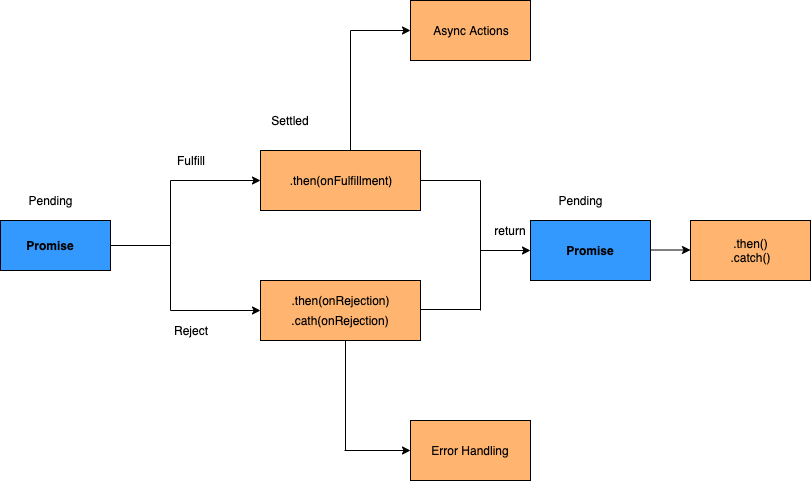
A Promise is a JavaScript object that represents the eventual completion (or failure) of an asynchronous operation and its resulting value. It acts as a placeholder for a value that may not be available yet but will be resolved in the future.
A Promise can be in one of three states:
pending: Initial state, neither fulfilled nor rejected.fulfilled: The operation completed successfully.rejected: The operation failed (e.g., due to a network error).
Promise Syntax
const promise = new Promise(function (resolve, reject) {
  // Perform async operation
});
Example: Creating and Using a Promise
const promise = new Promise((resolve, reject) => {
  setTimeout(() => {
    resolve("I'm a Promise!");
  }, 5000);
});

promise
  .then((value) => console.log(value)) // Logs after 5 seconds: "I'm a Promise!"
  .catch((error) => console.error(error))  // Handles any rejection
  .finally(() => console.log("Done"));     // Runs regardless of success or failure
In the above example:
- A
Promiseis created to handle an asynchronous operation withresolveandrejectcallbacks. - The
setTimeoutresolves the promise with a value after 5 seconds. .then(),.catch(), and.finally()are used to handle success, errors, and cleanup respectively.
The action flow of a promise will be as below,
Why do you need a promise
Promises are used to handle asynchronous operations, especially in languages like JavaScript, which often work with non-blocking operations such as network requests, file I/O, and timers. When an operation is asynchronous, it doesn't immediately return a result; instead, it works in the background and provides the result later. Handling this in a clean, organized way can be difficult without a structured approach.
Promises are used to:
- Handle asynchronous operations.
- Provide a cleaner alternative to callbacks.
- Avoid callback hell.
- Make code more readable and maintainable.
Explain the three states of promise
Promises have three states:
- Pending: This is an initial state of the Promise before an operation begins
- Fulfilled: This state indicates that the specified operation was completed.
- Rejected: This state indicates that the operation did not complete. In this case an error value will be thrown.
What is a callback function
A callback function is a function passed into another function as an argument. This function is invoked inside the outer function to complete an action. Let's take a simple example of how to use callback function
function callbackFunction(name) {
  console.log("Hello " + name);
}

function outerFunction(callback) {
  let name = prompt("Please enter your name.");
  callback(name);
}

outerFunction(callbackFunction);
Why do we need callbacks
The callbacks are needed because javascript is an event driven language. That means instead of waiting for a response, javascript will keep executing while listening for other events. Let's take an example with the first function invoking an API call(simulated by setTimeout) and the next function which logs the message.
function firstFunction() {
  // Simulate a code delay
  setTimeout(function () {
    console.log("First function called");
  }, 1000);
}
function secondFunction() {
  console.log("Second function called");
}
firstFunction();
secondFunction();

// Output:
// Second function called
// First function called
As observed from the output, javascript didn't wait for the response of the first function and the remaining code block got executed. So callbacks are used in a way to make sure that certain code doesn’t execute until the other code finishes execution.
What is a callback hell
Callback Hell is an anti-pattern with multiple nested callbacks which makes code hard to read and debug when dealing with asynchronous logic. The callback hell looks like below,
async1(function(){
    async2(function(){
        async3(function(){
            async4(function(){
                ....
            });
        });
    });
});
What are server-sent events
Server-sent events (SSE) is a server push technology enabling a browser to receive automatic updates from a server via HTTP connection without resorting to polling. These are a one way communications channel - events flow from server to client only. This has been used in Facebook/Twitter/X updates, stock price updates, news feeds etc.
How do you receive server-sent event notifications
The EventSource object is used to receive server-sent event notifications. For example, you can receive messages from server as below,
if (typeof EventSource !== "undefined") {
  var source = new EventSource("sse_generator.js");
  source.onmessage = function (event) {
    document.getElementById("output").innerHTML += event.data + "<br>";
  };
}
How do you check browser support for server-sent events
You can perform browser support for server-sent events before using it as below,
if (typeof EventSource !== "undefined") {
  // Server-sent events supported. Let's have some code here!
} else {
  // No server-sent events supported
}
What are the events available for server sent events
Below are the list of events available for server sent events
| Event | Description |
|---|---|
| onopen | It is used when a connection to the server is opened |
| onmessage | This event is used when a message is received |
| onerror | It happens when an error occurs |
What are the main rules of promise
A promise must follow a specific set of rules:
- A promise is an object that supplies a standard-compliant
.then()method - A pending promise may transition into either fulfilled or rejected state
- A fulfilled or rejected promise is settled and it must not transition into any other state.
- Once a promise is settled, the value must not change.
What is callback in callback
You can nest one callback inside in another callback to execute the actions sequentially one by one. This is known as callbacks in callbacks. Beware, too many levels of nesting lead to Callback hell
loadScript("/script1.js", function (script) {
  console.log("first script is loaded");

  loadScript("/script2.js", function (script) {
    console.log("second script is loaded");

    loadScript("/script3.js", function (script) {
      console.log("third script is loaded");
      // after all scripts are loaded
    });
  });
});
What is promise chaining
The process of executing a sequence of asynchronous tasks one after another using promises is known as Promise chaining. Let's take an example of promise chaining for calculating the final result,
new Promise(function (resolve, reject) {
  setTimeout(() => resolve(1), 1000);
})
  .then(function (result) {
    console.log(result); // 1
    return result * 2;
  })
  .then(function (result) {
    console.log(result); // 2
    return result * 3;
  })
  .then(function (result) {
    console.log(result); // 6
    return result * 4;
  });
In the above handlers, the result is passed to the chain of .then() handlers with the below work flow,
- The initial promise resolves in 1 second,
- After that
.thenhandler is called by logging the result(1) and then return a promise with the value of result * 2. - After that the value passed to the next
.thenhandler by logging the result(2) and return a promise with result * 3. - Finally the value passed to the last
.thenhandler by logging the result(6) and return a promise with result * 4.
What is promise.all
Promise.all is a promise that takes an array of promises as an input (an iterable), and it gets resolved when all the promises get resolved or any one of them gets rejected. For example, the syntax of promise.all method is below,
Promise.all([Promise1, Promise2, Promise3]) .then(result) => { console.log(result) }) .catch(error => console.log(`Error in promises ${error}`))
Note: Remember that the order of the promises(output the result) is maintained as per input order.
What is the purpose of the race method in promise
Promise.race() method will return the promise instance which is firstly resolved or rejected. Let's take an example of race() method where promise2 is resolved first
var promise1 = new Promise(function (resolve, reject) {
  setTimeout(resolve, 500, "one");
});
var promise2 = new Promise(function (resolve, reject) {
  setTimeout(resolve, 100, "two");
});

Promise.race([promise1, promise2]).then(function (value) {
  console.log(value); // "two" // Both promises will resolve, but promise2 is faster
});
What is a strict mode in javascript
JavaScript’s "use strict" directive is used to opt into a stricter parsing and error-handling mode for your scripts or functions. It helps catch common bugs, makes your code more secure, and prepares it for future versions of JavaScript.
Strict Mode is a new feature in ECMAScript 5 that allows you to place a program, or a function, in a “strict” operating context. This way it prevents certain actions from being taken and throws more exceptions. The literal expression "use strict"; instructs the browser to use the javascript code in the Strict mode. This also enables block-scoped variables.
Why do you need strict mode
Strict mode is useful to write "secure" JavaScript by notifying "bad syntax" into real errors. For example, it eliminates accidentally creating a global variable by throwing an error and also throws an error for assignment to a non-writable property, a getter-only property, a non-existing property, a non-existing variable, or a non-existing object.
How do you declare strict mode
The strict mode is declared by adding "use strict"; to the beginning of a script or a function. If declared at the beginning of a script, it has global scope.
"use strict";
x = 3.14; // This will cause an error because x is not declared
and if you declare inside a function, it has local scope
x = 3.14; // This will not cause an error.
myFunction();

function myFunction() {
  "use strict";
  y = 3.14; // This will cause an error
}
What is the purpose of double exclamation
The double exclamation or negation(!!) ensures the resulting type is a boolean. If it was falsey (e.g. 0, null, undefined, etc.), it will be false, otherwise, it will be true. For example, you can test IE version using this expression as below,
let isIE8 = false;
isIE8 = !!navigator.userAgent.match(/MSIE 8.0/);
console.log(isIE8); // returns true or false
If you don't use this expression then it returns the original value.
console.log(navigator.userAgent.match(/MSIE 8.0/)); // returns either an Array or null
Note: The expression !! is not an operator, but it is just twice of ! operator.
What is the purpose of the delete operator
The delete operator is used to delete the property as well as its value.
var user = { firstName: "John", lastName: "Doe", age: 20 };
delete user.age;

console.log(user); // {firstName: "John", lastName:"Doe"}
What is typeof operator
You can use the JavaScript typeof operator to find the type of a JavaScript variable. It returns the type of a variable or an expression.
typeof "John Abraham"; // Returns "string"
typeof (1 + 2); // Returns "number"
typeof [1, 2, 3]; // Returns "object" because all arrays are also objects
What is undefined property
The undefined property indicates that a variable has not been assigned a value, or declared but not initialized at all. The type of undefined value is undefined too.
var user; // Value is undefined, type is undefined
console.log(typeof user); //undefined
Any variable can be emptied by setting the value to undefined.
user = undefined;
What is null value
The value null represents the intentional absence of any object value. It is one of JavaScript's primitive values. The type of null value is object. You can empty the variable by setting the value to null.
var user = null;
console.log(typeof user); //object
What is the difference between null and undefined
Below are the main differences between null and undefined,
| Null | Undefined |
|---|---|
| It is an assignment value which indicates that variable points to no object. | It is not an assignment value where a variable has been declared but has not yet been assigned a value. |
| Type of null is object | Type of undefined is undefined |
| The null value is a primitive value that represents the null, empty, or non-existent reference. | The undefined value is a primitive value used when a variable has not been assigned a value. |
| Indicates the absence of a value for a variable | Indicates absence of variable itself |
| Converted to zero (0) while performing primitive operations | Converted to NaN while performing primitive operations |
What is eval
The eval() function evaluates JavaScript code represented as a string. The string can be a JavaScript expression, variable, statement, or sequence of statements.
console.log(eval("1 + 2")); // 3
What is the difference between window and document
Below are the main differences between window and document,
| Window | Document |
|---|---|
| It is the root level element in any web page | It is the direct child of the window object. This is also known as Document Object Model (DOM) |
| By default window object is available implicitly in the page | You can access it via window.document or document. |
| It has methods like alert(), confirm() and properties like document, location | It provides methods like getElementById, getElementsByTagName, createElement etc |
How do you access history in javascript
The window.history object contains the browser's history. You can load previous and next URLs in the history using back() and next() methods.
function goBack() {
  window.history.back();
}
function goForward() {
  window.history.forward();
}
Note: You can also access history without window prefix.
How do you detect caps lock key turned on or not
The mouseEvent getModifierState() is used to return a boolean value that indicates whether the specified modifier key is activated or not. The modifiers such as CapsLock, ScrollLock and NumLock are activated when they are clicked, and deactivated when they are clicked again.
Let's take an input element to detect the CapsLock on/off behavior with an example:
<input type="password" onmousedown="enterInput(event)" />

<p id="feedback"></p>

<script>
  function enterInput(e) {
    var flag = e.getModifierState("CapsLock");
    if (flag) {
      document.getElementById("feedback").innerHTML = "CapsLock activated";
    } else {
      document.getElementById("feedback").innerHTML =
        "CapsLock not activated";
    }
  }
</script>
What is isNaN
The isNaN() function is used to determine whether a value is an illegal number (Not-a-Number) or not. i.e, This function returns true if the value equates to NaN. Otherwise it returns false.
isNaN("Hello"); //true
isNaN("100"); //false
What are the differences between undeclared and undefined variables
Below are the major differences between undeclared(not defined) and undefined variables,
| undeclared | undefined |
|---|---|
| These variables do not exist in a program and are not declared | These variables declared in the program but have not assigned any value |
| If you try to read the value of an undeclared variable, then a runtime error is encountered | If you try to read the value of an undefined variable, an undefined value is returned. |
var a;
a; // yields undefined

b; // Throws runtime error like "Uncaught ReferenceError: b is not defined"
This can be confusing, because it says not defined instead of not declared (Chrome)
What are global variables
Global variables are those that are available throughout the length of the code without any scope. The var keyword is used to declare a local variable but if you omit it then it will become global variable
msg = "Hello"; // var is missing, it becomes global variable
What are the problems with global variables
The problem with global variables is the conflict of variable names of local and global scope. It is also difficult to debug and test the code that relies on global variables.
What is NaN property
The NaN property is a global property that represents "Not-a-Number" value. i.e, It indicates that a value is not a legal number. It is very rare to use NaN in a program but it can be used as return value for few cases
Math.sqrt(-1);
parseInt("Hello");
What is the purpose of isFinite function
The isFinite() function is used to determine whether a number is a finite, legal number. It returns false if the value is +infinity, -infinity, or NaN (Not-a-Number), otherwise it returns true.
isFinite(Infinity); // false
isFinite(NaN); // false
isFinite(-Infinity); // false

isFinite(100); // true
What is an event flow
Event flow refers to the order in which events are handled in the browser when a user interacts with elements on a webpage like clicking, typing, hovering, etc.
When you click an element that is nested in various other elements, before your click actually reaches its destination, or target element, it must trigger the click event for each of its parent elements first, starting at the top with the global window object.
Hence, there are three phases in JavaScript’s event flow:
- Event Capturing(Top to Bottom): The event starts from the window/document and moves down the DOM tree toward the target element.
- Target phase: The event reaches the target element — the element that was actually interacted with.
- Event Bubbling(Bottom to Top): The event then bubbles back up from the target element to the root.
What is event capturing
Event capturing is a phase of event propagation in which an event is first intercepted by the outermost ancestor element, then travels downward through the DOM hierarchy until it reaches the target (innermost) element.
To handle events during the capturing phase, you need to pass true as the third argument to the addEventListener method.
 <div>
   <button class="child">Hello</button>
 </div>

 <script>
   const parent = document.querySelector("div");
   const child = document.querySelector(".child");

   // Capturing phase: parent listener (runs first)
   parent.addEventListener("click", function () {
     console.log("Parent (capturing)");
   }, true); // `true` enables capturing

   // Bubbling phase: child listener (runs after)
   child.addEventListener("click", function () {
     console.log("Child (bubbling)");
   });
 </script>
 // Parent (capturing)
 // Child (bubbling)
What is event bubbling
Event bubbling is a type of event propagation in which an event first triggers on the innermost target element (the one the user interacted with), and then bubbles up through its ancestors in the DOM hierarchy — eventually reaching the outermost elements, like the document or window.
By default, event listeners in JavaScript are triggered during the bubbling phase, unless specified otherwise.
<div>
  <button class="child">Hello</button>
</div>

<script>
  const parent = document.querySelector("div");
  const child = document.querySelector(".child");

  // Bubbling phase (default)
  parent.addEventListener("click", function () {
    console.log("Parent");
  });

  child.addEventListener("click", function () {
    console.log("Child");
  });
</script>
//Child
//Parent
Here, at first, the event triggers on the child button. Thereafter it bubbles up and triggers the parent div's event handler.
How do you submit a form using JavaScript
You can submit a form using document.forms[0].submit(). All the form input's information is submitted using onsubmit event handler
function submit() {
  document.forms[0].submit();
}
How do you find operating system details
The window.navigator object contains information about the visitor's browser OS details. Some of the OS properties are available under platform property,
console.log(navigator.platform);
What is the difference between document load and DOMContentLoaded events
The DOMContentLoaded event is fired when the initial HTML document has been completely loaded and parsed, without waiting for assets(stylesheets, images, and subframes) to finish loading. Whereas The load event is fired when the whole page has loaded, including all dependent resources(stylesheets, images).
What is the difference between native, host and user objects
Native objects are objects that are part of the JavaScript language defined by the ECMAScript specification. For example, String, Math, RegExp, Object, Function etc core objects defined in the ECMAScript spec.
Host objects are objects provided by the browser or runtime environment (Node).
For example, window, XmlHttpRequest, DOM nodes etc are considered as host objects.
User objects are objects defined in the javascript code. For example, User objects created for profile information.
What are the tools or techniques used for debugging JavaScript code
You can use below tools or techniques for debugging javascript
- Chrome Devtools
- debugger statement
- Good old console.log statement
What are the pros and cons of promises over callbacks
Below are the list of pros and cons of promises over callbacks,
Pros:
- It avoids callback hell which is unreadable
- Easy to write sequential asynchronous code with .then()
- Easy to write parallel asynchronous code with Promise.all()
- Solves some of the common problems of callbacks(call the callback too late, too early, many times and swallow errors/exceptions)
Cons:
- It makes little complex code
- You need to load a polyfill if ES6 is not supported
What is the difference between an attribute and a property
Attributes are defined on the HTML markup whereas properties are defined on the DOM. For example, the below HTML element has 2 attributes: type and value,
<input type="text" value="Name:">
You can retrieve the attribute value as below, for example after typing "Good morning" into the input field:
const input = document.querySelector("input");
console.log(input.getAttribute("value")); // Good morning
console.log(input.value); // Good morning
And after you change the value of the text field to "Good evening", it becomes like
console.log(input.getAttribute("value")); // Good evening
console.log(input.value); // Good evening
What is same-origin policy
The same-origin policy is a policy that prevents JavaScript from making requests across domain boundaries. An origin is defined as a combination of URI scheme, hostname, and port number. If you enable this policy then it prevents a malicious script on one page from obtaining access to sensitive data on another web page using Document Object Model(DOM).
What is the purpose of void 0
Void(0) is used to prevent the page from refreshing. This will be helpful to eliminate the unwanted side-effect, because it will return the undefined primitive value. It is commonly used for HTML documents that use href="JavaScript:Void(0);" within an <a> element. i.e, when you click a link, the browser loads a new page or refreshes the same page. But this behavior will be prevented using this expression.
For example, the below link notify the message without reloading the page
<a href="JavaScript:void(0);" onclick="alert('Well done!')">
  Click Me!
</a>
Is JavaScript a compiled or interpreted language
JavaScript is an interpreted language, not a compiled language. An interpreter in the browser reads over the JavaScript code, interprets each line, and runs it. Nowadays modern browsers use a technology known as Just-In-Time (JIT) compilation, which compiles JavaScript to executable bytecode just as it is about to run.
Is JavaScript a case-sensitive language
Yes, JavaScript is a case sensitive language. The language keywords, variables, function & object names, and any other identifiers must always be typed with a consistent capitalization of letters.
Is there any relation between Java and JavaScript
No, they are entirely two different programming languages and have nothing to do with each other. But both of them are Object Oriented Programming languages and like many other languages, they follow similar syntax for basic features(if, else, for, switch, break, continue etc).
What are events
Events are "things" that happen to HTML elements. When JavaScript is used in HTML pages, JavaScript can react on these events. Some of the examples of HTML events are,
- Web page has finished loading
- Input field was changed
- Button was clicked
Let's describe the behavior of click event for button element,
<!doctype html>
<html>
 <head>
   <script>
     function greeting() {
       alert('Hello! Good morning');
     }
   </script>
 </head>
 <body>
   <button type="button" onclick="greeting()">Click me</button>
 </body>
</html>
Who created javascript
JavaScript was created by Brendan Eich in 1995 during his time at Netscape Communications. Initially it was developed under the name Mocha, but later the language was officially called LiveScript when it first shipped in beta releases of Netscape.
What is the use of preventDefault method
The preventDefault() method cancels the event if it is cancelable, meaning that the default action or behaviour that belongs to the event will not occur. For example, prevent form submission when clicking on submit button and prevent opening the page URL when clicking on hyperlink are some common use cases.
document
  .getElementById("link")
  .addEventListener("click", function (event) {
    event.preventDefault();
  });
Note: Remember that not all events are cancelable.
What is the use of stopPropagation method
The stopPropagation method is used to stop the event from bubbling up the event chain. For example, the below nested divs with stopPropagation method prevents default event propagation when clicking on nested div(Div1)
<p>Click DIV1 Element</p>
<div onclick="secondFunc()">DIV 2
  <div onclick="firstFunc(event)">DIV 1</div>
</div>

<script>
function firstFunc(event) {
  alert("DIV 1");
  event.stopPropagation();
}

function secondFunc() {
  alert("DIV 2");
}
</script>
What are the steps involved in return false usage
The return false statement in event handlers performs the below steps,
- First it stops the browser's default action or behaviour.
- It prevents the event from propagating the DOM
- Stops callback execution and returns immediately when called.
What is BOM
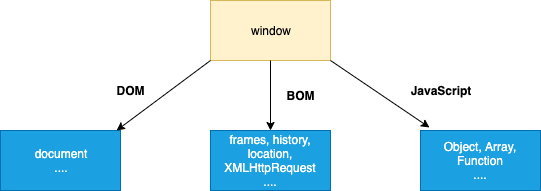
The Browser Object Model (BOM) allows JavaScript to "talk to" the browser. It consists of the objects navigator, history, screen, location and document which are children of the window. The Browser Object Model is not standardized and can change based on different browsers.
What is the use of setTimeout
The setTimeout() method is used to call a function or evaluate an expression after a specified number of milliseconds. For example, let's log a message after 2 seconds using setTimeout method,
setTimeout(function () {
  console.log("Good morning");
}, 2000);
What is the use of setInterval
The setInterval() method is used to call a function or evaluate an expression at specified intervals (in milliseconds). For example, let's log a message after 2 seconds using setInterval method,
setInterval(function () {
  console.log("Good morning");
}, 2000);
Why is JavaScript treated as Single threaded
JavaScript is a single-threaded language. Because the language specification does not allow the programmer to write code so that the interpreter can run parts of it in parallel in multiple threads or processes. Whereas languages like java, go, C++ can make multi-threaded and multi-process programs.
What is an event delegation
Event delegation is a technique for listening to events where you delegate a parent element as the listener for all of the events that happen inside it.
For example, if you wanted to detect field changes inside a specific form, you can use event delegation technique,
var form = document.querySelector("#registration-form");

// Listen for changes to fields inside the form
form.addEventListener(
  "input",
  function (event) {
    // Log the field that was changed
    console.log(event.target);
  },
  false
);
What is ECMAScript
ECMAScript is the scripting language that forms the basis of JavaScript. ECMAScript standardized by the ECMA International standards organization in the ECMA-262 and ECMA-402 specifications. The first edition of ECMAScript was released in 1997.
What is JSON
JSON (JavaScript Object Notation) is a lightweight format that is used for data interchanging. It is based on a subset of JavaScript language in the way objects are built in JavaScript.
What are the syntax rules of JSON
Below are the list of syntax rules of JSON
- The data is in name/value pairs
- The data is separated by commas
- Curly braces hold objects
- Square brackets hold arrays
What is the purpose JSON stringify
When sending data to a web server, the data has to be in a string format. You can achieve this by converting JSON object into a string using stringify() method.
var userJSON = { name: "John", age: 31 };
var userString = JSON.stringify(userJSON);
console.log(userString); //"{"name":"John","age":31}"
How do you parse JSON string
When receiving the data from a web server, the data is always in a string format. But you can convert this string value to a javascript object using parse() method.
var userString = '{"name":"John","age":31}';
var userJSON = JSON.parse(userString);
console.log(userJSON); // {name: "John", age: 31}
Why do you need JSON
When exchanging data between a browser and a server, the data can only be text. Since JSON is text only, it can easily be sent to and from a server, and used as a data format by any programming language.
What are PWAs
Progressive web applications (PWAs) are a type of mobile app delivered through the web, built using common web technologies including HTML, CSS and JavaScript. These PWAs are deployed to servers, accessible through URLs, and indexed by search engines.
What is the purpose of clearTimeout method
The clearTimeout() function is used in javascript to clear the timeout which has been set by setTimeout()function before that. i.e, The return value of setTimeout() function is stored in a variable and it’s passed into the clearTimeout() function to clear the timer.
For example, the below setTimeout method is used to display the message after 3 seconds. This timeout can be cleared by the clearTimeout() method.
<script>
     var msg;
     function greeting() {
        alert('Good morning');
     }
     function start() {
       msg =setTimeout(greeting, 3000);

     }

     function stop() {
         clearTimeout(msg);
     }
</script>
What is the purpose of clearInterval method
The clearInterval() function is used in javascript to clear the interval which has been set by setInterval() function. i.e, The return value returned by setInterval() function is stored in a variable and it’s passed into the clearInterval() function to clear the interval.
For example, the below setInterval method is used to display the message for every 3 seconds. This interval can be cleared by the clearInterval() method.
<script>
     var msg;
     function greeting() {
        alert('Good morning');
     }
     function start() {
       msg = setInterval(greeting, 3000);

     }

     function stop() {
         clearInterval(msg);
     }
</script>
How do you redirect new page in javascript
In vanilla javascript, you can redirect to a new page using the location property of window object. The syntax would be as follows,
function redirect() {
  window.location.href = "newPage.html";
}
How do you check whether a string contains a substring
There are 3 possible ways to check whether a string contains a substring or not,
- Using includes: ES6 provided
String.prototype.includesmethod to test a string contains a substring
var mainString = "hello",
  subString = "hell";
mainString.includes(subString);
- Using indexOf: In an ES5 or older environment, you can use
String.prototype.indexOfwhich returns the index of a substring. If the index value is not equal to -1 then it means the substring exists in the main string.
var mainString = "hello",
  subString = "hell";
mainString.indexOf(subString) !== -1;
- Using RegEx: The advanced solution is using Regular expression's test method(
RegExp.test), which allows for testing for against regular expressions
var mainString = "hello",
  regex = /hell/;
regex.test(mainString);
How do you validate an email in javascript
You can validate an email in javascript using regular expressions. It is recommended to do validations on the server side instead of the client side. Because the javascript can be disabled on the client side.
function validateEmail(email) {
  var re =
    /^(([^<>()\[\]\\.,;:\s@"]+(\.[^<>()\[\]\\.,;:\s@"]+)*)|(".+"))@((\[[0-9]{1,3}\.[0-9]{1,3}\.[0-9]{1,3}\.[0-9]{1,3}\])|(([a-zA-Z\-0-9]+\.)+[a-zA-Z]{2,}))$/;
  return re.test(String(email).toLowerCase());
}
How do you get the current url with javascript
You can use window.location.href expression to get the current url path and you can use the same expression for updating the URL too. You can also use document.URL for read-only purposes but this solution has issues in FF.
console.log("location.href", window.location.href); // Returns full URL
What are the various url properties of location object
The below Location object properties can be used to access URL components of the page,
- href - The entire URL
- protocol - The protocol of the URL
- host - The hostname and port of the URL
- hostname - The hostname of the URL
- port - The port number in the URL
- pathname - The path name of the URL
- search - The query portion of the URL
- hash - The anchor portion of the URL
How do you get query string values in javascript
You can use URLSearchParams to get query string values in javascript. Let's see an example to get the client code value from URL query string,
const urlParams = new URLSearchParams(window.location.search);
const clientCode = urlParams.get("clientCode");
How do you check if a key exists in an object
You can check whether a key exists in an object or not using three approaches,
-
Using in operator: You can use the in operator whether a key exists in an object or not
"key" in obj;and If you want to check if a key doesn't exist, remember to use parenthesis,
!("key" in obj); -
Using hasOwnProperty method: You can use
hasOwnPropertyto particularly test for properties of the object instance (and not inherited properties)obj.hasOwnProperty("key"); // true -
Using undefined comparison: If you access a non-existing property from an object, the result is undefined. Let’s compare the properties against undefined to determine the existence of the property.
const user = {
  name: "John",
};

console.log(user.name !== undefined); // true
console.log(user.nickName !== undefined); // false
How do you loop through or enumerate javascript object
You can use the for-in loop to loop through javascript object. You can also make sure that the key you get is an actual property of an object, and doesn't come from the prototype using hasOwnProperty method.
var object = {
  k1: "value1",
  k2: "value2",
  k3: "value3",
};

for (var key in object) {
  if (object.hasOwnProperty(key)) {
    console.log(key + " -> " + object[key]); // k1 -> value1 ...
  }
}
How do you test for an empty object
There are different solutions based on ECMAScript versions
- Using Object entries(ECMA 7+): You can use object entries length along with constructor type.
Object.entries(obj).length === 0 && obj.constructor === Object; // Since date object length is 0, you need to check constructor check as well
- Using Object keys(ECMA 5+): You can use object keys length along with constructor type.
Object.keys(obj).length === 0 && obj.constructor === Object; // Since date object length is 0, you need to check constructor check as well
- Using for-in with hasOwnProperty(Pre-ECMA 5): You can use a for-in loop along with hasOwnProperty.
function isEmpty(obj) {
  for (var prop in obj) {
    if (obj.hasOwnProperty(prop)) {
      return false;
    }
  }

  return JSON.stringify(obj) === JSON.stringify({});
}
What is an arguments object
The arguments object is an Array-like object accessible inside functions that contains the values of the arguments passed to that function. For example, let's see how to use arguments object inside sum function,
function sum() {
  var total = 0;
  for (var i = 0, len = arguments.length; i < len; ++i) {
    total += arguments[i];
  }
  return total;
}

sum(1, 2, 3); // returns 6
Note: You can't apply array methods on arguments object. But you can convert into a regular array as below.
var argsArray = Array.prototype.slice.call(arguments);
How do you make first letter of the string in an uppercase
You can create a function which uses a chain of string methods such as charAt, toUpperCase and slice methods to generate a string with the first letter in uppercase.
function capitalizeFirstLetter(string) {
  return string.charAt(0).toUpperCase() + string.slice(1);
}
What are the pros and cons of for loops
The for-loop is a commonly used iteration syntax in javascript. It has both pros and cons
Pros
- Works on every environment
- You can use break and continue flow control statements
Cons
- Too verbose
- Imperative
- You might face off-by-one errors.
How do you display the current date in javascript
You can use new Date() to generate a new Date object containing the current date and time. For example, let's display the current date in mm/dd/yyyy
var today = new Date();
var dd = String(today.getDate()).padStart(2, "0");
var mm = String(today.getMonth() + 1).padStart(2, "0"); //January is 0!
var yyyy = today.getFullYear();

today = mm + "/" + dd + "/" + yyyy;
document.write(today);
How do you compare two date objects
You need to use date.getTime() method in order to compare unix timestamp values
var d1 = new Date();
var d2 = new Date(d1);
console.log(d1.getTime() === d2.getTime()); //True
console.log(d1 === d2); // False
How do you check if a string starts with another string
You can use ECMAScript 6's String.prototype.startsWith() method to check if a string starts with another string or not. But it is not yet supported in all browsers. Let's see an example to see this usage,
"Good morning".startsWith("Good"); // true
"Good morning".startsWith("morning"); // false
How do you trim a string in javascript
JavaScript provided a trim method on string types to trim any whitespaces present at the beginning or ending of the string.
" Hello World ".trim(); //Hello World
If your browser(<IE9) doesn't support this method then you can use below polyfill.
if (!String.prototype.trim) {
  (function () {
    // Make sure we trim BOM and NBSP
    var rtrim = /^[\s\uFEFF\xA0]+|[\s\uFEFF\xA0]+$/g;
    String.prototype.trim = function () {
      return this.replace(rtrim, "");
    };
  })();
}
How do you add a key value pair in javascript
There are two possible solutions to add new properties to an object.
Let's take a simple object to explain these solutions.
var object = {
  key1: value1,
  key2: value2,
};
- Using dot notation: This solution is useful when you know the name of the property
object.key3 = "value3";
- Using square bracket notation: This solution is useful when the name of the property is dynamically determined or the key's name is non-JS like "user-name"
obj["key3"] = "value3";
Is the !-- notation represents a special operator
No,that's not a special operator. But it is a combination of 2 standard operators one after the other,
- A logical not (!)
- A prefix decrement (--)
At first, the value decremented by one and then tested to see if it is equal to zero or not for determining the truthy/falsy value.
How do you assign default values to variables
You can use the logical or operator || in an assignment expression to provide a default value. The syntax looks like as below,
var a = b || c;
As per the above expression, variable 'a 'will get the value of 'c' only if 'b' is falsy (if is null, false, undefined, 0, empty string, or NaN), otherwise 'a' will get the value of 'b'.
How do you define multiline strings
You can define multiline string literals using the '\n' character followed by line terminator('').
var str = "This is a \n very lengthy \n sentence!";
console.log(str);
But if you have a space after the '\n' character, there will be indentation inconsistencies.
What is an app shell model
An application shell (or app shell) architecture is one way to build a Progressive Web App that reliably and instantly loads on your users' screens, similar to what you see in native applications. It is useful for getting some initial HTML to the screen fast without a network.
Can we define properties for functions
Yes, we can define properties for functions because functions are also objects.
fn = function (x) {
  //Function code goes here
};

fn.name = "John";

fn.profile = function (y) {
  //Profile code goes here
};
What is the way to find the number of parameters expected by a function
You can use function.length syntax to find the number of parameters expected by a function. Let's take an example of sum function to calculate the sum of numbers,
function sum(num1, num2, num3, num4) {
  return num1 + num2 + num3 + num4;
}
sum.length; // 4 is the number of parameters expected.
What is a polyfill
A polyfill is a piece of JS code used to provide modern functionality on older browsers that do not natively support it. For example, Silverlight plugin polyfill can be used to mimic the functionality of an HTML Canvas element on Microsoft Internet Explorer 7.
There are two main polyfill libraries available,
- Core.js: It is a modular javascript library used for cutting-edge ECMAScript features.
- Polyfill.io: It provides polyfills that are required for browser needs.
What are break and continue statements
The break statement is used to "jump out" of a loop. i.e, It breaks the loop and continues executing the code after the loop.
for (i = 0; i < 10; i++) {
  if (i === 5) {
    break;
  }
  text += "Number: " + i + "<br>";
}
The continue statement is used to "jump over" one iteration in the loop. i.e, It breaks one iteration (in the loop), if a specified condition occurs, and continues with the next iteration in the loop.
for (i = 0; i < 10; i++) {
  if (i === 5) {
    continue;
  }
  text += "Number: " + i + "<br>";
}
What are js labels
The label statement allows us to name loops and blocks in JavaScript. We can then use these labels to refer back to the code later. For example, the below code with labels avoids printing the numbers when they are same,
var i, j;

loop1: for (i = 0; i < 3; i++) {
  loop2: for (j = 0; j < 3; j++) {
    if (i === j) {
      continue loop1;
    }
    console.log("i = " + i + ", j = " + j);
  }
}

// Output is:
//   "i = 1, j = 0"
//   "i = 2, j = 0"
//   "i = 2, j = 1"
What are the benefits of keeping declarations at the top
It is recommended to keep all declarations at the top of each script or function. The benefits of doing this are,
- Gives cleaner code
- It provides a single place to look for local variables
- Easy to avoid unwanted global variables
- It reduces the possibility of unwanted re-declarations
What are the benefits of initializing variables
It is recommended to initialize variables because of the below benefits,
- It gives cleaner code
- It provides a single place to initialize variables
- Avoid undefined values in the code
What are the recommendations to create new object
It is recommended to avoid creating new objects using new Object(). Instead you can initialize values based on it's type to create the objects.
- Assign {} instead of new Object()
- Assign "" instead of new String()
- Assign 0 instead of new Number()
- Assign false instead of new Boolean()
- Assign [] instead of new Array()
- Assign /()/ instead of new RegExp()
- Assign function (){} instead of new Function()
You can define them as an example,
var v1 = {};
var v2 = "";
var v3 = 0;
var v4 = false;
var v5 = [];
var v6 = /()/;
var v7 = function () {};
How do you define JSON arrays
JSON arrays are written inside square brackets and arrays contain javascript objects. For example, the JSON array of users would be as below,
"users":[
  {"firstName":"John", "lastName":"Abrahm"},
  {"firstName":"Anna", "lastName":"Smith"},
  {"firstName":"Shane", "lastName":"Warn"}
]
How do you generate random integers
You can use Math.random() with Math.floor() to return random integers. For example, if you want generate random integers between 1 to 10, the multiplication factor should be 10,
Math.floor(Math.random() * 10) + 1; // returns a random integer from 1 to 10
Math.floor(Math.random() * 100) + 1; // returns a random integer from 1 to 100
Note: Math.random() returns a random number between 0 (inclusive), and 1 (exclusive)
Can you write a random integers function to print integers within a range
Yes, you can create a proper random function to return a random number between min and max (both included)
function randomInteger(min, max) {
  return Math.floor(Math.random() * (max - min + 1)) + min;
}
randomInteger(1, 100); // returns a random integer from 1 to 100
randomInteger(1, 1000); // returns a random integer from 1 to 1000
What is tree shaking
Tree shaking is a form of dead code elimination. It means that unused modules will not be included in the bundle during the build process and for that it relies on the static structure of ES2015 module syntax,( i.e. import and export). Initially this has been popularized by the ES2015 module bundler rollup, these days practically all bundlers use this technique.
What is the need of tree shaking
Tree Shaking can significantly reduce the code size in any application. i.e, The less code we send over the wire the more performant the application will be. For example, if we just want to create a “Hello World” Application using SPA frameworks then it will take around a few MBs, but by tree shaking it can bring down the size to just a few hundred KBs. Tree shaking is implemented in Rollup and Webpack bundlers.
Is it recommended to use eval
No, it allows arbitrary code to be run which causes a security problem. As we know that the eval() function is used to run text as code. In most of the cases, it should not be necessary to use it.
What is a Regular Expression
A regular expression is a sequence of characters that forms a search pattern. You can use this search pattern for searching data in a text. These can be used to perform all types of text search and text replace operations. Let's see the syntax format now,
/pattern/modifiers;
For example, the regular expression or search pattern with case-insensitive username would be,
/John/i;
What are the string methods that accept Regular expression
There are six string methods: search(), replace(), replaceAll(), match(), matchAll(), and split().
The search() method uses an expression to search for a match, and returns the position of the match.
var msg = "Hello John";
var n = msg.search(/John/i); // 6
The replace() and replaceAll() methods are used to return a modified string where the pattern is replaced.
var msg = "ball bat";
var n1 = msg.replace(/b/i, "c"); // call bat
var n2 = msg.replaceAll(/b/i, "c"); // call cat
The match() and matchAll() methods are used to return the matches when matching a string against a regular expression.
var msg = "Hello John";
var n1 = msg.match(/[A-Z]/g); // ["H", "J"]
var n2 = msg.matchAll(/[A-Z]/g); // this returns an iterator
The split() method is used to split a string into an array of substrings, and returns the new array.
var msg = "Hello John";
var n = msg.split(/\s/); // ["Hello", "John"]
What are modifiers in regular expression
Modifiers can be used to perform case-insensitive and global searches. Let's list some of the modifiers,
| Modifier | Description |
|---|---|
| i | Perform case-insensitive matching |
| g | Perform a global match rather than stops at first match |
| m | Perform multiline matching |
Let's take an example of global modifier,
var text = "Learn JS one by one";
var pattern = /one/g;
var result = text.match(pattern); // one,one
What are regular expression patterns
Regular Expressions provide a group of patterns in order to match characters. Basically they are categorized into 3 types,
- Brackets: These are used to find a range of characters.
For example, below are some use cases,
- [abc]: Used to find any of the characters between the brackets(a,b,c)
- [0-9]: Used to find any of the digits between the brackets
- (a|b): Used to find any of the alternatives separated with |
- Metacharacters: These are characters with a special meaning.
For example, below are some use cases,
- \d: Used to find a digit
- \s: Used to find a whitespace character
- \b: Used to find a match at the beginning or ending of a word
- Quantifiers: These are useful to define quantities.
For example, below are some use cases,
- n+: Used to find matches for any string that contains at least one n
- n*: Used to find matches for any string that contains zero or more occurrences of n
- n?: Used to find matches for any string that contains zero or one occurrences of n
What is a RegExp object
RegExp object is a regular expression object with predefined properties and methods. Let's see the simple usage of RegExp object,
var regexp = new RegExp("\\w+");
console.log(regexp);
// expected output: /\w+/
How do you search a string for a pattern
You can use the test() method of regular expression in order to search a string for a pattern, and return true or false depending on the result.
var pattern = /you/;
console.log(pattern.test("How are you?")); //true
What is the purpose of exec method
The purpose of exec method is similar to test method but it executes a search for a match in a specified string and returns a result array, or null instead of returning true/false.
var pattern = /you/;
console.log(pattern.exec("How are you?")); //["you", index: 8, input: "How are you?", groups: undefined]
How do you change the style of a HTML element
You can change inline style or classname of a HTML element using javascript DOM-manipulation
- Using style property: You can modify inline style using style property
document.getElementById("title").style.fontSize = "30px";
- Using ClassName property: It is easy to modify element class using className property
document.getElementById("title").className = "custom-title";
What would be the result of 1+2+'3'
The output is going to be 33. Since 1 and 2 are numeric values, the result of the first two digits is going to be a numeric value 3. The next digit is a string type value because of that the addition of numeric value 3 and string type value 3 is just going to be a concatenation value 33. Other operations like 3 * '3' do yield correct results because the string is coerced into a number.
What is a debugger statement
The debugger statement invokes any available debugging functionality, such as setting a breakpoint. If no debugging functionality is available, this statement has no effect. For example, in the below function a debugger statement has been inserted. So execution is paused at the debugger statement just like a breakpoint in the script source.
function getProfile() {
  // code goes here
  debugger;
  // code goes here
}
What is the purpose of breakpoints in debugging
You can set breakpoints in the javascript code once the debugger statement is executed and the debugger window pops up. At each breakpoint, javascript will stop executing, and let you examine the JavaScript values. After examining values, you can resume the execution of code using the play button.
Can I use reserved words as identifiers
No, you cannot use the reserved words as variables, labels, object or function names. Let's see one simple example,
var else = "hello"; // Uncaught SyntaxError: Unexpected token else
How do you detect a mobile browser
You can use regex which returns a true or false value depending on whether or not the user is browsing with a mobile.
window.mobilecheck = function () {
  var mobileCheck = false;
  (function (a) {
    if (
      /(android|bb\d+|meego).+mobile|avantgo|bada\/|blackberry|blazer|compal|elaine|fennec|hiptop|iemobile|ip(hone|od)|iris|kindle|lge |maemo|midp|mmp|mobile.+firefox|netfront|opera m(ob|in)i|palm( os)?|phone|p(ixi|re)\/|plucker|pocket|psp|series(4|6)0|symbian|treo|up\.(browser|link)|vodafone|wap|windows ce|xda|xiino/i.test(
        a
      ) ||
      /1207|6310|6590|3gso|4thp|50[1-6]i|770s|802s|a wa|abac|ac(er|oo|s\-)|ai(ko|rn)|al(av|ca|co)|amoi|an(ex|ny|yw)|aptu|ar(ch|go)|as(te|us)|attw|au(di|\-m|r |s )|avan|be(ck|ll|nq)|bi(lb|rd)|bl(ac|az)|br(e|v)w|bumb|bw\-(n|u)|c55\/|capi|ccwa|cdm\-|cell|chtm|cldc|cmd\-|co(mp|nd)|craw|da(it|ll|ng)|dbte|dc\-s|devi|dica|dmob|do(c|p)o|ds(12|\-d)|el(49|ai)|em(l2|ul)|er(ic|k0)|esl8|ez([4-7]0|os|wa|ze)|fetc|fly(\-|_)|g1 u|g560|gene|gf\-5|g\-mo|go(\.w|od)|gr(ad|un)|haie|hcit|hd\-(m|p|t)|hei\-|hi(pt|ta)|hp( i|ip)|hs\-c|ht(c(\-| |_|a|g|p|s|t)|tp)|hu(aw|tc)|i\-(20|go|ma)|i230|iac( |\-|\/)|ibro|idea|ig01|ikom|im1k|inno|ipaq|iris|ja(t|v)a|jbro|jemu|jigs|kddi|keji|kgt( |\/)|klon|kpt |kwc\-|kyo(c|k)|le(no|xi)|lg( g|\/(k|l|u)|50|54|\-[a-w])|libw|lynx|m1\-w|m3ga|m50\/|ma(te|ui|xo)|mc(01|21|ca)|m\-cr|me(rc|ri)|mi(o8|oa|ts)|mmef|mo(01|02|bi|de|do|t(\-| |o|v)|zz)|mt(50|p1|v )|mwbp|mywa|n10[0-2]|n20[2-3]|n30(0|2)|n50(0|2|5)|n7(0(0|1)|10)|ne((c|m)\-|on|tf|wf|wg|wt)|nok(6|i)|nzph|o2im|op(ti|wv)|oran|owg1|p800|pan(a|d|t)|pdxg|pg(13|\-([1-8]|c))|phil|pire|pl(ay|uc)|pn\-2|po(ck|rt|se)|prox|psio|pt\-g|qa\-a|qc(07|12|21|32|60|\-[2-7]|i\-)|qtek|r380|r600|raks|rim9|ro(ve|zo)|s55\/|sa(ge|ma|mm|ms|ny|va)|sc(01|h\-|oo|p\-)|sdk\/|se(c(\-|0|1)|47|mc|nd|ri)|sgh\-|shar|sie(\-|m)|sk\-0|sl(45|id)|sm(al|ar|b3|it|t5)|so(ft|ny)|sp(01|h\-|v\-|v )|sy(01|mb)|t2(18|50)|t6(00|10|18)|ta(gt|lk)|tcl\-|tdg\-|tel(i|m)|tim\-|t\-mo|to(pl|sh)|ts(70|m\-|m3|m5)|tx\-9|up(\.b|g1|si)|utst|v400|v750|veri|vi(rg|te)|vk(40|5[0-3]|\-v)|vm40|voda|vulc|vx(52|53|60|61|70|80|81|83|85|98)|w3c(\-| )|webc|whit|wi(g |nc|nw)|wmlb|wonu|x700|yas\-|your|zeto|zte\-/i.test(
        a.substr(0, 4)
      )
    )
      mobileCheck = true;
  })(navigator.userAgent || navigator.vendor || window.opera);
  return mobileCheck;
};
How do you detect a mobile browser without regexp
You can detect mobile browsers by simply running through a list of devices and checking if the useragent matches anything. This is an alternative solution for RegExp usage,
function detectmob() {
  if (
    navigator.userAgent.match(/Android/i) ||
    navigator.userAgent.match(/webOS/i) ||
    navigator.userAgent.match(/iPhone/i) ||
    navigator.userAgent.match(/iPad/i) ||
    navigator.userAgent.match(/iPod/i) ||
    navigator.userAgent.match(/BlackBerry/i) ||
    navigator.userAgent.match(/Windows Phone/i)
  ) {
    return true;
  } else {
    return false;
  }
}
How do you get the image width and height using JS
You can programmatically get the image and check the dimensions(width and height) using JavaScript.
var img = new Image();
img.onload = function () {
  console.log(this.width + "x" + this.height);
};
img.src = "http://www.google.com/intl/en_ALL/images/logo.gif";
How do you make synchronous HTTP request
Browsers provide an XMLHttpRequest object which can be used to make synchronous HTTP requests from JavaScript.
function httpGet(theUrl) {
  var xmlHttpReq = new XMLHttpRequest();
  xmlHttpReq.open("GET", theUrl, false); // false for synchronous request
  xmlHttpReq.send(null);
  return xmlHttpReq.responseText;
}
How do you make asynchronous HTTP request
Browsers provide an XMLHttpRequest object which can be used to make asynchronous HTTP requests from JavaScript by passing the 3rd parameter as true.
function httpGetAsync(theUrl, callback) {
  var xmlHttpReq = new XMLHttpRequest();
  xmlHttpReq.onreadystatechange = function () {
    if (xmlHttpReq.readyState == 4 && xmlHttpReq.status == 200)
      callback(xmlHttpReq.responseText);
  };
  xmlHttpReq.open("GET", theUrl, true); // true for asynchronous
  xmlHttpReq.send(null);
}
Today this is considered deprecated, because an async fetch call (in browsers later than 2016) is simpler and more robust.
How do you convert date to another timezone in javascript
You can use the toLocaleString() method to convert dates in one timezone to another. For example, let's convert current date to British English timezone as below,
console.log(new Date().toLocaleString("en-GB", { timeZone: "UTC" })); //29/06/2019, 09:56:00
What are the properties used to get size of window
You can use innerWidth, innerHeight, clientWidth, clientHeight properties of windows, document element and document body objects to find the size of a window. Let's use a combination of these properties to calculate the size of a window or document,
var width =
  window.innerWidth ||
  document.documentElement.clientWidth ||
  document.body.clientWidth;

var height =
  window.innerHeight ||
  document.documentElement.clientHeight ||
  document.body.clientHeight;
What is a conditional operator in javascript
The conditional (ternary) operator is the only JavaScript operator that takes three operands which acts as a shortcut for if statements.
var isAuthenticated = false;
console.log(
  isAuthenticated ? "Hello, welcome" : "Sorry, you are not authenticated"
); // Sorry, you are not authenticated
Can you apply chaining on conditional operator
Yes, you can apply chaining on conditional operators similar to if … else if … else if … else chain. The syntax is going to be as below,
function traceValue(someParam) {
  return condition1
    ? value1
    : condition2
    ? value2
    : condition3
    ? value3
    : value4;
}

// The above conditional operator is equivalent to:

function traceValue(someParam) {
  if (condition1) {
    return value1;
  } else if (condition2) {
    return value2;
  } else if (condition3) {
    return value3;
  } else {
    return value4;
  }
}
What are the ways to execute javascript after a page load
You can execute javascript after page load in many different ways,
- window.onload:
window.onload = function ...
- document.onload:
document.onload = function ...
- body onload:
<body onload="script();">
What is the difference between proto and prototype
The __proto__ object is the actual object that is used in the lookup chain to resolve methods, etc. Whereas prototype is the object that is used to build __proto__ when you create an object with the new operator (a special variant of a function call).
new Employee().__proto__ === Employee.prototype;
new Employee().prototype === undefined;
There are few more differences,
| feature | Prototype | proto |
|---|---|---|
| Access | All function constructors have prototype properties. | All objects have __proto__ property |
| Purpose | Used to reduce memory wastage with a single copy of function | Used in lookup chain to resolve methods, constructors etc. |
| ECMAScript | Introduced in ES6 | Introduced in ES5 |
| Usage | Frequently used | Rarely used |
Can you give an example of when you really need a semicolon
It is recommended to use semicolons after every statement in JavaScript. For example, in the below case (that is an IIFE = Immediately Invoked Function Expression) it throws an error ".. is not a function" at runtime due to missing semicolon.
// define a function
var fn = (function () {
  //...
})(
  // semicolon missing at this line

  // then execute some code inside a closure
  function () {
    //...
  }
)();
and it will be interpreted as
var fn = (function () {
  //...
})(function () {
  //...
})();
In this case, we are passing the second function as an argument to the first function and then trying to call the result of the first function call as a function. Hence, the second function will fail with a "... is not a function" error at runtime.
What is the freeze method
The freeze() method is used to freeze an object. Freezing an object does not allow adding new properties to an object, prevents removing, and prevents changing the enumerability, configurability, or writability of existing properties. i.e. It returns the passed object and does not create a frozen copy.
const obj = {
  prop: 100,
};

Object.freeze(obj);
obj.prop = 200; // Throws an error in strict mode

console.log(obj.prop); //100
Remember freezing is only applied to the top-level properties in objects but not for nested objects. For example, let's try to freeze user object which has employment details as nested object and observe that details have been changed.
const user = {
  name: "John",
  employment: {
    department: "IT",
  },
};

Object.freeze(user);
user.employment.department = "HR";
Note: It causes a TypeError if the argument passed is not an object.
What is the purpose of the freeze method
Below are the main benefits of using freeze method,
- It is used for freezing objects and arrays.
- It is used to make an object immutable.
Why do I need to use the freeze method
In the Object-oriented paradigm, an existing API contains certain elements that are not intended to be extended, modified, or re-used outside of their current context. Hence it works as the final keyword which is used in various languages.
How do you detect a browser language preference
You can use the navigator object to detect a browser language preference as below,
var language =
  (navigator.languages && navigator.languages[0]) || // Chrome / Firefox
  navigator.language || // All browsers
  navigator.userLanguage; // IE <= 10

console.log(language);
How to convert a string to title case with javascript
Title case means that the first letter of each word is capitalized. You can convert a string to title case using the below function,
function toTitleCase(str) {
  return str.replace(/\w\S*/g, function (txt) {
    return txt.charAt(0).toUpperCase() + txt.substring(1).toLowerCase();
  });
}
toTitleCase("good morning john"); // Good Morning John
How do you detect if javascript is disabled on the page
You can use the <noscript> tag to detect javascript disabled or not. The code block inside <noscript> gets executed when JavaScript is disabled, and is typically used to display alternative content when the page generated in JavaScript.
<script type="javascript">
    // JS related code goes here
</script>
<noscript>
    <a href="next_page.html?noJS=true">JavaScript is disabled in the page. Please click Next Page</a>
</noscript>
What are various operators supported by javascript
An operator is capable of manipulating(mathematical and logical computations) a certain value or operand. There are various operators supported by JavaScript as below,
- Arithmetic Operators: Includes + (Addition), – (Subtraction), * (Multiplication), / (Division), % (Modulus), ++ (Increment) and – – (Decrement)
- Comparison Operators: Includes == (Equal), != (Not Equal), === (Equal with type), > (Greater than), >= (Greater than or Equal to), < (Less than), <= (Less than or Equal to)
- Logical Operators: Includes && (Logical AND), || (Logical OR), ! (Logical NOT)
- Assignment Operators: Includes = (Assignment Operator), += (Add and Assignment Operator), –= (Subtract and Assignment Operator), *= (Multiply and Assignment), /= (Divide and Assignment), %= (Modules and Assignment)
- Ternary Operators: It includes conditional(: ?) Operator
- typeof Operator: It uses to find type of variable. The syntax looks like
typeof variable
What is a rest parameter
Rest parameter is an improved way to handle function parameters which allows us to represent an indefinite number of arguments as an array. The syntax would be as below,
function f(a, b, ...theArgs) {
  // ...
}
For example, let's take a sum example to calculate on dynamic number of parameters,
function sum(...args) {
  let total = 0;
  for (const i of args) {
    total += i;
  }
  return total;
}

console.log(sum(1, 2)); //3
console.log(sum(1, 2, 3)); //6
console.log(sum(1, 2, 3, 4)); //10
console.log(sum(1, 2, 3, 4, 5)); //15
Note: Rest parameter is added in ES2015 or ES6
What happens if you do not use rest parameter as a last argument
The rest parameter should be the last argument, as its job is to collect all the remaining arguments into an array. For example, if you define a function like below it doesn’t make any sense and will throw an error.
function someFunc(a,…b,c){
//You code goes here
return;
}
What are the bitwise operators available in javascript
Below are the list of bitwise logical operators used in JavaScript
- Bitwise AND ( & )
- Bitwise OR ( | )
- Bitwise XOR ( ^ )
- Bitwise NOT ( ~ )
- Left Shift ( << )
- Sign Propagating Right Shift ( >> )
- Zero fill Right Shift ( >>> )
What is a spread operator
Spread operator allows iterables( arrays / objects / strings ) to be expanded into single arguments/elements. Let's take an example to see this behavior,
function calculateSum(x, y, z) {
  return x + y + z;
}

const numbers = [1, 2, 3];

console.log(calculateSum(...numbers)); // 6
How do you determine whether object is frozen or not
Object.isFrozen() method is used to determine if an object is frozen or not.An object is frozen if all of the below conditions hold true,
- If it is not extensible.
- If all of its properties are non-configurable.
- If all its data properties are non-writable. The usage is going to be as follows,
const object = {
  property: "Welcome JS world",
};
Object.freeze(object);
console.log(Object.isFrozen(object));
How do you determine two values same or not using object
The Object.is() method determines whether two values are the same value. For example, the usage with different types of values would be,
Object.is("hello", "hello"); // true
Object.is(window, window); // true
Object.is([], []); // false
Two values are considered identical if one of the following holds:
- both undefined
- both null
- both true or both false
- both strings of the same length with the same characters in the same order
- both the same object (means both object have same reference)
- both numbers and both +0 both -0 both NaN both non-zero and both not NaN and both have the same value.
What is the purpose of using object is method
Some of the applications of Object's is method are follows,
- It is used for comparison of two strings.
- It is used for comparison of two numbers.
- It is used for comparing the polarity of two numbers.
- It is used for comparison of two objects.
How do you copy properties from one object to other
You can use the Object.assign() method which is used to copy the values and properties from one or more source objects to a target object. It returns the target object which has properties and values copied from the source objects. The syntax would be as below,
Object.assign(target, ...sources);
Let's take example with one source and one target object,
const target = { a: 1, b: 2 };
const source = { b: 3, c: 4 };

const returnedTarget = Object.assign(target, source);

console.log(target); // { a: 1, b: 3, c: 4 }

console.log(returnedTarget); // { a: 1, b: 3, c: 4 }
As observed in the above code, there is a common property(b) from source to target so it's value has been overwritten.
What are the applications of the assign method
Below are the some of main applications of Object.assign() method,
- It is used for cloning an object.
- It is used to merge objects with the same properties.
What is a proxy object
The Proxy object is used to define custom behavior for fundamental operations such as property lookup, assignment, enumeration, function invocation, etc.
A proxy is created with two parameters: a target object which you want to proxy and a handler object which contains methods to intercept fundamental operations. The syntax would be as follows,
var p = new Proxy(target, handler);
Let's take a look at below examples of proxy object and how the get method which customize the lookup behavior,
//Example1:

const person = {
  name: "Sudheer Jonna",
  age: 35,
};

const handler = {
  get(target, prop) {
    if (prop === "name") {
      return "Mr. " + target[prop];
    }
    return target[prop];
  },
};

const proxy = new Proxy(person, handler);

//Example2:

var handler1 = {
  get: function (obj, prop) {
    return prop in obj ? obj[prop] : 100;
  },
};

var p = new Proxy({}, handler1);
p.a = 10;
p.b = null;

console.log(p.a, p.b); // 10, null
console.log("c" in p, p.c); // false, 100
In the above code, it uses get handler which define the behavior of the proxy when an operation is performed on it. These proxies are mainly used for some of the below cross-cutting concerns.
- Logging
- Authentication or Authorization
- Data binding and observables
- Function parameter validation
Note: This feature was introduced with ES6.
What is the purpose of the seal method
The Object.seal() method is used to seal an object, by preventing new properties from being added to it and marking all existing properties as non-configurable. But values of present properties can still be changed as long as they are writable. The next level of immutability would be the Object.freeze() method. Let's see the below example to understand more about seal() method
const object = {
  property: "Welcome JS world",
};
Object.seal(object);
object.property = "Welcome to object world";
console.log(Object.isSealed(object)); // true
delete object.property; // You cannot delete when sealed
console.log(object.property); //Welcome to object world
What are the applications of the seal method
Below are the main applications of Object.seal() method,
- It is used for sealing objects and arrays.
- It is used to make properties of an object non-configurable.
What are the differences between the freeze and seal methods
If an object is frozen using the Object.freeze() method then its properties become immutable and no changes can be made in them whereas if an object is sealed using the Object.seal() method then the changes can be made in the existing properties of the object.
How do you determine if an object is sealed or not
The Object.isSealed() method is used to determine if an object is sealed or not. An object is sealed if all of the below conditions hold true
- If it is not extensible.
- If all of its properties are non-configurable.
- If it is not removable (but not necessarily non-writable). Let's see it in the action
const object = {
  property: "Hello, Good morning",
};

Object.seal(object); // Using seal() method to seal the object

console.log(Object.isSealed(object)); // checking whether the object is sealed or not
How do you get enumerable key and value pairs
The Object.entries() method is used to return an array of a given object's own enumerable string-keyed property [key, value] pairs, in the same order as that provided by a for...in loop. Let's see the functionality of object.entries() method in an example,
const object = {
  a: "Good morning",
  b: 100,
};

for (let [key, value] of Object.entries(object)) {
  console.log(`${key}: ${value}`); // a: 'Good morning'
  // b: 100
}
Note: The order is not guaranteed as object defined.
What is the main difference between Object.values and Object.entries method
The Object.values() method's behavior is similar to Object.entries() method but it returns an array of values instead [key,value] pairs.
const object = {
  a: "Good morning",
  b: 100,
};

for (let value of Object.values(object)) {
  console.log(`${value}`); // 'Good morning \n100'
}
How can you get the list of keys of any object
You can use the Object.keys() method which is used to return an array of a given object's own property names, in the same order as we get with a normal loop. For example, you can get the keys of a user object,
const user = {
  name: "John",
  gender: "male",
  age: 40,
};

console.log(Object.keys(user)); //['name', 'gender', 'age']
How do you create an object with a prototype
The Object.create() method is used to create a new object with the specified prototype object and properties. i.e, It uses an existing object as the prototype of the newly created object. It returns a new object with the specified prototype object and properties.
const user = {
  name: "John",
  printInfo: function () {
    console.log(`My name is ${this.name}.`);
  },
};

const admin = Object.create(user);

admin.name = "Nick"; // Remember that "name" is a property set on "admin" but not on "user" object

admin.printInfo(); // My name is Nick
What is a WeakSet
A WeakSet is used to store a collection of weakly(weak references) held objects. The syntax would be as follows,
new WeakSet([iterable]);
Let's see the below example to explain it's behavior,
var ws = new WeakSet();
var user = {};
ws.add(user);
ws.has(user); // true
ws.delete(user); // removes user from the set
ws.has(user); // false, user has been removed
What are the differences between WeakSet and Set
The main difference is that references to objects in Set are strong while references to objects in WeakSet are weak. i.e, An object in WeakSet can be garbage collected if there is no other reference to it.
Other differences are:
Setcan store any value whereasWeakSetcan store only collections of objectsWeakSetdoes not have size property unlikeSetWeakSetdoes not have methods such as clear, keys, values, entries, forEach.WeakSetis not iterable.
List down the collection of methods available on WeakSet
Below are the list of methods available on WeakSet,
add(value): A new object is appended with the given valuedelete(value): Deletes the value from the collection.has(value): It returns true if the value is present in the collection, otherwise it returns false.
Let's see the functionality of all the above methods in an example,
var weakSetObject = new WeakSet();
var firstObject = {};
var secondObject = {};
// add(value)
weakSetObject.add(firstObject);
weakSetObject.add(secondObject);
console.log(weakSetObject.has(firstObject)); //true
weakSetObject.delete(secondObject);
What is a WeakMap
A WeakMap object is a collection of key/value pairs in which the keys are weakly referenced. In this case, keys must be objects and the values can be arbitrary values. The syntax looks like the following:
new WeakMap([iterable]);
Let's see the below example to explain it's behavior,
var ws = new WeakMap();
var user = {};
ws.set(user);
ws.has(user); // true
ws.delete(user); // removes user from the map
ws.has(user); // false, user has been removed
What are the differences between WeakMap and Map
The main difference is that references to key objects in Map are strong while references to key objects in WeakMap are weak. i.e, A key object in WeakMap can be garbage collected if there is no other reference to it.
Other differences are,
Mapcan store any key type whereasWeakMapcan store only collections of key objectsWeakMapdoes not have size property unlikeMapWeakMapdoes not have methods such as clear, keys, values, entries, forEach.WeakMapis not iterable.
List down the collection of methods available on WeakMap
Below are the list of methods available on WeakMap,
set(key, value): Sets the value for the key in theWeakMapobject. Returns theWeakMapobject.delete(key): Removes any value associated to the key.has(key): Returns a Boolean asserting whether a value has been associated to the key in theWeakMapobject or not.get(key): Returns the value associated to the key, or undefined if there is none. Let's see the functionality of all the above methods in an example,
var weakMapObject = new WeakMap();
var firstObject = {};
var secondObject = {};
// set(key, value)
weakMapObject.set(firstObject, "John");
weakMapObject.set(secondObject, 100);
console.log(weakMapObject.has(firstObject)); //true
console.log(weakMapObject.get(firstObject)); // John
weakMapObject.delete(secondObject);
What is the purpose of uneval
The uneval() is an builtin function which is used to create a string representation of the source code of an Object. It is a top-level function and is not associated with any object. Let's see the below example to know more about it's functionality,
var a = 1;
uneval(a); // returns a String containing 1
uneval(function user() {}); // returns "(function user(){})"
The uneval() function has been deprecated. It is recommended to use toString() for functions and JSON.stringify() for other cases.
function user() {}
console.log(user.toString()); // returns "(function user(){})"
How do you encode an URL
The encodeURI() function is used to encode complete URI which has special characters except (, / ? : @ & = + $ #) characters.
var uri = "https://mozilla.org/?x=шеллы";
var encoded = encodeURI(uri);
console.log(encoded); // https://mozilla.org/?x=%D1%88%D0%B5%D0%BB%D0%BB%D1%8B
How do you decode an URL
The decodeURI() function is used to decode a Uniform Resource Identifier (URI) previously created by encodeURI().
var uri = "https://mozilla.org/?x=шеллы";
var encoded = encodeURI(uri);
console.log(encoded); // https://mozilla.org/?x=%D1%88%D0%B5%D0%BB%D0%BB%D1%8B
try {
  console.log(decodeURI(encoded)); // "https://mozilla.org/?x=шеллы"
} catch (e) {
  // catches a malformed URI
  console.error(e);
}
How do you print the contents of web page
The window object provides a print() method which is used to print the contents of the current window. It opens a Print dialog box which lets you choose between various printing options. Let's see the usage of print method in an example,
<input type="button" value="Print" onclick="window.print()" />
Note: In most browsers, it will block while the print dialog is open.
What is the difference between uneval and eval
The uneval function returns the source of a given object; whereas the eval function does the opposite, by evaluating that source code in a different memory area. Let's see an example to clarify the difference,
var msg = uneval(function greeting() {
  return "Hello, Good morning";
});
var greeting = eval(msg);
greeting(); // returns "Hello, Good morning"
What is an anonymous function
An anonymous function is a function without a name! Anonymous functions are commonly assigned to a variable name or used as a callback function. The syntax would be as below,
function (optionalParameters) {
  //do something
}

const myFunction = function(){ //Anonymous function assigned to a variable
  //do something
};

[1, 2, 3].map(function(element){ //Anonymous function used as a callback function
  //do something
});
Let's see the above anonymous function in an example,
var x = function (a, b) {
  return a * b;
};
var z = x(5, 10);
console.log(z); // 50
What is the precedence order between local and global variables
A local variable takes precedence over a global variable with the same name. Let's see this behavior in an example.
var msg = "Good morning";
function greeting() {
  msg = "Good Evening";
  console.log(msg); // Good Evening
}
greeting();
What are javascript accessors
ECMAScript 5 introduced javascript object accessors or computed properties through getters and setters. Getters uses the get keyword whereas Setters uses the set keyword.
var user = {
  firstName: "John",
  lastName: "Abraham",
  language: "en",
  get lang() {
    return this.language;
  },
  set lang(lang) {
    this.language = lang;
  },
};
console.log(user.lang); // getter access lang as en
user.lang = "fr";
console.log(user.lang); // setter used to set lang as fr
How do you define property on Object constructor
The Object.defineProperty() static method is used to define a new property directly on an object, or modify an existing property on an object, and returns the object. Let's see an example to know how to define property,
const newObject = {};

Object.defineProperty(newObject, "newProperty", {
  value: 100,
  writable: false,
});

console.log(newObject.newProperty); // 100

newObject.newProperty = 200; // It throws an error in strict mode due to writable setting
What is the difference between get and defineProperty
Both have similar results unless you use classes. If you use get the property will be defined on the prototype of the object whereas using Object.defineProperty() the property will be defined on the instance it is applied to.
What are the advantages of Getters and Setters
Below are the list of benefits of Getters and Setters,
- They provide simpler syntax
- They are used for defining computed properties, or accessors in JS.
- Useful to provide equivalence relation between properties and methods
- They can provide better data quality
- Useful for doing things behind the scenes with the encapsulated logic.
Can I add getters and setters using defineProperty method
Yes, You can use the Object.defineProperty() method to add Getters and Setters. For example, the below counter object uses increment, decrement, add and subtract properties,
var obj = { counter: 0 };

// Define getters
Object.defineProperty(obj, "increment", {
  get: function () {
    this.counter++;
    return this.counter;
  },
});
Object.defineProperty(obj, "decrement", {
  get: function () {
    this.counter--;
    return this.counter;
  },
});

// Define setters
Object.defineProperty(obj, "add", {
  set: function (value) {
    this.counter += value;
  },
});
Object.defineProperty(obj, "subtract", {
  set: function (value) {
    this.counter -= value;
  },
});

obj.add = 10;
obj.subtract = 5;
console.log(obj.increment); //6
console.log(obj.decrement); //5
What is the purpose of switch-case
The switch case statement in JavaScript is used for decision making purposes. In a few cases, using the switch case statement is going to be more convenient than if-else statements. The syntax would be as below,
switch (expression)
{
    case value1:
        statement1;
        break;
    case value2:
        statement2;
        break;
    .
    .
    case valueN:
        statementN;
        break;
    default:
        statementDefault;
}
The above multi-way branch statement provides an easy way to dispatch execution to different parts of code based on the value of the expression.
What are the conventions to be followed for the usage of switch case
Below are the list of conventions should be taken care,
- The expression can be of type either number or string.
- Duplicate values are not allowed for the expression.
- The default statement is optional. If the expression passed to switch does not match with any case value then the statement within default case will be executed.
- The break statement is used inside the switch to terminate a statement sequence.
- The break statement is optional. But if it is omitted, the execution will continue on into the next case.
What are primitive data types
A primitive data type is data that has a primitive value (which has no properties or methods). There are 7 types of primitive data types.
- string
- number
- boolean
- null
- undefined
- bigint
- symbol
What are the different ways to access object properties
There are 3 possible ways for accessing the property of an object.
- Dot notation: It uses dot for accessing the properties
objectName.property;
- Square brackets notation: It uses square brackets for property access
objectName["property"];
- Expression notation: It uses expression in the square brackets
objectName[expression];
What are the function parameter rules
JavaScript functions follow below rules for parameters,
- The function definitions do not specify data types for parameters.
- Do not perform type checking on the passed arguments.
- Do not check the number of arguments received. i.e, The below function follows the above rules,
function functionName(parameter1, parameter2, parameter3) {
  console.log(parameter1); // 1
}
functionName(1);
What is an error object
An error object is a built in error object that provides error information when an error occurs. It has two properties: name and message. For example, the below function logs error details,
try {
  greeting("Welcome");
} catch (err) {
  console.log(err.name + "<br>" + err.message);
}
When do you get a syntax error
A SyntaxError is thrown if you try to evaluate code with a syntax error. For example, the below missing quote for the function parameter throws a syntax error
try {
  eval("greeting('welcome)"); // Missing ' will produce an error
} catch (err) {
  console.log(err.name);
}
What are the different error names from error object
There are 7 different types of error names returned from error object,
| Error Name | Description |
|---|---|
AggregateError | An error indicating that multiple errors occurred |
EvalError | An error has occurred in the eval() function |
RangeError | An error has occurred with a number "out of range" |
ReferenceError | An error due to an illegal reference |
SyntaxError | An error due to a syntax error |
TypeError | An error due to a type error |
URIError | An error due to encodeURI() |
What are the various statements in error handling
Below are the list of statements used in an error handling,
- try: This statement is used to test a block of code for errors
- catch: This statement is used to handle the error
- throw: This statement is used to create custom errors.
- finally: This statement is used to execute code after try and catch regardless of the result.
What are the two types of loops in javascript
- Entry Controlled loops: In this kind of loop type, the test condition is tested before entering the loop body. For example, For Loop and While Loop comes under this category.
- Exit Controlled Loops: In this kind of loop type, the test condition is tested or evaluated at the end of the loop body. i.e, the loop body will execute at least once irrespective of test condition true or false. For example, do-while loop comes under this category.
What is nodejs
Node.js is a server-side platform built on Chrome's JavaScript runtime for easily building fast and scalable network applications. It is an event-based, non-blocking, asynchronous I/O runtime that uses Google's V8 JavaScript engine and libuv library.
What is the Intl object
The Intl object is the namespace for the ECMAScript Internationalization API, which provides language sensitive string comparison, number formatting, and date and time formatting. It provides access to several constructors and language sensitive functions.
How do you perform language specific date and time formatting
You can use the Intl.DateTimeFormat object which is a constructor for objects that enable language-sensitive date and time formatting. Let's see this behavior with an example,
var date = new Date(Date.UTC(2019, 07, 07, 3, 0, 0));
console.log(new Intl.DateTimeFormat("en-GB").format(date)); // 07/08/2019
console.log(new Intl.DateTimeFormat("en-AU").format(date)); // 07/08/2019
What is an Iterator
An iterator is an object which defines a sequence and a return value upon its termination. It implements the Iterator protocol with a next() method which returns an object with two properties: value (the next value in the sequence) and done (which is true if the last value in the sequence has been consumed).
How does synchronous iteration works
Synchronous iteration was introduced in ES6 and it works with below set of components,
Iterable: It is an object which can be iterated over via a method whose key is Symbol.iterator.
Iterator: It is an object returned by invoking [Symbol.iterator]() on an iterable. This iterator object wraps each iterated element in an object and returns it via next() method one by one.
IteratorResult: It is an object returned by next() method. The object contains two properties; the value property contains an iterated element and the done property determines whether the element is the last element or not.
Let's demonstrate synchronous iteration with an array as below
const iterable = ["one", "two", "three"];
const iterator = iterable[Symbol.iterator]();
console.log(iterator.next()); // { value: 'one', done: false }
console.log(iterator.next()); // { value: 'two', done: false }
console.log(iterator.next()); // { value: 'three', done: false }
console.log(iterator.next()); // { value: 'undefined, done: true }
What is the event loop
The event loop is a process that continuously monitors both the call stack and the event queue and checks whether or not the call stack is empty. If the call stack is empty and there are pending events in the event queue, the event loop dequeues the event from the event queue and pushes it to the call stack. The call stack executes the event, and any additional events generated during the execution are added to the end of the event queue.
Note: The event loop allows Node.js to perform non-blocking I/O operations, even though JavaScript is single-threaded, by offloading operations to the system kernel whenever possible. Since most modern kernels are multi-threaded, they can handle multiple operations executing in the background.
What is the call stack
Call Stack is a data structure for javascript interpreters to keep track of function calls(creates execution context) in the program. It has two major actions,
- Whenever you call a function for its execution, you are pushing it to the stack.
- Whenever the execution is completed, the function is popped out of the stack.
Let's take an example and it's state representation in a diagram format
function hungry() {
  eatFruits();
}
function eatFruits() {
  return "I'm eating fruits";
}

// Invoke the `hungry` function
hungry();
The above code processed in a call stack as below,
- Add the
hungry()function to the call stack list and execute the code. - Add the
eatFruits()function to the call stack list and execute the code. - Delete the
eatFruits()function from our call stack list. - Delete the
hungry()function from the call stack list since there are no items anymore.
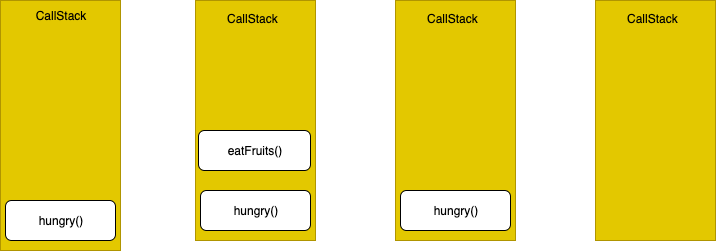
What is the event queue
The event queue follows the queue data structure. It stores async callbacks to be added to the call stack. It is also known as the Callback Queue or Macrotask Queue.
Whenever the call stack receives an async function, it is moved into the Web API. Based on the function, Web API executes it and awaits the result. Once it is finished, it moves the callback into the event queue (the callback of a promise is moved into the microtask queue).
The event loop constantly checks whether or not the call stack is empty. Once the call stack is empty and there is a callback in the event queue, the event loop moves the callback into the call stack. But if there is a callback in the microtask queue as well, it is moved first. The microtask queue has a higher priority than the event queue.
What is a decorator
A decorator is an expression that evaluates to a function and that takes the target, name, and decorator descriptor as arguments. Also, it optionally returns a decorator descriptor to install on the target object. Let's define admin decorator for user class at design time,
function admin(isAdmin) {
   return function(target) {
       target.isAdmin = isAdmin;
   }
}

@admin(true)
class User() {
}
console.log(User.isAdmin); //true

 @admin(false)
 class User() {
 }
 console.log(User.isAdmin); //false
What are the properties of the Intl object
Below are the list of properties available on the Intl object,
- Collator: These are the objects that enable language-sensitive string comparison.
- DateTimeFormat: These are the objects that enable language-sensitive date and time formatting.
- ListFormat: These are the objects that enable language-sensitive list formatting.
- NumberFormat: Objects that enable language-sensitive number formatting.
- PluralRules: Objects that enable plural-sensitive formatting and language-specific rules for plurals.
- RelativeTimeFormat: Objects that enable language-sensitive relative time formatting.
What is an Unary operator
The unary(+) operator is used to convert a variable to a number.If the variable cannot be converted, it will still become a number but with the value NaN. Let's see this behavior in an action.
var x = "100";
var y = +x;
console.log(typeof x, typeof y); // string, number

var a = "Hello";
var b = +a;
console.log(typeof a, typeof b, b); // string, number, NaN
How do you sort elements in an array
The sort() method is used to sort the elements of an array in place and returns the sorted array. The default sort order is ascending, based on the string Unicode order. The example usage would be as below,
var months = ["Aug", "Sep", "Jan", "June"];
months.sort();
console.log(months); //  ["Aug", "Jan", "June", "Sep"]
Beware: sort() is changing the original array.
What is the purpose of compareFunction while sorting arrays
The compareFunction is used to define the sort order. If omitted, the array elements are converted to strings, then sorted according to each character's Unicode code point value.
Let's take an example to see the usage of compareFunction,
let numbers = [1, 2, 5, 3, 4];
numbers.sort((a, b) => b - a);
console.log(numbers); // [5, 4, 3, 2, 1]
How do you reverse an array
You can use the reverse() method to reverse the elements in an array. This method is useful to sort an array in descending order. Let's see the usage of reverse() method in an example,
let numbers = [1, 2, 5, 3, 4];
numbers.sort((a, b) => b - a);
numbers.reverse();
console.log(numbers); // [1, 2, 3, 4 ,5]
How do you find the min and max values in an array
You can use Math.min and Math.max methods on array variables to find the minimum and maximum elements within an array. Let's create two functions to find the min and max value with in an array,
var marks = [50, 20, 70, 60, 45, 30];
function findMin(arr) {
  return Math.min.apply(null, arr);
}
function findMax(arr) {
  return Math.max.apply(null, arr);
}

console.log(findMin(marks));
console.log(findMax(marks));
How do you find the min and max values without Math functions
You can write functions which loop through an array comparing each value with the lowest value or highest value to find the min and max values. Let's create those functions to find min and max values,
var marks = [50, 20, 70, 60, 45, 30];
function findMin(arr) {
  var length = arr.length;
  var min = Infinity;
  while (length--) {
    if (arr[length] < min) {
      min = arr[length];
    }
  }
  return min;
}

function findMax(arr) {
  var length = arr.length;
  var max = -Infinity;
  while (length--) {
    if (arr[length] > max) {
      max = arr[length];
    }
  }
  return max;
}

console.log(findMin(marks));
console.log(findMax(marks));
What is an empty statement and purpose of it
The empty statement is a semicolon (;) indicating that no statement will be executed, even if JavaScript syntax requires one. Since there is no action with an empty statement you might think that it's usage is quite less, but the empty statement is occasionally useful when you want to create a loop that has an empty body. For example, you can initialize an array with zero values as below,
// Initialize an array a
for (let i = 0; i < a.length; a[i++] = 0);
How do you get the metadata of a module
You can use the import.meta object which is a meta-property exposing context-specific meta data to a JavaScript module. It contains information about the current module, such as the module's URL. In browsers, you might get different meta data than NodeJS.
<script type="module" src="welcome-module.js"></script>;
console.log(import.meta); // { url: "file:///home/user/welcome-module.js" }
What is the comma operator
The comma operator is used to evaluate each of its operands from left to right and returns the value of the last operand. This is totally different from comma usage within arrays, objects, and function arguments and parameters. For example, the usage for numeric expressions would be as below,
var x = 1;
x = (x++, x);

console.log(x); // 2
What is the advantage of the comma operator
It is normally used to include multiple expressions in a location that requires a single expression. One of the common usages of this comma operator is to supply multiple parameters in a for loop. For example, the below for loop uses multiple expressions in a single location using comma operator,
for (var a = 0, b =10; a <= 10; a++, b--)
You can also use the comma operator in a return statement where it processes before returning.
function myFunction() {
  var a = 1;
  return (a += 10), a; // 11
}
What is typescript
TypeScript is a typed superset of JavaScript created by Microsoft that adds optional types, classes and many other features, and compiles to plain JavaScript. Angular is built entirely in TypeScript and it is used as the primary language there. You can install it globally as
npm install -g typescript
Let's see a simple example of TypeScript usage,
function greeting(name: string): string {
  return "Hello, " + name;
}

let user = "Sudheer";

console.log(greeting(user));
The greeting method allows only string type as argument.
What are the differences between javascript and typescript
Below are the list of differences between javascript and typescript,
| feature | typescript | javascript |
|---|---|---|
| Language paradigm | Object oriented programming language | Multi-paradigm language |
| Typing support | Supports static typing | Dynamic typing |
| Modules | Supported | Not supported |
| Interface | It has interfaces concept | Doesn't support interfaces |
| Optional parameters | Functions support optional parameters | No support of optional parameters for functions |
What are the advantages of typescript over javascript
Below are some of the advantages of typescript over javascript,
- TypeScript is able to find compile time errors at the development time only and it makes sures less runtime errors. Whereas javascript is an interpreted language.
- TypeScript is strongly-typed or supports static typing which allows for checking type correctness at compile time. This is not available in javascript.
- TypeScript compiler can compile the .ts files into ES3,ES4 and ES5 unlike ES6 features of javascript which may not be supported in some browsers.
What is an object initializer
An object initializer is an expression that describes the initialization of an Object. The syntax for this expression is represented as a comma-delimited list of zero or more pairs of property names and associated values of an object, enclosed in curly braces ({}). This is also known as literal notation. It is one of the ways to create an object.
var initObject = { a: "John", b: 50, c: {} };

console.log(initObject.a); // John
What is a constructor method
The constructor method is a special method for creating and initializing an object created within a class. If you do not specify a constructor method, a default constructor is used. The example usage of constructor would be as below,
class Employee {
  constructor() {
    this.name = "John";
  }
}

var employeeObject = new Employee();

console.log(employeeObject.name); // John
What happens if you write constructor more than once in a class
The "constructor" in a class is a special method and it should be defined only once in a class. i.e, If you write a constructor method more than once in a class it will throw a SyntaxError error.
 class Employee {
   constructor() {
     this.name = "John";
   }
   constructor() {   //  Uncaught SyntaxError: A class may only have one constructor
     this.age = 30;
   }
 }

 var employeeObject = new Employee();

 console.log(employeeObject.name);
This constructor is called by using the special function call new (see example above).
How do you call the constructor of a parent class
You can use the super keyword to call the constructor of a parent class. Remember that super() must be called before using this reference. Otherwise it will cause a reference error. Let's the usage of it,
class Square extends Rectangle {
  constructor(length) {
    super(length, length);
    this.name = "Square";
  }

  get area() {
    return this.width * this.height;
  }

  set area(value) {
    this.area = value;
  }
}
How do you get the prototype of an object
You can use the Object.getPrototypeOf(obj) method to return the prototype of the specified object. i.e. The value of the internal prototype property. If there are no inherited properties then null value is returned.
const newPrototype = {};
const newObject = Object.create(newPrototype);

console.log(Object.getPrototypeOf(newObject) === newPrototype); // true
What happens If I pass string type for getPrototype method
In ES5, it will throw a TypeError exception if the obj parameter isn't an object. Whereas in ES2015, the parameter will be coerced to an Object.
// ES5
Object.getPrototypeOf("James"); // TypeError: "James" is not an object
// ES2015
Object.getPrototypeOf("James"); // String.prototype
How do you set the prototype of one object to another
You can use the Object.setPrototypeOf() method that sets the prototype (i.e., the internal Prototype property) of a specified object to another object or null. For example, if you want to set prototype of a square object to rectangle object would be as follows,
Object.setPrototypeOf(Square.prototype, Rectangle.prototype);
Object.setPrototypeOf({}, null);
How do you check whether an object can be extended or not
The Object.isExtensible() method is used to determine if an object is extendable or not. i.e, Whether it can have new properties added to it or not.
const newObject = {};
console.log(Object.isExtensible(newObject)); //true
Note: By default, all the objects are extendable. i.e, The new properties can be added or modified.
How do you prevent an object from being extend
The Object.preventExtensions() method is used to prevent new properties from ever being added to an object. In other words, it prevents future extensions to the object. Let's see the usage of this property,
const newObject = {};
Object.preventExtensions(newObject); // NOT extendable

try {
  Object.defineProperty(newObject, "newProperty", {
    // Adding new property
    value: 100,
  });
} catch (e) {
  console.log(e); // TypeError: Cannot define property newProperty, object is not extensible
}
What are the different ways to make an object non-extensible
You can mark an object non-extensible in 3 ways,
Object.preventExtensionsObject.sealObject.freeze
var newObject = {};

Object.preventExtensions(newObject); // Prevent objects are non-extensible
Object.isExtensible(newObject); // false

var sealedObject = Object.seal({}); // Sealed objects are non-extensible
Object.isExtensible(sealedObject); // false

var frozenObject = Object.freeze({}); // Frozen objects are non-extensible
Object.isExtensible(frozenObject); // false
How do you define multiple properties on an object
The Object.defineProperties() method is used to define new or modify existing properties directly on an object and returning the object. Let's define multiple properties on an empty object,
const newObject = {};

Object.defineProperties(newObject, {
  newProperty1: {
    value: "John",
    writable: true,
  },
  newProperty2: {},
});
What is the MEAN stack
The MEAN (MongoDB, Express, AngularJS, and Node.js) stack is the most popular open-source JavaScript software tech stack available for building dynamic web apps where you can write both the server-side and client-side halves of the web project entirely in JavaScript.
What is obfuscation in javascript
Obfuscation is the deliberate act of creating obfuscated javascript code(i.e, source or machine code) that is difficult for humans to understand. It is something similar to encryption, but a machine can understand the code and execute it. Let's see the below function before Obfuscation,
function greeting() {
  console.log("Hello, welcome to JS world");
}
And after the code Obfuscation, it would be appeared as below,
eval(
  (function (p, a, c, k, e, d) {
    e = function (c) {
      return c;
    };
    if (!"".replace(/^/, String)) {
      while (c--) {
        d[c] = k[c] || c;
      }
      k = [
        function (e) {
          return d[e];
        },
      ];
      e = function () {
        return "\\w+";
      };
      c = 1;
    }
    while (c--) {
      if (k[c]) {
        p = p.replace(new RegExp("\\b" + e(c) + "\\b", "g"), k[c]);
      }
    }
    return p;
  })(
    "2 1(){0.3('4, 7 6 5 8')}",
    9,
    9,
    "console|greeting|function|log|Hello|JS|to|welcome|world".split("|"),
    0,
    {}
  )
);
Why do you need Obfuscation
Below are the few reasons for Obfuscation,
- The Code size will be reduced. So data transfers between server and client will be fast.
- It hides the business logic from outside world and protects the code from others
- Reverse engineering is highly difficult
- The download time will be reduced
What is Minification
Minification is the process of removing all unnecessary characters(empty spaces are removed) and variables will be renamed without changing it's functionality. It is also a type of obfuscation .
What are the advantages of minification
Normally it is recommended to use minification for heavy traffic and intensive requirements of resources. It reduces file sizes with below benefits,
- Decreases loading times of a web page
- Saves bandwidth usages
What are the differences between obfuscation and Encryption
Below are the main differences between obfuscation and encryption,
| Feature | Obfuscation | Encryption |
|---|---|---|
| Definition | Changing the form of any data in any other form | Changing the form of information to an unreadable format by using a key |
| A key to decode | It can be decoded without any key | It is required |
| Target data format | It will be converted to a complex form | Converted into an unreadable format |
What are the common tools used for minification
There are many online/offline tools to minify the javascript files,
- Google's Closure Compiler
- UglifyJS2
- jsmin
- javascript-minifier.com/
- prettydiff.com
How do you perform form validation using javascript
JavaScript can be used to perform HTML form validation. For example, if the form field is empty, the function needs to notify, and return false, to prevent the form being submitted. Let's perform user login in an html form,
<form name="myForm" onsubmit="return validateForm()" method="post">
User name:
<input type="text" name="uname" />
<input type="submit" value="Submit" />
</form>
And the validation on user login is below,
function validateForm() {
var x = document.forms["myForm"]["uname"].value;
if (x == "") {
alert("The username shouldn't be empty");
return false;
}
}
How do you perform form validation without javascript
You can perform HTML form validation automatically without using javascript. The validation enabled by applying the required attribute to prevent form submission when the input is empty.
<form method="post">
<input type="text" name="uname" required />
<input type="submit" value="Submit" />
</form>
Note: Automatic form validation does not work in Internet Explorer 9 or earlier.
What are the DOM methods available for constraint validation
The below DOM methods are available for constraint validation on an invalid input,
checkValidity(): It returns true if an input element contains valid data.setCustomValidity(): It is used to set thevalidationMessageproperty of an input element. Let's take an user login form with DOM validations
function myFunction() {
var userName = document.getElementById("uname");
if (!userName.checkValidity()) {
document.getElementById("message").innerHTML =
userName.validationMessage;
} else {
document.getElementById("message").innerHTML =
"Entered a valid username";
}
}
What are the available constraint validation DOM properties
Below are the list of some of the constraint validation DOM properties available,
validity: It provides a list of boolean properties related to the validity of an input element.validationMessage: It displays the message when the validity is false.willValidate: It indicates if an input element will be validated or not.
What are the validity properties
The validity property of an input element provides a set of properties related to the validity of data.
customError: It returns true, if a custom validity message is set.patternMismatch: It returns true, if an element's value does not match its pattern attribute.rangeOverflow: It returns true, if an element's value is greater than its max attribute.rangeUnderflow: It returns true, if an element's value is less than its min attribute.stepMismatch: It returns true, if an element's value is invalid according to step attribute.tooLong: It returns true, if an element's value exceeds its maxLength attribute.typeMismatch: It returns true, if an element's value is invalid according to type attribute.valueMissing: It returns true, if an element with a required attribute has no value.valid: It returns true, if an element's value is valid.
Give an example usage of the rangeOverflow property
If an element's value is greater than its max attribute then the rangeOverflow property is true. For example, the below form submission throws an error if the value is more than 100,
<input id="age" type="number" max="100" />
<button onclick="myOverflowFunction()">OK</button>
function myOverflowFunction() {
if (document.getElementById("age").validity.rangeOverflow) {
alert("The mentioned age is not allowed");
}
}
Are enums available in javascript
No, javascript does not natively support enums. But there are different kinds of solutions to simulate them even though they may not provide exact equivalents. For example, you can use freeze or seal on object,
var DaysEnum = Object.freeze({"monday":1, "tuesday":2, "wednesday":3, ...})
What is an enum
An enum is a type restricting variables to one value from a predefined set of constants. JavaScript has no enums but typescript provides built-in enum support.
enum Color {
RED, GREEN, BLUE
}
How do you list all properties of an object
You can use the Object.getOwnPropertyNames() method which returns an array of all properties found directly in a given object. Let's see the usage of this in an example below:
const newObject = {
a: 1,
b: 2,
c: 3,
};
console.log(Object.getOwnPropertyNames(newObject));
["a", "b", "c"];
How do you get property descriptors of an object
You can use the Object.getOwnPropertyDescriptors() method which returns all own property descriptors of a given object. The example usage of this method is below,
const newObject = {
a: 1,
b: 2,
c: 3,
};
const descriptorsObject = Object.getOwnPropertyDescriptors(newObject);
console.log(descriptorsObject.a.writable); //true
console.log(descriptorsObject.a.configurable); //true
console.log(descriptorsObject.a.enumerable); //true
console.log(descriptorsObject.a.value); // 1
What are the attributes provided by a property descriptor
A property descriptor is a record which has the following attributes
value: The value associated with the propertywritable: Determines whether the value associated with the property can be changed or notconfigurable: Returns true if the type of this property descriptor can be changed and if the property can be deleted from the corresponding object.enumerable: Determines whether the property appears during enumeration of the properties on the corresponding object or not.set: A function which serves as a setter for the propertyget: A function which serves as a getter for the property
How do you extend classes
The extends keyword is used in class declarations/expressions to create a class which is a child of another class. It can be used to subclass custom classes as well as built-in objects. The syntax would be as below,
class ChildClass extends ParentClass { ... }
Let's take an example of Square subclass from Polygon parent class,
class Square extends Rectangle {
constructor(length) {
super(length, length);
this.name = "Square";
}
get area() {
return this.width * this.height;
}
set area(value) {
this.area = value;
}
}
How do I modify the url without reloading the page
The window.location.href property will be helpful to modify the url but it reloads the page. HTML5 introduced the history.pushState() and history.replaceState() methods, which allow you to add and modify history entries, respectively. For example, you can use pushState as below,
window.history.pushState("page2", "Title", "/page2.html");
This mechanism is used by routing libraries of frameworks like React and Angular in order to simulate the behaviour of a multi-page-website, even though they are only SPA (Single Page Applications).
How do you check whether or not an array includes a particular value
The Array#includes() method is used to determine whether an array includes a particular value among its entries by returning either true or false. Let's see an example to find an element(numeric and string) within an array.
var numericArray = [1, 2, 3, 4];
console.log(numericArray.includes(3)); // true
var stringArray = ["green", "yellow", "blue"];
console.log(stringArray.includes("blue")); //true
How do you compare scalar arrays
You can use length and every method of arrays to compare two scalars (compared directly using ===) arrays. The combination of these expressions can give the expected result,
const arrayFirst = [1, 2, 3, 4, 5];
const arraySecond = [1, 2, 3, 4, 5];
console.log(
arrayFirst.length === arraySecond.length &&
arrayFirst.every((value, index) => value === arraySecond[index])
); // true
If you would like to compare arrays irrespective of order then you should sort them before,
const arrayFirst = [2, 3, 1, 4, 5];
const arraySecond = [1, 2, 3, 4, 5];
console.log(
arrayFirst.length === arraySecond.length &&
arrayFirst
.sort()
.every((value, index) => value === arraySecond[index])
); //true
How to get the value from get parameters
The new URL() object accepts the url string and searchParams property of this object can be used to access the get parameters.
let urlString = "http://www.some-domain.com/about.html?x=1&y=2&z=3"; //window.location.href
let url = new URL(urlString);
let parameterZ = url.searchParams.get("z");
console.log(parameterZ); // 3
How do you print numbers with commas as thousand separators
You can use the Number.prototype.toLocaleString() method which returns a string with a language-sensitive representation such as thousand separator, currency etc. of this number.
function convertToThousandFormat(x) {
return x.toLocaleString(); // 12,345.679
}
console.log(convertToThousandFormat(12345.6789));
What is the difference between java and javascript
Both are totally unrelated programming languages and no relation between them. Java is statically typed, compiled, runs on its own VM. Whereas JavaScript is dynamically typed, interpreted, and runs in a browser and nodejs environments. Let's see the major differences in a tabular format,
| Feature | Java | JavaScript |
|---|---|---|
| Typed | It's a strongly typed language | It's a dynamic typed language |
| Paradigm | Object oriented programming | Prototype based programming |
| Scoping | Block scoped | Function-scoped, block scoped since ES6 |
| Concurrency | Thread based | event based |
Does JavaScript support namespaces
JavaScript doesn’t support namespaces by default. So if you create any element (function, method, object, variable) then it becomes global and pollutes the global namespace. Let's take an example of defining two functions without any namespace,
function func1() {
console.log("This is a first definition");
}
function func1() {
console.log("This is a second definition");
}
func1(); // This is a second definition
It always calls the second function definition. In this case, namespaces will solve the name collision problem.
How do you declare a namespace
Even though JavaScript lacks namespaces, we can use Objects, an IIFE (Immediately Invoked Function Expression) or let/const to create namespaces.
-
Using Object Literal Notation: Let's wrap variables and functions inside an Object literal which acts as a namespace. After that you can access them using object notation
var namespaceOne = { function func1() { console.log("This is a first definition"); } } var namespaceTwo = { function func1() { console.log("This is a second definition"); } } namespaceOne.func1(); // This is a first definition namespaceTwo.func1(); // This is a second definition -
Using IIFE (Immediately invoked function expression): The outer pair of parentheses of IIFE creates a local scope for all the code inside of it and makes the anonymous function a function expression. Due to that, you can create the same function in two different function expressions to act as a namespace.
(function () { function fun1() { console.log("This is a first definition"); } fun1(); })(); (function () { function fun1() { console.log("This is a second definition"); } fun1(); })(); -
Using a block and a let/const declaration: In ECMAScript 6, you can simply use a block and a let declaration to restrict the scope of a variable to a block.
{ let myFunction = function fun1() { console.log("This is a first definition"); }; myFunction(); } //myFunction(): ReferenceError: myFunction is not defined. { let myFunction = function fun1() { console.log("This is a second definition"); }; myFunction(); } //myFunction(): ReferenceError: myFunction is not defined.
How do you invoke javascript code in an iframe from the parent page
Initially iFrame needs to be accessed using either document.getElementBy or window.frames. After that contentWindow property of iFrame gives the access for targetFunction
document.getElementById("targetFrame").contentWindow.targetFunction();
window.frames[0].frameElement.contentWindow.targetFunction(); // Accessing iframe this way may not work in latest versions chrome and firefox
How do you get the timezone offset of a date object
You can use the getTimezoneOffset method of the date object. This method returns the time zone difference, in minutes, from current locale (host system settings) to UTC
var offset = new Date().getTimezoneOffset();
console.log(offset); // -480
How do you load CSS and JS files dynamically
You can create both link and script elements in the DOM and append them as child to head tag. Let's create a function to add script and style resources as below,
function loadAssets(filename, filetype) {
if (filetype == "css") {
// External CSS file
var fileReference = document.createElement("link");
fileReference.setAttribute("rel", "stylesheet");
fileReference.setAttribute("type", "text/css");
fileReference.setAttribute("href", filename);
} else if (filetype == "js") {
// External JavaScript file
var fileReference = document.createElement("script");
fileReference.setAttribute("type", "text/javascript");
fileReference.setAttribute("src", filename);
}
if (typeof fileReference != "undefined")
document.getElementsByTagName("head")[0].appendChild(fileReference);
}
What are the different methods to find HTML elements in DOM
If you want to access any element in an HTML page, you need to start with accessing the document object. Later you can use any of the below methods to find the HTML element,
document.getElementById(id): It finds an element by Iddocument.getElementsByTagName(name): It finds an element by tag name (returns an node list)document.getElementsByClassName(name): It finds an element by class name (returns an node list)document.querySelector(cssSelector): It finds an element by css selectordocument.querySelectorAll(cssSelector): It finds all elements by css selector (returns a node list)
What is jQuery
jQuery is a popular cross-browser JavaScript library that provides Document Object Model (DOM) traversal, event handling, animations and AJAX interactions by minimizing the discrepancies across browsers. It is widely famous with its philosophy of “Write less, do more”. For example, you can display welcome message on the page load using jQuery as below,
$(document).ready(function () {
// It selects the document and apply the function on page load
alert("Welcome to jQuery world");
});
Note: You can download it from jquery's official site or install it from CDNs, like google.
What is V8 JavaScript engine
V8 is an open source high-performance JavaScript engine used by the Google Chrome browser, written in C++. It is also being used in the node.js project. It implements ECMAScript and WebAssembly, and runs on Windows 7 or later, macOS 10.12+, and Linux systems that use x64, IA-32, ARM, or MIPS processors. Note: It can run standalone, or can be embedded into any C++ application.
Why do we call javascript as dynamic language
JavaScript is a loosely typed or a dynamic language because variables in JavaScript are not directly associated with any particular value type, and any variable can be assigned/reassigned with values of all types.
let age = 50; // age is a number now
age = "old"; // age is a string now
age = true; // age is a boolean
What is a void operator
The void operator evaluates the given expression and then returns undefined (i.e, without returning value). The syntax would be as below,
void expression;
void expression;
Let's display a message without any redirection or reload
<a href="javascript:void(alert('Welcome to JS world'))">
Click here to see a message
</a>
Note: This operator is often used to obtain the undefined primitive value, using void(0). Also it can be used to call asynchronous functions without waiting for the result.
How to set the cursor to wait
The cursor can be set to wait in JavaScript by using the property cursor. Let's perform this behavior on page load using the below function.
function myFunction() {
window.document.body.style.cursor = "wait";
}
and this function invoked on page load
<body onload="myFunction()"></body>
How do you create an infinite loop
You can create infinite loops using for and while loops without using any expressions. The for loop construct or syntax is better approach in terms of ESLint and code optimizer tools,
for (;;) {}
while (true) {}
Why do you need to avoid with statement
JavaScript's with statement was intended to provide a shorthand for writing recurring accesses to objects. So it can help reduce file size by reducing the need to repeat a lengthy object reference without performance penalty. Let's take an example where it is used to avoid redundancy when accessing an object several times.
a.b.c.greeting = "welcome";
a.b.c.age = 32;
Using with it turns this into:
with (a.b.c) {
greeting = "welcome";
age = 32;
}
But this with statement creates performance problems since one cannot predict whether an argument will refer to a real variable or to a property inside the with argument.
What is the output of the following for loops
for (var i = 0; i < 4; i++) {
// global scope
setTimeout(() => console.log(i));
}
for (let i = 0; i < 4; i++) {
// block scope
setTimeout(() => console.log(i));
}
The output of the above for loops is 4 4 4 4 and 0 1 2 3
Explanation: Due to the event queue/loop of javascript, the setTimeout callback function is called after the loop has been executed. Since the variable i is declared with the var keyword it became a global variable and the value was equal to 4 using iteration when the time setTimeout function is invoked. Hence, the output of the second loop is 4 4 4 4.
Whereas in the second loop, the variable i is declared as the let keyword it becomes a block scoped variable and it holds a new value(0, 1 ,2 3) for each iteration. Hence, the output of the first loop is 0 1 2 3.
List down some of the features of ES6
Below are the list of some new features of ES6,
- Support for constants or immutable variables
- Block-scope support for variables, constants and functions
- Arrow functions
- Default parameters
- Rest and Spread Parameters
- Template Literals
- Multi-line Strings
- Destructuring Assignment
- Enhanced Object Literals
- Promises
- Classes
- Modules
What is ES6
ES6 is the sixth edition of the javascript language and it was released in June 2015. It was initially known as ECMAScript 6 (ES6) and later renamed to ECMAScript 2015. Almost all the modern browsers support ES6 but for the old browsers there are many transpilers, like Babel.js etc.
Can I redeclare let and const variables
No, you cannot redeclare let and const variables. If you do, it throws below error
Uncaught SyntaxError: Identifier 'someVariable' has already been declared
Explanation: The variable declaration with var keyword refers to a function scope and the variable is treated as if it were declared at the top of the enclosing scope due to hoisting feature. So all the multiple declarations contributing to the same hoisted variable without any error. Let's take an example of re-declaring variables in the same scope for both var and let/const variables.
var name = "John";
function myFunc() {
var name = "Nick";
var name = "Abraham"; // Re-assigned in the same function block
alert(name); // Abraham
}
myFunc();
alert(name); // John
The block-scoped multi-declaration throws syntax error,
let name = "John";
function myFunc() {
let name = "Nick";
let name = "Abraham"; // Uncaught SyntaxError: Identifier 'name' has already been declared
alert(name);
}
myFunc();
alert(name);
Does the `const` variable make the value immutable
No, the const variable doesn't make the value immutable. But it disallows subsequent assignments(i.e, You can declare with assignment but can't assign another value later)
const userList = [];
userList.push("John"); // Can mutate even though it can't re-assign
console.log(userList); // ['John']
What are default parameters
In ES5, we need to depend on logical OR operators to handle default values of function parameters. Whereas in ES6, Default function parameters feature allows parameters to be initialized with default values if no value or undefined is passed. Let's compare the behavior with an examples,
//ES5
var calculateArea = function (height, width) {
height = height || 50;
width = width || 60;
return width * height;
};
console.log(calculateArea()); //300
The default parameters makes the initialization more simpler,
//ES6
var calculateArea = function (height = 50, width = 60) {
return width * height;
};
console.log(calculateArea()); //300
What are template literals
Template literals or template strings are string literals allowing embedded expressions. These are enclosed by the back-tick (`) character instead of double or single quotes. In ES6, this feature enables using dynamic expressions as below,
var greeting = `Welcome to JS World, Mr. ${firstName} ${lastName}.`;
In ES5, you need break string like below,
var greeting = 'Welcome to JS World, Mr. ' + firstName + ' ' + lastName.`
Note: You can use multi-line strings and string interpolation features with template literals.
How do you write multi-line strings in template literals
In ES5, you would have to use newline escape characters('\n') and concatenation symbols(+) in order to get multi-line strings.
console.log("This is string sentence 1\n" + "This is string sentence 2");
Whereas in ES6, You don't need to mention any newline sequence character,
console.log(`This is string sentence
'This is string sentence 2`);
What are nesting templates
The nesting template is a feature supported within template literals syntax to allow inner backticks inside a placeholder ${ } within the template. For example, the below nesting template is used to display the icons based on user permissions whereas outer template checks for platform type,
const iconStyles = `icon ${
isMobilePlatform()
? ""
: `icon-${user.isAuthorized ? "submit" : "disabled"}`
}`;
You can write the above use case without nesting template features as well. However, the nesting template feature is more compact and readable.
//Without nesting templates
const iconStyles = `icon ${
isMobilePlatform()
? ""
: user.isAuthorized
? "icon-submit"
: "icon-disabled"
}`;
What are tagged templates
Tagged templates are the advanced form of templates in which tags allow you to parse template literals with a function. The tag function accepts the first parameter as an array of strings and remaining parameters as expressions. This function can also return manipulated strings based on parameters. Let's see the usage of this tagged template behavior of an IT professional skill set in an organization,
var user1 = "John";
var skill1 = "JavaScript";
var experience1 = 15;
var user2 = "Kane";
var skill2 = "JavaScript";
var experience2 = 5;
function myInfoTag(strings, userExp, experienceExp, skillExp) {
var str0 = strings[0]; // "Mr/Ms. "
var str1 = strings[1]; // " is a/an "
var str2 = strings[2]; // "in"
var expertiseStr;
if (experienceExp > 10) {
expertiseStr = "expert developer";
} else if (skillExp > 5 && skillExp <= 10) {
expertiseStr = "senior developer";
} else {
expertiseStr = "junior developer";
}
return `${str0}${userExp}${str1}${expertiseStr}${str2}${skillExp}`;
}
var output1 = myInfoTag`Mr/Ms. ${user1} is a/an ${experience1} in ${skill1}`;
var output2 = myInfoTag`Mr/Ms. ${user2} is a/an ${experience2} in ${skill2}`;
console.log(output1); // Mr/Ms. John is a/an expert developer in JavaScript
console.log(output2); // Mr/Ms. Kane is a/an junior developer in JavaScript
What are raw strings
ES6 provides a raw strings feature using the String.raw() method which is used to get the raw string form of template strings. This feature allows you to access the raw strings as they were entered, without processing escape sequences. For example, the usage would be as below,
var calculationString = String.raw`The sum of numbers is \n${
1 + 2 + 3 + 4
}!`;
console.log(calculationString); // The sum of numbers is \n10!
If you don't use raw strings, the newline character sequence will be processed by displaying the output in multiple lines
var calculationString = `The sum of numbers is \n${1 + 2 + 3 + 4}!`;
console.log(calculationString);
// The sum of numbers is
// 10!
Also, the raw property is available on the first argument to the tag function
function tag(strings) {
console.log(strings.raw[0]);
}
What is destructuring assignment
The destructuring assignment is a JavaScript expression that makes it possible to unpack values from arrays or properties from objects into distinct variables. Let's get the month values from an array using destructuring assignment
var [one, two, three] = ["JAN", "FEB", "MARCH"];
console.log(one); // "JAN"
console.log(two); // "FEB"
console.log(three); // "MARCH"
and you can get user properties of an object using destructuring assignment,
var { name, age } = { name: "John", age: 32 };
console.log(name); // John
console.log(age); // 32
What are default values in destructuring assignment
A variable can be assigned a default value when the value unpacked from the array or object is undefined during destructuring assignment. It helps to avoid setting default values separately for each assignment. Let's take an example for both arrays and object use cases,
Arrays destructuring:
var x, y, z;
[x = 2, y = 4, z = 6] = [10];
console.log(x); // 10
console.log(y); // 4
console.log(z); // 6
Objects destructuring:
var { x = 2, y = 4, z = 6 } = { x: 10 };
console.log(x); // 10
console.log(y); // 4
console.log(z); // 6
How do you swap variables in destructuring assignment
If you don't use destructuring assignment, swapping two values requires a temporary variable. Whereas using a destructuring feature, two variable values can be swapped in one destructuring expression. Let's swap two number variables in array destructuring assignment,
var x = 10,
y = 20;
[x, y] = [y, x];
console.log(x); // 20
console.log(y); // 10
What are enhanced object literals
Object literals make it easy to quickly create objects with properties inside the curly braces. For example, it provides shorter syntax for common object property definition as below.
//ES6
var x = 10,
y = 20;
obj = { x, y };
console.log(obj); // {x: 10, y:20}
//ES5
var x = 10,
y = 20;
obj = { x: x, y: y };
console.log(obj); // {x: 10, y:20}
What are dynamic imports
The dynamic imports using import() function syntax allows us to load modules on demand by using promises or the async/await syntax. Currently this feature is in stage4 proposal. The main advantage of dynamic imports is reduction of our bundle's sizes, the size/payload response of our requests and overall improvements in the user experience.
The syntax of dynamic imports would be as below,
import("./Module").then((Module) => Module.method());
What are the use cases for dynamic imports
Below are some of the use cases of using dynamic imports over static imports,
-
Import a module on-demand or conditionally. For example, if you want to load a polyfill on legacy browser
if (isLegacyBrowser()) { import(···) .then(···); } -
Compute the module specifier at runtime. For example, you can use it for internationalization.
import(`messages_${getLocale()}.js`).then(···); -
Import a module from within a regular script instead a module.
What are typed arrays
Typed arrays are array-like objects from ECMAScript 6 API for handling binary data. JavaScript provides 12 Typed array types,
- Int8Array: An array of 8-bit signed integers
- Uint8Array: An array of 8-bit unsigned integers
- Uint8ClampedArray: An array of 8-bit unsigned integers clamped to 0-255
- Int16Array: An array of 16-bit signed integers
- Uint16Array: An array of 16-bit unsigned integers
- Int32Array: An array of 32-bit signed integers
- Uint32Array: An array of 32-bit unsigned integers
- BigInt64Array: An array of 64-bit signed BigInts
- BigUint64Array: An array of 64-bit unsigned BigInts
- Float16Array: An array of 16-bit floating point numbers
- Float32Array: An array of 32-bit floating point numbers
- Float64Array: An array of 64-bit floating point numbers
For example, you can create an array of 8-bit signed integers as below
const a = new Int8Array();
// You can pre-allocate n bytes
const bytes = 1024;
const a = new Int8Array(bytes);
What are the advantages of module loaders
The module loaders provides the below features,
- Dynamic loading
- State isolation
- Global namespace isolation
- Compilation hooks
- Nested virtualization
What is collation
Collation is used for sorting a set of strings and searching within a set of strings. It is parameterized by locale and aware of Unicode. Let's take comparison and sorting features,
- Comparison:
var list = ["ä", "a", "z"]; // In German, "ä" sorts with "a" Whereas in Swedish, "ä" sorts after "z"
var l10nDE = new Intl.Collator("de");
var l10nSV = new Intl.Collator("sv");
console.log(l10nDE.compare("ä", "z") === -1); // true
console.log(l10nSV.compare("ä", "z") === +1); // true
- Sorting:
var list = ["ä", "a", "z"]; // In German, "ä" sorts with "a" Whereas in Swedish, "ä" sorts after "z"
var l10nDE = new Intl.Collator("de");
var l10nSV = new Intl.Collator("sv");
console.log(list.sort(l10nDE.compare)); // [ "a", "ä", "z" ]
console.log(list.sort(l10nSV.compare)); // [ "a", "z", "ä" ]
What is for...of statement
The for...of statement creates a loop iterating over iterable objects or elements such as built-in String, Array, Array-like objects (like arguments or NodeList), TypedArray, Map, Set, and user-defined iterables. The basic usage of for...of statement on arrays would be as below,
let arrayIterable = [10, 20, 30, 40, 50];
for (let value of arrayIterable) {
value++;
console.log(value); // 11 21 31 41 51
}
What is the output of below spread operator array
[..."John Resig"];
The output of the array is ['J', 'o', 'h', 'n', ' ', 'R', 'e', 's', 'i', 'g']
Explanation: The string is an iterable type and the spread operator within an array maps every character of an iterable to one element. Hence, each character of a string becomes an element within an Array.
Is PostMessage secure
Yes, postMessages can be considered very secure as long as the programmer/developer is careful about checking the origin and source of an arriving message. But if you try to send/receive a message without verifying its source will create cross-site scripting attacks.
What are the problems with postmessage target origin as wildcard
The second argument of postMessage method specifies which origin is allowed to receive the message. If you use the wildcard “*” as an argument then any origin is allowed to receive the message. In this case, there is no way for the sender window to know if the target window is at the target origin when sending the message. If the target window has been navigated to another origin, the other origin would receive the data. Hence, this may lead to XSS vulnerabilities.
targetWindow.postMessage(message, "*");
How do you avoid receiving postMessages from attackers
Since the listener listens for any message, an attacker can trick the application by sending a message from the attacker’s origin, which gives an impression that the receiver received the message from the actual sender’s window. You can avoid this issue by validating the origin of the message on the receiver's end using the “message.origin” attribute.
For example, let's check the sender's origin http://www.some-sender.com on receiver side www.some-receiver.com,
//Listener on http://www.some-receiver.com/
window.addEventListener("message", function(message){
if(/^http://www\.some-sender\.com$/.test(message.origin)){
console.log('You received the data from valid sender', message.data);
}
});
Can I avoid using postMessages completely
You cannot avoid using postMessages completely(or 100%). Even though your application doesn’t use postMessage considering the risks, a lot of third party scripts use postMessage to communicate with the third party service. So your application might be using postMessage without your knowledge.
Is postMessages synchronous
The postMessages are synchronous in IE8 browser but they are asynchronous in IE9 and all other modern browsers (i.e, IE9+, Firefox, Chrome, Safari).Due to this asynchronous behaviour, we use a callback mechanism when the postMessage is returned.
What paradigm is Javascript
JavaScript is a multi-paradigm language, supporting imperative/procedural programming, Object-Oriented Programming and functional programming. JavaScript supports Object-Oriented Programming with prototypical inheritance.
What is the difference between internal and external javascript
Internal JavaScript: It is the source code within the script tag. External JavaScript: The source code is stored in an external file(stored with .js extension) and referred with in the tag.
Is JavaScript faster than server side script
Yes, JavaScript is faster than server side scripts. Because JavaScript is a client-side script it does not require any web server’s help for its computation or calculation. So JavaScript is always faster than any server-side script like ASP, PHP, etc.
How do you get the status of a checkbox
You can apply the checked property on the selected checkbox in the DOM. If the value is true it means the checkbox is checked, otherwise it is unchecked. For example, the below HTML checkbox element can be access using javascript as below:
<input type="checkbox" id="checkboxname" value="Agree" />
Agree the conditions
<br />
console.log(document.getElementById(‘checkboxname’).checked); // true or false
What is the purpose of double tilde operator
The double tilde operator(~~) is known as double NOT bitwise operator. This operator is a slightly quicker substitute for Math.floor().
How do you convert character to ASCII code
You can use the String.prototype.charCodeAt() method to convert string characters to ASCII numbers. For example, let's find ASCII code for the first letter of 'ABC' string,
"ABC".charCodeAt(0); // returns 65
Whereas String.fromCharCode() method converts numbers to equal ASCII characters.
String.fromCharCode(65, 66, 67); // returns 'ABC'
What is ArrayBuffer
An ArrayBuffer object is used to represent a generic, fixed-length raw binary data buffer. You can create it as below,
let buffer = new ArrayBuffer(16); // create a buffer of length 16
alert(buffer.byteLength); // 16
To manipulate an ArrayBuffer, we need to use a “view” object.
//Create a DataView referring to the buffer
let view = new DataView(buffer);
What is the output of below string expression
console.log("Welcome to JS world"[0]);
The output of the above expression is "W". Explanation: The bracket notation with specific index on a string returns the character at a specific location. Hence, it returns the character "W" of the string. Since this is not supported in IE7 and below versions, you may need to use the .charAt() method to get the desired result.
What is the purpose of Error object
The Error constructor creates an error object and the instances of error objects are thrown when runtime errors occur. The Error object can also be used as a base object for user-defined exceptions. The syntax of error object would be as below,
new Error([message[, fileName[, lineNumber]]])
You can throw user defined exceptions or errors using Error object in try...catch block as below,
try {
if (withdraw > balance)
throw new Error("Oops! You don't have enough balance");
} catch (e) {
console.log(e.name + ": " + e.message);
}
What is the purpose of EvalError object
The EvalError object indicates an error regarding the global eval() function. Even though this exception is not thrown by JavaScript anymore, the EvalError object remains for compatibility. The syntax of this expression would be as below,
new EvalError([message[, fileName[, lineNumber]]])
You can throw EvalError with in try...catch block as below,
try {
throw new EvalError('Eval function error', 'someFile.js', 100);
} catch (e) {
console.log(e.message, e.name, e.fileName); // "Eval function error", "EvalError", "someFile.js"
What are the list of cases error thrown from non-strict mode to strict mode
When you apply 'use strict'; syntax, some of the below cases will throw a SyntaxError before executing the script
- When you use Octal syntax
var n = 022;
- Using
withstatement - When you use delete operator on a variable name
- Using eval or arguments as variable or function argument name
- When you use newly reserved keywords
- When you declare a function in a block and access it from outside of the block
if (someCondition) {
function f() {}
}
f(); // ReferenceError: f is not defined
Hence, the errors from above cases are helpful to avoid errors in development/production environments.
Do all objects have prototypes
No. All objects have prototypes except two exceptions:
- Object.prototype itself — This is the base object in the prototype chain, and its prototype is
null. - Objects created with
**Object.create(null)**— These are deliberately created with no prototype, so they don’t inherit fromObject.prototype.
All other standard objects do have a prototype.
What is the difference between a parameter and an argument
Parameter is the variable name of a function definition whereas an argument represents the value given to a function when it is invoked. Let's explain this with a simple function
function myFunction(parameter1, parameter2, parameter3) {
console.log(arguments[0]); // "argument1"
console.log(arguments[1]); // "argument2"
console.log(arguments[2]); // "argument3"
}
myFunction("argument1", "argument2", "argument3");
What is the purpose of some method in arrays
The some() method is used to test whether at least one element in the array passes the test implemented by the provided function. The method returns a boolean value. Let's take an example to test for any odd elements,
var array = [1, 2, 3, 4, 5, 6, 7, 8, 9, 10];
var odd = (element) => element % 2 !== 0;
console.log(array.some(odd)); // true (the odd element exists)
How do you combine two or more arrays
The concat() method is used to join two or more arrays by returning a new array containing all the elements. The syntax would be as below,
array1.concat(array2, array3, ..., arrayX)
Let's take an example of array's concatenation with veggies and fruits arrays,
var veggies = ["Tomato", "Carrot", "Cabbage"];
var fruits = ["Apple", "Orange", "Pears"];
var veggiesAndFruits = veggies.concat(fruits);
console.log(veggiesAndFruits); // Tomato, Carrot, Cabbage, Apple, Orange, Pears
What is the difference between Shallow and Deep copy
There are two ways to copy an object,
Shallow Copy: Shallow copy is a bitwise copy of an object. A new object is created that has an exact copy of the values in the original object. If any of the fields of the object are references to other objects, just the reference addresses are copied i.e., only the memory address is copied.
Example
var empDetails = {
name: "John",
age: 25,
expertise: "Software Developer",
};
to create a duplicate
var empDetailsShallowCopy = empDetails; //Shallow copying!
if we change some property value in the duplicate one like this:
empDetailsShallowCopy.name = "Johnson";
The above statement will also change the name of empDetails, since we have a shallow copy. That means we're losing the original data as well.
Deep copy: A deep copy copies all fields, and makes copies of dynamically allocated memory pointed to by the fields. A deep copy occurs when an object is copied along with the objects to which it refers.
Example
var empDetails = {
name: "John",
age: 25,
expertise: "Software Developer",
};
Create a deep copy by using the properties from the original object into new variable
var empDetailsDeepCopy = {
name: empDetails.name,
age: empDetails.age,
expertise: empDetails.expertise,
};
Now if you change empDetailsDeepCopy.name, it will only affect empDetailsDeepCopy & not empDetails
How do you create specific number of copies of a string
The repeat() method is used to construct and return a new string which contains the specified number of copies of the string on which it was called, concatenated together. Remember that this method has been added to the ECMAScript 2015 specification.
Let's take an example of Hello string to repeat it 4 times,
"Hello".repeat(4); // 'HelloHelloHelloHello'
How do you return all matching strings against a regular expression
The matchAll() method can be used to return an iterator of all results matching a string against a regular expression. For example, the below example returns an array of matching string results against a regular expression,
let regexp = /Hello(\d?)/g;
let greeting = "Hello1Hello2Hello3";
let greetingList = [...greeting.matchAll(regexp)];
console.log(greetingList[0][0]); //Hello1
console.log(greetingList[1][0]); //Hello2
console.log(greetingList[2][0]); //Hello3
How do you trim a string at the beginning or ending
The trim method of string prototype is used to trim on both sides of a string. But if you want to trim especially at the beginning or ending of the string then you can use trimStart/trimLeft and trimEnd/trimRight methods. Let's see an example of these methods on a greeting message,
var greeting = " Hello, Goodmorning! ";
console.log(greeting); // " Hello, Goodmorning! "
console.log(greeting.trimStart()); // "Hello, Goodmorning! "
console.log(greeting.trimLeft()); // "Hello, Goodmorning! "
console.log(greeting.trimEnd()); // " Hello, Goodmorning!"
console.log(greeting.trimRight()); // " Hello, Goodmorning!"
What is the output of below console statement with unary operator
Let's take console statement with unary operator as given below,
console.log(+"Hello"); // NaN
The output of the above console log statement returns NaN. Because the element is prefixed by the unary operator and the JavaScript interpreter will try to convert that element into a number type. Since the conversion fails, the value of the statement results in NaN value.
Does javascript uses mixins
JavaScript does not have built-in support for mixins as a formal language feature. However, developers commonly implement mixins using various patterns to enable code reuse and composition.
A mixin is a way to add reusable functionality from one or more objects into a class or another object, without using classical inheritance. It promotes object composition by combining behaviors or properties from different sources into a single destination.
Mixin Example using Object composition
// Define a mixin
const canEat = {
eat() {
console.log("Eating...");
}
};
const canWalk = {
walk() {
console.log("Walking...");
}
};
const canRead = {
read() {
console.log("Reading...");
}
};
// Create a class
class Person {
constructor(name) {
this.name = name;
}
}
// Apply mixins
Object.assign(Person.prototype, canEat, canWalk, canRead);
// Use it
const person = new Person("Sudheer");
person.eat(); // Output: Eating...
person.walk(); // Output: Walking...
person.read(); // Output: Reading...
Benefits
-
Avoids deep inheritance hierarchies
- Encourages composition over inheritance
- Promotes reusable and modular code
Modern JavaScript favors mixin alternatives like composition, delegation, higher-order functions, and class mixins to promote reusable and modular code. Libraries like Lodash offer utilities for object composition, while frameworks like Vue.js provide built-in mixin features to promote reusable and modular code.
What is a thunk function
A thunk is just a function which delays the evaluation of the value. It doesn’t take any arguments but gives the value whenever you invoke the thunk. i.e, It is used not to execute now but it will be sometime in the future. Let's take a synchronous example,
const add = (x, y) => x + y;
const thunk = () => add(2, 3);
thunk(); // 5
What are asynchronous thunks
The asynchronous thunks are useful to make network requests. Let's see an example of network requests,
function fetchData(fn) {
fetch("https://jsonplaceholder.typicode.com/todos/1")
.then((response) => response.json())
.then((json) => fn(json));
}
const asyncThunk = function () {
return fetchData(function getData(data) {
console.log(data);
});
};
asyncThunk();
The getData function won't be called immediately but it will be invoked only when the data is available from API endpoint. The setTimeout function is also used to make our code asynchronous. The best real time example is redux state management library which uses the asynchronous thunks to delay the actions to dispatch.
What is the output of below function calls
Code snippet:
const circle = {
radius: 20,
diameter() {
return this.radius * 2;
},
perimeter: () => 2 * Math.PI * this?.radius,
};
console.log(circle.diameter());
console.log(circle.perimeter());
Output:
The output is 40 and NaN. Remember that diameter is a regular function, whereas the value of perimeter is an arrow function. The this keyword of a regular function(i.e, diameter) refers to the surrounding scope which is a class(i.e, Shape object). Whereas this keyword of perimeter function refers to the surrounding scope which is a window object. Since there is no radius property on window objects it returns an undefined value and the multiple of number value returns NaN value.
How to remove all line breaks from a string
The easiest approach is using regular expressions to detect and replace newlines in the string. In this case, we use replace function along with string to replace with, which in our case is an empty string.
function remove_linebreaks( var message ) {
return message.replace( /[\r\n]+/gm, "" );
}
In the above expression, g and m are for global and multiline flags.
What is the difference between reflow and repaint
A repaint occurs when changes are made which affect the visibility of an element, but not its layout. Examples of this include outline, visibility, or background color. A reflow involves changes that affect the layout of a portion of the page (or the whole page). Resizing the browser window, changing the font, content changing (such as user typing text), using JavaScript methods involving computed styles, adding or removing elements from the DOM, and changing an element's classes are a few of the things that can trigger reflow. Reflow of an element causes the subsequent reflow of all child and ancestor elements as well as any elements following it in the DOM.
What happens with negating an array
Negating an array with ! character will coerce the array into a boolean. Since Arrays are considered to be truthy So negating it will return false.
console.log(![]); // false
What happens if we add two arrays
If you add two arrays together, it will convert them both to strings and concatenate them. For example, the result of adding arrays would be as below,
console.log(["a"] + ["b"]); // "ab"
console.log([] + []); // ""
console.log(![] + []); // "false", because ![] returns false.
What is the output of prepend additive operator on falsy values
If you prepend the additive(+) operator on falsy values(null, undefined, NaN, false, ""), the falsy value converts to a number value zero. Let's display them on browser console as below,
console.log(+null); // 0
console.log(+undefined); // NaN
console.log(+false); // 0
console.log(+NaN); // NaN
console.log(+""); // 0
How do you create self string using special characters
The self string can be formed with the combination of []()!+ characters. You need to remember the below conventions to achieve this pattern.
- Since Arrays are truthful values, negating the arrays will produce false: ![] === false
- As per JavaScript coercion rules, the addition of arrays together will toString them: [] + [] === ""
- Prepend an array with + operator will convert an array to false, the negation will make it true and finally converting the result will produce value '1': +(!(+[])) === 1
By applying the above rules, we can derive below conditions
(![] + [] === "false" + !+[]) === 1;
Now the character pattern would be created as below,
s e l f
^^^^^^^^^^^^^ ^^^^^^^^^^^^^ ^^^^^^^^^^^^^ ^^^^^^^^^^^^^
(![] + [])[3] + (![] + [])[4] + (![] + [])[2] + (![] + [])[0]
^^^^^^^^^^^^^ ^^^^^^^^^^^^^ ^^^^^^^^^^^^^ ^^^^^^^^^^^^^
(![] + [])[+!+[]+!+[]+!+[]] +
(![] + [])[+!+[]+!+[]+!+[]+!+[]] +
(![] + [])[+!+[]+!+[]] +
(![] + [])[+[]]
^^^^^^^^^^^^^^^^^^^^^^^^^^^^^
(![]+[])[+!+[]+!+[]+!+[]]+(![]+[])[+!+[]+!+[]+!+[]+!+[]]+(![]+[])[+!+[]+!+[]]+(![]+[])[+[]]
How do you remove falsy values from an array
You can apply the filter method on the array by passing Boolean as a parameter. This way it removes all falsy values(0, undefined, null, false and "") from the array.
const myArray = [false, null, 1, 5, undefined];
myArray.filter(Boolean); // [1, 5] // is same as myArray.filter(x => x);
How do you get unique values of an array
You can get unique values of an array with the combination of Set and rest expression/spread(...) syntax.
console.log([...new Set([1, 2, 4, 4, 3])]); // [1, 2, 4, 3]
What is destructuring aliases
Sometimes you would like to have a destructured variable with a different name than the property name. In that case, you'll use a : newName to specify a name for the variable. This process is called destructuring aliases.
const obj = { x: 1 };
// Grabs obj.x as { otherName }
const { x: otherName } = obj;
How do you map the array values without using map method
You can map the array values without using the map method by just using the from method of Array. Let's map city names from Countries array,
const countries = [
{ name: "India", capital: "Delhi" },
{ name: "US", capital: "Washington" },
{ name: "Russia", capital: "Moscow" },
{ name: "Singapore", capital: "Singapore" },
{ name: "China", capital: "Beijing" },
{ name: "France", capital: "Paris" },
];
const cityNames = Array.from(countries, ({ capital }) => capital);
console.log(cityNames); // ['Delhi, 'Washington', 'Moscow', 'Singapore', 'Beijing', 'Paris']
How do you empty an array
You can empty an array quickly by setting the array length to zero.
let cities = ["Singapore", "Delhi", "London"];
cities.length = 0; // cities becomes []
How do you round numbers to certain decimals
You can round numbers to a certain number of decimals using toFixed method from native javascript.
let pie = 3.141592653;
pie = pie.toFixed(3); // 3.142
What is the easiest way to convert an array to an object
You can convert an array to an object with the same data using spread(...) operator.
var fruits = ["banana", "apple", "orange", "watermelon"];
var fruitsObject = { ...fruits };
console.log(fruitsObject); // {0: "banana", 1: "apple", 2: "orange", 3: "watermelon"}
How do you create an array with some data
You can create an array with some data or an array with the same values using fill method.
var newArray = new Array(5).fill("0");
console.log(newArray); // ["0", "0", "0", "0", "0"]
What are the placeholders from console object
Below are the list of placeholders available from console object,
- %o — It takes an object,
- %s — It takes a string,
- %d — It is used for a decimal or integer These placeholders can be represented in the console.log as below
const user = { name: "John", id: 1, city: "Delhi" };
console.log(
"Hello %s, your details %o are available in the object form",
"John",
user
); // Hello John, your details {name: "John", id: 1, city: "Delhi"} are available in object
Is it possible to add CSS to console messages
Yes, you can apply CSS styles to console messages similar to html text on the web page.
console.log(
"%c The text has blue color, with large font and red background",
"color: blue; font-size: x-large; background: red"
);
The text will be displayed as below,

Note: All CSS styles can be applied to console messages.
What is the purpose of dir method of console object
The console.dir() is used to display an interactive list of the properties of the specified JavaScript object as JSON.
const user = { name: "John", id: 1, city: "Delhi" };
console.dir(user);
The user object displayed in JSON representation
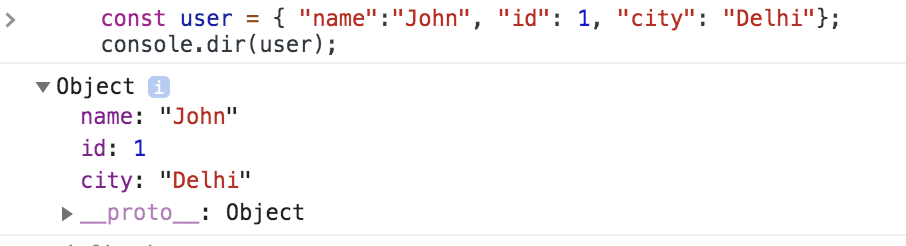
Is it possible to debug HTML elements in console
Yes, it is possible to get and debug HTML elements in the console just like inspecting elements.
const element = document.getElementsByTagName("body")[0];
console.log(element);
It prints the HTML element in the console,
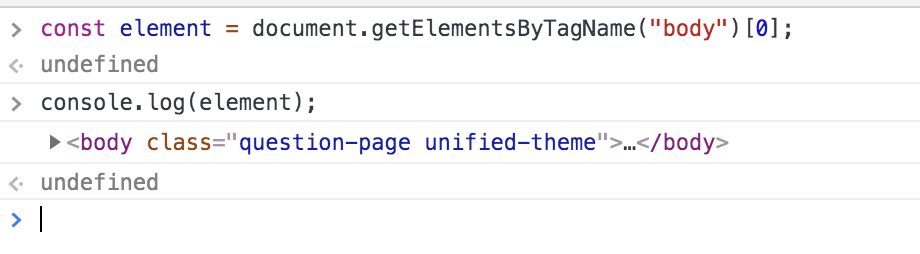
How do you display data in a tabular format using console object
The console.table() is used to display data in the console in a tabular format to visualize complex arrays or objects.
const users = [
{ name: "John", id: 1, city: "Delhi" },
{ name: "Max", id: 2, city: "London" },
{ name: "Rod", id: 3, city: "Paris" },
];
console.table(users);
The data visualized in a table format,
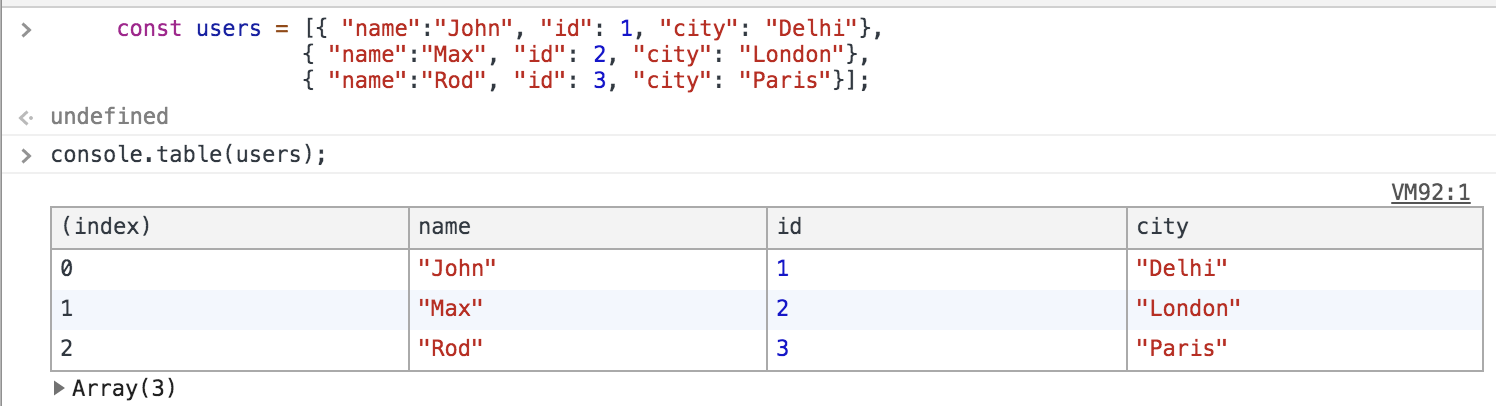 Not: Remember that
 console.table() is not supported in IE.
How do you verify that an argument is a Number or not
The combination of IsNaN and isFinite methods are used to confirm whether an argument is a number or not.
function isNumber(n) {
return !isNaN(parseFloat(n)) && isFinite(n);
}
How do you create copy to clipboard button
You need to select the content(using .select() method) of the input element and execute the copy command with execCommand (i.e, execCommand('copy')). You can also execute other system commands like cut and paste.
document.querySelector("#copy-button").onclick = function () {
// Select the content
document.querySelector("#copy-input").select();
// Copy to the clipboard
document.execCommand("copy");
};
What is the shortcut to get timestamp
You can use new Date().getTime() to get the current timestamp. There is an alternative shortcut to get the value.
console.log(+new Date());
console.log(Date.now());
How do you flattening multi dimensional arrays
Flattening bi-dimensional arrays is trivial with Spread operator.
const biDimensionalArr = [11, [22, 33], [44, 55], [66, 77], 88, 99];
const flattenArr = [].concat(...biDimensionalArr); // [11, 22, 33, 44, 55, 66, 77, 88, 99]
But you can make it work with multi-dimensional arrays by recursive calls,
function flattenMultiArray(arr) {
const flattened = [].concat(...arr);
return flattened.some((item) => Array.isArray(item))
? flattenMultiArray(flattened)
: flattened;
}
const multiDimensionalArr = [
11,
[22, 33],
[44, [55, 66, [77, [88]], 99]],
];
const flatArr = flattenMultiArray(multiDimensionalArr); // [11, 22, 33, 44, 55, 66, 77, 88, 99]
Also you can use the flat method of Array.
const arr = [1, [2, 3], 4, 5, [6, 7]];
const fllattenArr = arr.flat(); // [1, 2, 3, 4, 5, 6, 7]
// And for multiDimensional arrays
const multiDimensionalArr = [
11,
[22, 33],
[44, [55, 66, [77, [88]], 99]],
];
const oneStepFlat = multiDimensionalArr.flat(1); // [11, 22, 33, 44, [55, 66, [77, [88]], 99]]
const towStep = multiDimensionalArr.flat(2); // [11, 22, 33, 44, 55, 66, [77, [88]], 99]
const fullyFlatArray = multiDimensionalArr.flat(Infinity); // [11, 22, 33, 44, 55, 66, 77, 88, 99]
What is the easiest multi condition checking
You can use indexOf to compare input with multiple values instead of checking each value as one condition.
// Verbose approach
if (
input === "first" ||
input === 1 ||
input === "second" ||
input === 2
) {
someFunction();
}
// Shortcut
if (["first", 1, "second", 2].indexOf(input) !== -1) {
someFunction();
}
How do you capture browser back button
The beforeunload event is triggered when the window, the document and its resources are about to be unloaded. This event is helpful to warn users about losing the current data and detect back button event.
window.addEventListener("beforeunload", () => {
console.log("Clicked browser back button");
});
You can also use popstate event to detect the browser back button.
Note: The history entry has been activated using history.pushState method.
window.addEventListener("popstate", () => {
console.log("Clicked browser back button");
box.style.backgroundColor = "white";
});
const box = document.getElementById("div");
box.addEventListener("click", () => {
box.style.backgroundColor = "blue";
window.history.pushState({}, null, null);
});
In the preceeding code, When the box element clicked, its background color appears in blue color and changed to while color upon clicking the browser back button using popstate event handler. The state property of popstate contains the copy of history entry's state object.
How do you disable right click in the web page
The right click on the page can be disabled by returning false from the oncontextmenu attribute on the body element.
<body oncontextmenu="return false;"></body>
What are wrapper objects
Primitive Values like string,number and boolean don't have properties and methods but they are temporarily converted or coerced to an object(Wrapper object) when you try to perform actions on them. For example, if you apply toUpperCase() method on a primitive string value, it does not throw an error but returns uppercase of the string.
let name = "john";
console.log(name.toUpperCase()); // Behind the scenes treated as console.log(new String(name).toUpperCase());
i.e, Every primitive except null and undefined have Wrapper Objects and the list of wrapper objects are String,Number,Boolean,Symbol and BigInt.
What is AJAX
AJAX stands for Asynchronous JavaScript and XML and it is a group of related technologies(HTML, CSS, JavaScript, XMLHttpRequest API etc) used to display data asynchronously. i.e. We can send data to the server and get data from the server without reloading the web page.
What are the different ways to deal with Asynchronous Code
Below are the list of different ways to deal with Asynchronous code.
- Callbacks
- Promises
- Async/await
- Third-party libraries such as async.js,bluebird etc
How to cancel a fetch request
Until a few days back, One shortcoming of native promises is no direct way to cancel a fetch request. But the new AbortController from js specification allows you to use a signal to abort one or multiple fetch calls.
The basic flow of cancelling a fetch request would be as below,
- Create an
AbortControllerinstance - Get the signal property of an instance and pass the signal as a fetch option for signal
- Call the AbortController's abort property to cancel all fetches that use that signal For example, passing the same signal to multiple fetch calls will cancel all requests with that signal,
const controller = new AbortController();
const { signal } = controller;
fetch("http://localhost:8000", { signal })
.then((response) => {
console.log(`Request 1 is complete!`);
})
.catch((e) => {
if (e.name === "AbortError") {
// We know it's been canceled!
}
});
fetch("http://localhost:8000", { signal })
.then((response) => {
console.log(`Request 2 is complete!`);
})
.catch((e) => {
if (e.name === "AbortError") {
// We know it's been canceled!
}
});
// Wait 2 seconds to abort both requests
setTimeout(() => controller.abort(), 2000);
What is web speech API
Web speech API is used to enable modern browsers recognize and synthesize speech(i.e, voice data into web apps). This API was introduced by W3C Community in the year 2012. It has two main parts:
- SpeechRecognition (Asynchronous Speech Recognition or Speech-to-Text): It provides the ability to recognize voice context from an audio input and respond accordingly. This is accessed by the
SpeechRecognitioninterface. The example below shows how to use this API to get text from speech,
window.SpeechRecognition =
window.webkitSpeechRecognition || window.SpeechRecognition; // webkitSpeechRecognition for Chrome and SpeechRecognition for FF
const recognition = new window.SpeechRecognition();
recognition.onresult = (event) => {
// SpeechRecognitionEvent type
const speechToText = event.results[0][0].transcript;
console.log(speechToText);
};
recognition.start();
In this API, browser is going to ask you for permission to use your microphone
- SpeechSynthesis (Text-to-Speech): It provides the ability to recognize voice context from an audio input and respond. This is accessed by the
SpeechSynthesisinterface. For example, the below code is used to get voice/speech from text,
if ("speechSynthesis" in window) {
var speech = new SpeechSynthesisUtterance("Hello World!");
speech.lang = "en-US";
window.speechSynthesis.speak(speech);
}
The above examples can be tested on chrome(33+) browser's developer console. Note: This API is still a working draft and only available in Chrome and Firefox browsers(ofcourse Chrome only implemented the specification)
What is minimum timeout throttling
Both browser and NodeJS javascript environments throttles with a minimum delay that is greater than 0ms. That means even though setting a delay of 0ms will not happen instantaneously. Browsers: They have a minimum delay of 4ms. This throttle occurs when successive calls are triggered due to callback nesting(certain depth) or after a certain number of successive intervals. Note: The older browsers have a minimum delay of 10ms. Nodejs: They have a minimum delay of 1ms. This throttle happens when the delay is larger than 2147483647 or less than 1. The best example to explain this timeout throttling behavior is the order of below code snippet.
function runMeFirst() {
console.log("My script is initialized");
}
setTimeout(runMeFirst, 0);
console.log("Script loaded");
and the output would be in
Script loaded
My script is initialized
If you don't use setTimeout, the order of logs will be sequential.
function runMeFirst() {
console.log("My script is initialized");
}
runMeFirst();
console.log("Script loaded");
and the output is,
My script is initialized
Script loaded
How do you implement zero timeout in modern browsers
You can't use setTimeout(fn, 0) to execute the code immediately due to minimum delay of greater than 0ms. But you can use window.postMessage() to achieve this behavior.
What are tasks in event loop
A task is any javascript code/program which is scheduled to be run by the standard mechanisms such as initially starting to run a program, run an event callback, or an interval or timeout being fired. All these tasks are scheduled on a task queue. Below are the list of use cases to add tasks to the task queue,
- When a new javascript program is executed directly from console or running by the
<script>element, the task will be added to the task queue. - When an event fires, the event callback added to task queue
- When a setTimeout or setInterval is reached, the corresponding callback added to task queue
What is microtask
A microtask is a type of JavaScript callback that is scheduled to run immediately after the currently executing script and before the next event loop tick. Microtasks are executed after the current task completes and before any new tasks (macrotasks) are run. This ensures a fast and predictable update cycle.
Common sources of microtasks stored in the microtask queue include:
-
Promises: When a Promise is resolved or rejected, its
.then(),.catch(), and.finally()callbacks are placed in the microtask queue.Promise.resolve().then(() => { console.log('Microtask from a Promise'); }); -
queueMicrotask():
A method that explicitly schedules a function to be run in the microtask queue.
queueMicrotask(() => { console.log('Microtask from queueMicrotask'); }); -
MutationObserver callbacks:
Observers changes in the DOM and triggers a callback as a microtask.
const observer = new MutationObserver(() => { console.log('Microtask from MutationObserver'); }) observer.observe(document.body, {childList: true}); -
await:
Await internally uses Promises, so the code afterawaitis scheduled as a microtask.async function asyncFunction() { await null; console.log('Microtask from Await'); // Schedule this code as microtask }
Note: All of these microtasks are processed in the same turn of the event loop.
What are different event loops
In JavaScript, there are multiple event loops that can be used depending on the context of your application. The most common event loops are:
- The Browser Event Loop
- The Node.js Event Loop
-
Browser Event Loop: The Browser Event Loop is used in client-side JavaScript applications and is responsible for handling events that occur within the browser environment, such as user interactions (clicks, keypresses, etc.), HTTP requests, and other asynchronous actions.
-
The Node.js Event Loop is used in server-side JavaScript applications and is responsible for handling events that occur within the Node.js runtime environment, such as file I/O, network I/O, and other asynchronous actions.
What is the purpose of queueMicrotask
The queueMicrotask function is used to schedule a microtask, which is a function that will be executed asynchronously in the microtask queue. The purpose of queueMicrotask is to ensure that a function is executed after the current task has finished, but before the browser performs any rendering or handles user events.
Example:
console.log("Start"); //1
queueMicrotask(() => {
console.log("Inside microtask"); // 3
});
console.log("End"); //2
By using queueMicrotask, you can ensure that certain tasks or callbacks are executed at the earliest opportunity during the JavaScript event loop, making it useful for performing work that needs to be done asynchronously but with higher priority than regular setTimeout or setInterval callbacks.
How do you use javascript libraries in typescript file
It is known that not all JavaScript libraries or frameworks have TypeScript declaration files. But if you still want to use libraries or frameworks in your TypeScript files without getting compilation errors, the only solution is declare keyword along with a variable declaration. For example, let's imagine you have a library called customLibrary that doesn’t have a TypeScript declaration and have a namespace called customLibrary in the global namespace. You can use this library in typescript code as below,
declare var customLibrary;
In the runtime, typescript will provide the type to the customLibrary variable as any type. The another alternative without using declare keyword is below
var customLibrary: any;
What are the differences between promises and observables
Some of the major difference in a tabular form
| Promises | Observables |
|---|---|
| Emits only a single value at a time | Emits multiple values over a period of time(stream of values ranging from 0 to multiple) |
| Eager in nature; they are going to be called immediately | Lazy in nature; they require subscription to be invoked |
| Promise is always asynchronous even though it resolved immediately | Observable can be either synchronous or asynchronous |
| Doesn't provide any operators | Provides operators such as map, forEach, filter, reduce, retry, and retryWhen etc |
| Cannot be canceled | Canceled by using unsubscribe() method |
What is heap
Heap(Or memory heap) is the memory location where objects are stored when we define variables. i.e, This is the place where all the memory allocations and de-allocation take place. Both heap and call-stack are two containers of JS runtime. Whenever runtime comes across variables and function declarations in the code it stores them in the Heap.
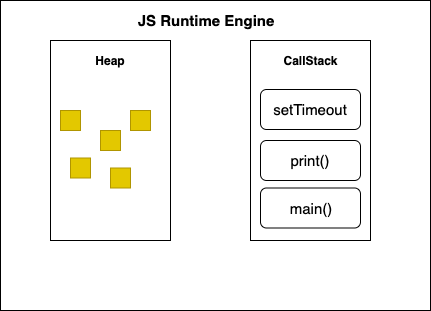
What is an event table
Event Table is a data structure that stores and keeps track of all the events which will be executed asynchronously like after some time interval or after the resolution of some API requests. i.e Whenever you call a setTimeout function or invoke async operation, it is added to the Event Table. It doesn't not execute functions on it’s own. The main purpose of the event table is to keep track of events and send them to the Event Queue as shown in the below diagram.
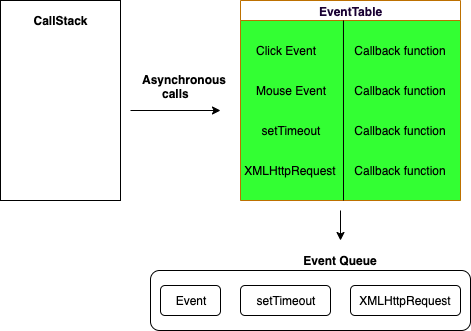
What is a microTask queue
Microtask Queue is the new queue where all the tasks initiated by promise objects get processed before the callback queue. The microtasks queue are processed before the next rendering and painting jobs. But if these microtasks are running for a long time then it leads to visual degradation.
What is the difference between shim and polyfill
A shim is a library that brings a new API to an older environment, using only the means of that environment. It isn't necessarily restricted to a web application. For example, es5-shim.js is used to emulate ES5 features on older browsers (mainly pre IE9). Whereas polyfill is a piece of code (or plugin) that provides the technology that you, the developer, expect the browser to provide natively. In a simple sentence, a polyfill is a shim for a browser API.
How do you detect primitive or non primitive value type
In JavaScript, primitive types include boolean, string, number, BigInt, null, Symbol and undefined. Whereas non-primitive types include the Objects. But you can easily identify them with the below function,
var myPrimitive = 30;
var myNonPrimitive = {};
function isPrimitive(val) {
return Object(val) !== val;
}
isPrimitive(myPrimitive);
isPrimitive(myNonPrimitive);
If the value is a primitive data type, the Object constructor creates a new wrapper object for the value. But If the value is a non-primitive data type (an object), the Object constructor will give the same object.
What is babel
Babel is a JavaScript transpiler to convert ECMAScript 2015+ code into a backwards compatible version of JavaScript in current and older browsers or environments. Some of the main features are listed below,
- Transform syntax
- Polyfill features that are missing in your target environment (using @babel/polyfill)
- Source code transformations (or codemods)
Is Node.js completely single threaded
Node is a single thread, but some of the functions included in the Node.js standard library(e.g, fs module functions) are not single threaded. i.e, Their logic runs outside of the Node.js single thread to improve the speed and performance of a program.
What are the common use cases of observables
Some of the most common use cases of observables are web sockets with push notifications, user input changes, repeating intervals, etc
What is RxJS
RxJS (Reactive Extensions for JavaScript) is a library for implementing reactive programming using observables that makes it easier to compose asynchronous or callback-based code. It also provides utility functions for creating and working with observables.
What is the difference between Function constructor and function declaration
The functions which are created with Function constructor do not create closures to their creation contexts but they are always created in the global scope. i.e, the function can access its own local variables and global scope variables only. Whereas function declarations can access outer function variables(closures) too.
Let's see this difference with an example,
Function Constructor:
var a = 100;
function createFunction() {
var a = 200;
return new Function("return a;");
}
console.log(createFunction()()); // 100
Function declaration:
var a = 100;
function createFunction() {
var a = 200;
return function func() {
return a;
};
}
console.log(createFunction()()); // 200
What is a Short circuit condition
Short circuit conditions are meant for condensed way of writing simple if statements. Let's demonstrate the scenario using an example. If you would like to login to a portal with an authentication condition, the expression would be as below,
if (authenticate) {
loginToPorta();
}
Since the javascript logical operators evaluated from left to right, the above expression can be simplified using && logical operator
authenticate && loginToPorta();
What is the easiest way to resize an array
The length property of an array is useful to resize or empty an array quickly. Let's apply length property on number array to resize the number of elements from 5 to 2,
var array = [1, 2, 3, 4, 5];
console.log(array.length); // 5
array.length = 2;
console.log(array.length); // 2
console.log(array); // [1,2]
and the array can be emptied too
var array = [1, 2, 3, 4, 5];
array.length = 0;
console.log(array.length); // 0
console.log(array); // []
What is an observable
An Observable is basically a function that can return a stream of values either synchronously or asynchronously to an observer over time. The consumer can get the value by calling subscribe() method.
Let's look at a simple example of an Observable
import { Observable } from "rxjs";
const observable = new Observable((observer) => {
setTimeout(() => {
observer.next("Message from a Observable!");
}, 3000);
});
observable.subscribe((value) => console.log(value));
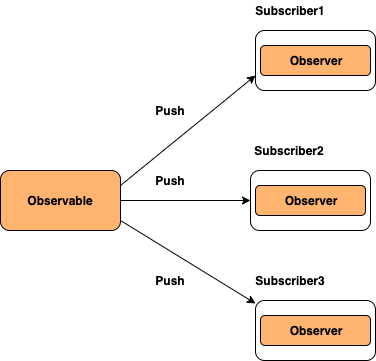
Note: Observables are not part of the JavaScript language yet but they are being proposed to be added to the language
What is the difference between function and class declarations
The main difference between function declarations and class declarations is hoisting. The function declarations are hoisted but not class declarations.
Classes:
const user = new User(); // ReferenceError
class User {}
Constructor Function:
const user = new User(); // No error
function User() {}
What is an async function
An async function is a function declared with the async keyword which enables asynchronous, promise-based behavior to be written in a cleaner style by avoiding promise chains. These functions can contain zero or more await expressions.
Let's take a below async function example,
async function logger() {
let data = await fetch("http://someapi.com/users"); // pause until fetch returns
console.log(data);
}
logger();
It is basically syntax sugar over ES2015 promises and generators.
How do you prevent promises swallowing errors
While using asynchronous code, JavaScript’s ES6 promises can make your life a lot easier without having callback pyramids and error handling on every second line. But Promises have some pitfalls and the biggest one is swallowing errors by default.
Let's say you expect to print an error to the console for all the below cases,
Promise.resolve("promised value").then(function () {
throw new Error("error");
});
Promise.reject("error value").catch(function () {
throw new Error("error");
});
new Promise(function (resolve, reject) {
throw new Error("error");
});
But there are many modern JavaScript environments that won't print any errors. You can fix this problem in different ways,
-
Add catch block at the end of each chain: You can add catch block to the end of each of your promise chains
Promise.resolve("promised value") .then(function () { throw new Error("error"); }) .catch(function (error) { console.error(error.stack); });But it is quite difficult to type for each promise chain and verbose too.
-
Add done method: You can replace first solution's then and catch blocks with done method
Promise.resolve("promised value").done(function () { throw new Error("error"); });Let's say you want to fetch data using HTTP and later perform processing on the resulting data asynchronously. You can write
doneblock as below,getDataFromHttp() .then(function (result) { return processDataAsync(result); }) .done(function (processed) { displayData(processed); });In future, if the processing library API changed to synchronous then you can remove
doneblock as below,getDataFromHttp().then(function (result) { return displayData(processDataAsync(result)); });and then you forgot to add
doneblock tothenblock leads to silent errors. -
Extend ES6 Promises by Bluebird: Bluebird extends the ES6 Promises API to avoid the issue in the second solution. This library has a “default” onRejection handler which will print all errors from rejected Promises to stderr. After installation, you can process unhandled rejections
Promise.onPossiblyUnhandledRejection(function (error) { throw error; });and discard a rejection, just handle it with an empty catch
Promise.reject("error value").catch(function () {});
What is deno
Deno is a simple, modern and secure runtime for JavaScript and TypeScript that uses V8 JavaScript engine and the Rust programming language. It solves the inherent problems of Node.Js and has been officially released in May 2018. Unlike Node.JS, by default Deno executes the code in a sandbox, which means that runtime has no access to below areas:
- The file system
- The network
- Execution of other scripts
- The environment variables
How do you make an object iterable in javascript
By default, plain objects are not iterable. But you can make the object iterable by defining a Symbol.iterator property on it.
Let's demonstrate this with an example,
const collection = {
one: 1,
two: 2,
three: 3,
[Symbol.iterator]() {
const values = Object.keys(this);
let i = 0;
return {
next: () => {
return {
value: this[values[i++]],
done: i > values.length,
};
},
};
},
};
const iterator = collection[Symbol.iterator]();
console.log(iterator.next()); // → {value: 1, done: false}
console.log(iterator.next()); // → {value: 2, done: false}
console.log(iterator.next()); // → {value: 3, done: false}
console.log(iterator.next()); // → {value: undefined, done: true}
The above process can be simplified using a generator function,
const collection = {
one: 1,
two: 2,
three: 3,
[Symbol.iterator]: function* () {
for (let key in this) {
yield this[key];
}
},
};
const iterator = collection[Symbol.iterator]();
console.log(iterator.next()); // {value: 1, done: false}
console.log(iterator.next()); // {value: 2, done: false}
console.log(iterator.next()); // {value: 3, done: false}
console.log(iterator.next()); // {value: undefined, done: true}
What is a Proper Tail Call
First, we should know about tail call before talking about "Proper Tail Call". A tail call is a subroutine or function call performed as the final action of a calling function. Whereas Proper tail call(PTC) is a technique where the program or code will not create additional stack frames for a recursion when the function call is a tail call.
For example, the below classic or head recursion of factorial function relies on stack for each step. Each step need to be processed upto n * factorial(n - 1)
function factorial(n) {
if (n === 0) {
return 1;
}
return n * factorial(n - 1);
}
console.log(factorial(5)); //120
But if you use Tail recursion functions, they keep passing all the necessary data it needs down the recursion without relying on the stack.
function factorial(n, acc = 1) {
if (n === 0) {
return acc;
}
return factorial(n - 1, n * acc);
}
console.log(factorial(5)); //120
The above pattern returns the same output as the first one. But the accumulator keeps track of total as an argument without using stack memory on recursive calls.
How do you check an object is a promise or not
If you don't know if a value is a promise or not, wrapping the value as Promise.resolve(value) which returns a promise
function isPromise(object) {
if (Promise && Promise.resolve) {
return Promise.resolve(object) == object;
} else {
throw "Promise not supported in your environment";
}
}
var i = 1;
var promise = new Promise(function (resolve, reject) {
resolve();
});
console.log(isPromise(i)); // false
console.log(isPromise(promise)); // true
Another way is to check for .then() handler type
function isPromise(value) {
return Boolean(value && typeof value.then === "function");
}
var i = 1;
var promise = new Promise(function (resolve, reject) {
resolve();
});
console.log(isPromise(i)); // false
console.log(isPromise(promise)); // true
How to detect if a function is called as constructor
You can use new.target pseudo-property to detect whether a function was called as a constructor(using the new operator) or as a regular function call.
- If a constructor or function invoked using the new operator, new.target returns a reference to the constructor or function.
- For function calls, new.target is undefined.
function Myfunc() {
if (new.target) {
console.log("called with new");
} else {
console.log("not called with new");
}
}
new Myfunc(); // called with new
Myfunc(); // not called with new
Myfunc.call({}); // not called with new
What are the differences between arguments object and rest parameter
There are three main differences between arguments object and rest parameters
- The arguments object is an array-like but not an array. Whereas the rest parameters are array instances.
- The arguments object does not support methods such as sort, map, forEach, or pop. Whereas these methods can be used in rest parameters.
- The rest parameters are only the ones that haven’t been given a separate name, while the arguments object contains all arguments passed to the function
What are the differences between spread operator and rest parameter
Rest parameter collects all remaining elements into an array. Whereas Spread operator allows iterables( arrays / objects / strings ) to be expanded into single arguments/elements. i.e, Rest parameter is opposite to the spread operator.
What are the different kinds of generators
There are five kinds of generators,
-
Generator function declaration:
function* myGenFunc() { yield 1; yield 2; yield 3; } const genObj = myGenFunc(); -
Generator function expressions:
const myGenFunc = function* () { yield 1; yield 2; yield 3; }; const genObj = myGenFunc(); -
Generator method definitions in object literals:
const myObj = { *myGeneratorMethod() { yield 1; yield 2; yield 3; }, }; const genObj = myObj.myGeneratorMethod(); -
Generator method definitions in class:
class MyClass { *myGeneratorMethod() { yield 1; yield 2; yield 3; } } const myObject = new MyClass(); const genObj = myObject.myGeneratorMethod(); -
Generator as a computed property:
const SomeObj = { *[Symbol.iterator]() { yield 1; yield 2; yield 3; }, }; console.log(Array.from(SomeObj)); // [ 1, 2, 3 ]
What are the built-in iterables
Below are the list of built-in iterables in javascript,
- Arrays and TypedArrays
- Strings: Iterate over each character or Unicode code-points
- Maps: iterate over its key-value pairs
- Sets: iterates over their elements
- arguments: An array-like special variable in functions
- DOM collection such as NodeList
What are the differences between for...of and for...in statements
Both for...in and for...of statements iterate over js data structures. The only difference is over what they iterate:
- for..in iterates over all enumerable property keys of an object
- for..of iterates over the values of an iterable object.
Let's explain this difference with an example,
let arr = ["a", "b", "c"];
arr.newProp = "newVlue";
// key are the property keys
for (let key in arr) {
console.log(key); // 0, 1, 2 & newProp
}
// value are the property values
for (let value of arr) {
console.log(value); // a, b, c
}
Since for..in loop iterates over the keys of the object, the first loop logs 0, 1, 2 and newProp while iterating over the array object. The for..of loop iterates over the values of a arr data structure and logs a, b, c in the console.
How do you define instance and non-instance properties
The Instance properties must be defined inside of class methods. For example, name and age properties defined inside constructor as below,
class Person {
constructor(name, age) {
this.name = name;
this.age = age;
}
}
But Static(class) and prototype data properties must be defined outside of the ClassBody declaration. Let's assign the age value for Person class as below,
Person.staticAge = 30;
Person.prototype.prototypeAge = 40;
What is the difference between isNaN and Number.isNaN?
- isNaN: The global function
isNaNconverts the argument to a Number and returns true if the resulting value is NaN. - Number.isNaN: This method does not convert the argument. But it returns true when the type is a Number and value is NaN.
Let's see the difference with an example,
isNaN(‘hello’); // true
Number.isNaN('hello'); // false
How to invoke an IIFE without any extra brackets?
Immediately Invoked Function Expressions(IIFE) requires a pair of parenthesis to wrap the function which contains set of statements.
(function (dt) {
console.log(dt.toLocaleTimeString());
})(new Date());
Since both IIFE and void operator discard the result of an expression, you can avoid the extra brackets using void operator for IIFE as below,
void (function (dt) {
console.log(dt.toLocaleTimeString());
})(new Date());
Is that possible to use expressions in switch cases?
You might have seen expressions used in switch condition but it is also possible to use for switch cases by assigning true value for the switch condition. Let's see the weather condition based on temperature as an example,
const weather = (function getWeather(temp) {
switch (true) {
case temp < 0:
return "freezing";
case temp < 10:
return "cold";
case temp < 24:
return "cool";
default:
return "unknown";
}
})(10);
What is the easiest way to ignore promise errors?
The easiest and safest way to ignore promise errors is void that error. This approach is ESLint friendly too.
await promise.catch((e) => void e);
How do style the console output using CSS?
You can add CSS styling to the console output using the CSS format content specifier %c. The console string message can be appended after the specifier and CSS style in another argument. Let's print the red color text using console.log and CSS specifier as below,
console.log("%cThis is a red text", "color:red");
It is also possible to add more styles for the content. For example, the font-size can be modified for the above text
console.log(
"%cThis is a red text with bigger font",
"color:red; font-size:20px"
);
What is nullish coalescing operator (??)?
It is a logical operator that returns its right-hand side operand when its left-hand side operand is null or undefined, and otherwise returns its left-hand side operand. This can be contrasted with the logical OR (||) operator, which returns the right-hand side operand if the left operand is any falsy value, not only null or undefined.
console.log(null ?? true); // true
console.log(false ?? true); // false
console.log(undefined ?? true); // true
How do you group and nest console output?
The console.group() can be used to group related log messages to be able to easily read the logs and use console.groupEnd()to close the group. Along with this, you can also nest groups which allows to output message in hierarchical manner.
For example, if you’re logging a user’s details:
console.group("User Details");
console.log("name: Sudheer Jonna");
console.log("job: Software Developer");
// Nested Group
console.group("Address");
console.log("Street: Commonwealth");
console.log("City: Los Angeles");
console.log("State: California");
// Close nested group
console.groupEnd();
// Close outer group
console.groupEnd();
You can also use console.groupCollapsed() instead of console.group() if you want the groups to be collapsed by default.
What is the difference between dense and sparse arrays?
An array contains items at each index starting from first(0) to last(array.length - 1) is called as Dense array. Whereas if at least one item is missing at any index, the array is called as sparse.
Let's see the below two kind of arrays,
const avengers = ["Ironman", "Hulk", "CaptainAmerica"];
console.log(avengers[0]); // 'Ironman'
console.log(avengers[1]); // 'Hulk'
console.log(avengers[2]); // 'CaptainAmerica'
console.log(avengers.length); // 3
const justiceLeague = ["Superman", "Aquaman", , "Batman"];
console.log(justiceLeague[0]); // 'Superman'
console.log(justiceLeague[1]); // 'Aquaman'
console.log(justiceLeague[2]); // undefined
console.log(justiceLeague[3]); // 'Batman'
console.log(justiceLeague.length); // 4
What are the different ways to create sparse arrays?
There are 4 different ways to create sparse arrays in JavaScript
- Array literal: Omit a value when using the array literal
const justiceLeague = ["Superman", "Aquaman", , "Batman"]; console.log(justiceLeague); // ['Superman', 'Aquaman', empty ,'Batman'] - Array() constructor: Invoking Array(length) or new Array(length)
const array = Array(3); console.log(array); // [empty, empty ,empty] - Delete operator: Using delete array[index] operator on the array
const justiceLeague = ["Superman", "Aquaman", "Batman"]; delete justiceLeague[1]; console.log(justiceLeague); // ['Superman', empty, ,'Batman'] - Increase length property: Increasing length property of an array
const justiceLeague = ["Superman", "Aquaman", "Batman"]; justiceLeague.length = 5; console.log(justiceLeague); // ['Superman', 'Aquaman', 'Batman', empty, empty]
What is the difference between setTimeout, setImmediate and process.nextTick?
- Set Timeout: setTimeout() is to schedule execution of a one-time callback after delay milliseconds.
- Set Immediate: The setImmediate function is used to execute a function right after the current event loop finishes.
- Process NextTick: If process.nextTick() is called in a given phase, all the callbacks passed to process.nextTick() will be resolved before the event loop continues. This will block the event loop and create I/O Starvation if process.nextTick() is called recursively.
How do you reverse an array without modifying original array?
The reverse() method reverses the order of the elements in an array but it mutates the original array. Let's take a simple example to demonistrate this case,
const originalArray = [1, 2, 3, 4, 5];
const newArray = originalArray.reverse();
console.log(newArray); // [ 5, 4, 3, 2, 1]
console.log(originalArray); // [ 5, 4, 3, 2, 1]
There are few solutions that won't mutate the original array. Let's take a look.
-
Using slice and reverse methods: In this case, just invoke the
slice()method on the array to create a shallow copy followed byreverse()method call on the copy.const originalArray = [1, 2, 3, 4, 5]; const newArray = originalArray.slice().reverse(); //Slice an array gives a new copy console.log(originalArray); // [1, 2, 3, 4, 5] console.log(newArray); // [ 5, 4, 3, 2, 1] -
Using spread and reverse methods: In this case, let's use the spread syntax (...) to create a copy of the array followed by
reverse()method call on the copy.const originalArray = [1, 2, 3, 4, 5]; const newArray = [...originalArray].reverse(); console.log(originalArray); // [1, 2, 3, 4, 5] console.log(newArray); // [ 5, 4, 3, 2, 1] -
Using reduce and spread methods: Here execute a reducer function on an array elements and append the accumulated array on right side using spread syntax
const originalArray = [1, 2, 3, 4, 5]; const newArray = originalArray.reduce((accumulator, value) => { return [value, ...accumulator]; }, []); console.log(originalArray); // [1, 2, 3, 4, 5] console.log(newArray); // [ 5, 4, 3, 2, 1] -
Using reduceRight and spread methods: Here execute a right reducer function(i.e. opposite direction of reduce method) on an array elements and append the accumulated array on left side using spread syntax
const originalArray = [1, 2, 3, 4, 5]; const newArray = originalArray.reduceRight((accumulator, value) => { return [...accumulator, value]; }, []); console.log(originalArray); // [1, 2, 3, 4, 5] console.log(newArray); // [ 5, 4, 3, 2, 1] -
Using reduceRight and push methods: Here execute a right reducer function(i.e. opposite direction of reduce method) on an array elements and push the iterated value to the accumulator
const originalArray = [1, 2, 3, 4, 5]; const newArray = originalArray.reduceRight((accumulator, value) => { accumulator.push(value); return accumulator; }, []); console.log(originalArray); // [1, 2, 3, 4, 5] console.log(newArray); // [ 5, 4, 3, 2, 1]
How do you create custom HTML element?
The creation of custom HTML elements involves two main steps,
- Define your custom HTML element: First you need to define some custom class by extending HTMLElement class.
After that define your component properties (styles,text etc) using
connectedCallbackmethod. Note: The browser exposes a function calledcustomElements.defineinorder to reuse the element.class CustomElement extends HTMLElement { connectedCallback() { this.innerHTML = "This is a custom element"; } } customElements.define("custom-element", CustomElement); - Use custom element just like other HTML element: Declare your custom element as a HTML tag.
<body>
<custom-element>
</body>
What is global execution context?
The global execution context is the default or first execution context that is created by the JavaScript engine before any code is executed(i.e, when the file first loads in the browser). All the global code that is not inside a function or object will be executed inside this global execution context. Since JS engine is single threaded there will be only one global environment and there will be only one global execution context.
For example, the below code other than code inside any function or object is executed inside the global execution context.
var x = 10;
function A() {
console.log("Start function A");
function B() {
console.log("In function B");
}
B();
}
A();
console.log("GlobalContext");
What is function execution context?
Whenever a function is invoked, the JavaScript engine creates a different type of Execution Context known as a Function Execution Context (FEC) within the Global Execution Context (GEC) to evaluate and execute the code within that function.
What is debouncing?
Debouncing is a programming technique used to limit how often a function is executed. Specifically, it ensures that a function is only triggered after a certain amount of time has passed since it was last invoked. This prevents unnecessary or excessive function calls, which can help optimize performance and reduce unnecessary CPU usage or API requests.
For example, when a user types in a search box, you typically want to wait until they’ve finished typing before fetching suggestions. Without debouncing, an API call would be triggered on every keystroke, potentially causing performance issues. With debouncing, the function call is postponed until the user stops typing for a specified period (e.g., 300ms). If the user types again before this time elapses, the timer resets.
Typical use cases for debouncing include:
- Search box suggestions (wait until typing pauses before fetching results)
- Auto-saving text fields (save only after the user stops typing)
- Preventing double-clicks on buttons
- Handling window resize or scroll events efficiently
Example Debounce Function:
JavaScript
function debounce(func, timeout = 500) {
let timer;
return function (...args) {
clearTimeout(timer);
timer = setTimeout(() => {
func.apply(this, args);
}, timeout);
};
}
Usage Example:
JavaScript
function fetchResults() {
console.log("Fetching input suggestions");
}
const processChange = debounce(fetchResults, 300);
// Attach to input element
<input type="text" onkeyup="processChange()" />
// Attach to button
<button onclick="processChange()">Click me</button>
// Attach to window event
window.addEventListener("scroll", processChange);
How it works:
When processChange is invoked (e.g., by typing or clicking), any pending execution is canceled, and the function is scheduled to run after the specified delay. If another event occurs before the delay is up, the timer resets, and the function will only run after events have stopped for the delay duration.
Debouncing is an essential tool for improving user experience and application performance, especially when dealing with events that can fire rapidly and repeatedly.
What is throttling?
Throttling is a programming technique used to control the rate at which a function is executed. When an event is triggered continuously—such as during window resizing, scrolling, or mouse movement—throttling ensures that the associated event handler is not called more often than a specified interval. This helps improve performance by reducing the number of expensive function calls and preventing performance bottlenecks.
Common use cases:
- Window resize events
- Scroll events
- Mouse movement or drag events
- API rate limiting
How does throttling work?
Throttling will execute the function at most once every specified time interval, ignoring additional calls until the interval has passed.
Example: Throttle Implementation and Usage
JavaScript
// Simple throttle function: allows 'func' to run at most once every 'limit' ms
function throttle(func, limit) {
let inThrottle = false;
return function(...args) {
if (!inThrottle) {
func.apply(this, args);
inThrottle = true;
setTimeout(() => (inThrottle = false), limit);
}
};
}
// Usage: throttling a scroll event handler
function handleScrollAnimation() {
console.log('Scroll event triggered');
}
window.addEventListener(
"scroll",
throttle(handleScrollAnimation, 100) // Will run at most once every 100ms
);
What is optional chaining?
According to MDN official docs, the optional chaining operator (?.) permits reading the value of a property located deep within a chain of connected objects without having to expressly validate that each reference in the chain is valid.
The ?. operator is like the . chaining operator, except that instead of causing an error if a reference is nullish (null or undefined), the expression short-circuits with a return value of undefined. When used with function calls, it returns undefined if the given function does not exist.
const adventurer = {
name: "Alice",
cat: {
name: "Dinah",
},
};
const dogName = adventurer.dog?.name;
console.log(dogName);
// expected output: undefined
console.log(adventurer.someNonExistentMethod?.());
// expected output: undefined
What is an environment record?
According to ECMAScript specification 262 (9.1):
Environment Record is a specification type used to define the association of Identifiers to specific variables and functions, based upon the lexical nesting structure of ECMAScript code.
Usually an Environment Record is associated with some specific syntactic structure of ECMAScript code such as a FunctionDeclaration, a BlockStatement, or a Catch clause of a TryStatement.
Each time such code is evaluated, a new Environment Record is created to record the identifier bindings that are created by that code.
How to verify if a variable is an array?
It is possible to check if a variable is an array instance using 3 different ways,
-
Array.isArray() method:
The
Array.isArray(value)utility function is used to determine whether value is an array or not. This function returns a true boolean value if the variable is an array and a false value if it is not.const numbers = [1, 2, 3]; const user = { name: "John" }; Array.isArray(numbers); // true Array.isArray(user); //false -
instanceof operator:
The instanceof operator is used to check the type of an array at run time. It returns true if the type of a variable is an Array other false for other type.
const numbers = [1, 2, 3]; const user = { name: "John" }; console.log(numbers instanceof Array); // true console.log(user instanceof Array); // false -
Checking constructor type:
The constructor property of the variable is used to determine whether the variable Array type or not.
const numbers = [1, 2, 3]; const user = { name: "John" }; console.log(numbers.constructor === Array); // true console.log(user.constructor === Array); // false
What is pass by value and pass by reference?
Pass-by-value creates a new space in memory and makes a copy of a value. Primitives such as string, number, boolean etc will actually create a new copy. Hence, updating one value doesn't impact the other value. i.e, The values are independent of each other.
let a = 5;
let b = a;
b++;
console.log(a, b); //5, 6
In the above code snippet, the value of a is assigned to b and the variable b has been incremented. Since there is a new space created for variable b, any update on this variable doesn't impact the variable a.
Pass by reference doesn't create a new space in memory but the new variable adopts a memory address of an initial variable. Non-primitives such as objects, arrays and functions gets the reference of the initiable variable. i.e, updating one value will impact the other variable.
let user1 = {
name: "John",
age: 27,
};
let user2 = user1;
user2.age = 30;
console.log(user1.age, user2.age); // 30, 30
In the above code snippet, updating the age property of one object will impact the other property due to the same reference.
What are the differences between primitives and non-primitives?
JavaScript language has both primitives and non-primitives but there are few differences between them as below,
| Primitives | Non-primitives |
|---|---|
| These types are predefined | Created by developer |
| These are immutable | Mutable |
| Compare by value | Compare by reference |
| Stored in Stack | Stored in heap |
| Contain certain value | Can contain NULL too |
How do you create your own bind method using either call or apply method?
The custom bind function needs to be created on Function prototype inorder to use it as other builtin functions. This custom function should return a function similar to original bind method and the implementation of inner function needs to use apply method call.
The function which is going to bind using custom myOwnBind method act as the attached function(boundTargetFunction) and argument as the object for apply method call.
Function.prototype.myOwnBind = function (whoIsCallingMe) {
if (typeof this !== "function") {
throw new Error(this + "cannot be bound as it's not callable");
}
const boundTargetFunction = this;
return function () {
boundTargetFunction.apply(whoIsCallingMe, arguments);
};
};
What are the differences between pure and impure functions?
Some of the major differences between pure and impure function are as below,
| Pure function | Impure function |
|---|---|
| It has no side effects | It causes side effects |
| It is always return the same result | It returns different result on each call |
| Easy to read and debug | Difficult to read and debug because they are affected by external code |
What is referential transparency?
An expression in javascript that can be replaced by its value without affecting the behaviour of the program is called referential transparency. Pure functions are referentially transparent.
const add = (x, y) => x + y;
const multiplyBy2 = (x) => x * 2;
//Now add (2, 3) can be replaced by 5.
multiplyBy2(add(2, 3));
What are the possible side-effects in javascript?
A side effect is the modification of the state through the invocation of a function or expression. These side effects make our function impure by default. Below are some side effects which make function impure,
- Making an HTTP request. Asynchronous functions such as fetch and promise are impure.
- DOM manipulations
- Mutating the input data
- Printing to a screen or console: For example, console.log() and alert()
- Fetching the current time
- Math.random() calls: Modifies the internal state of Math object
What are compose and pipe functions?
The "compose" and "pipe" are two techniques commonly used in functional programming to simplify complex operations and make code more readable. They are not native to JavaScript and higher-order functions. the compose() applies right to left any number of functions to the output of the previous function.
What is module pattern?
Module pattern is a designed pattern used to wrap a set of variables and functions together in a single scope returned as an object. JavaScript doesn't have access specifiers similar to other languages(Java, Python, etc) to provide private scope. It uses IIFE (Immediately invoked function expression) to allow for private scopes. i.e., a closure that protect variables and methods.
The module pattern looks like below,
(function () {
// Private variables or functions goes here.
return {
// Return public variables or functions here.
};
})();
Let's see an example of a module pattern for an employee with private and public access,
const createEmployee = (function () {
// Private
const name = "John";
const department = "Sales";
const getEmployeeName = () => name;
const getDepartmentName = () => department;
// Public
return {
name,
department,
getName: () => getEmployeeName(),
getDepartment: () => getDepartmentName(),
};
})();
console.log(createEmployee.name);
console.log(createEmployee.department);
console.log(createEmployee.getName());
console.log(createEmployee.getDepartment());
Note: It mimic the concepts of classes with private variables and methods.
What is Function Composition?
It is an approach where the result of one function is passed on to the next function, which is passed to another until the final function is executed for the final result.
//example
const double = (x) => x * 2;
const square = (x) => x * x;
var output1 = double(2);
var output2 = square(output1);
console.log(output2);
var output_final = square(double(2));
console.log(output_final);
How to use await outside of async function prior to ES2022?
Prior to ES2022, if you attempted to use an await outside of an async function resulted in a SyntaxError.
await Promise.resolve(console.log("Hello await")); // SyntaxError: await is only valid in async function
But you can fix this issue with an alternative IIFE (Immediately Invoked Function Expression) to get access to the feature.
(async function () {
await Promise.resolve(console.log("Hello await")); // Hello await
})();
In ES2022, you can write top-level await without writing any hacks.
await Promise.resolve(console.log("Hello await")); //Hello await
What is the purpose of the this keyword in JavaScript?
The this keyword in JavaScript refers to the object that is executing the current function. Its value is determined by how a function is called, not where it is defined. this is essential for writing object-oriented and event-driven code, as it allows methods to interact with the data of the object they belong to.
Example 1: this in a Global Context
console.log(this);
- In a global context, this refers to the global object (e.g., window in a browser).
Example 2: this in a Function
function displayThis() {
console.log(this);
}
displayThis();
- In a regular function, this refers to the global object(window in browser and global in nodejs) for non-strict mode. In strict mode, it's value is undefined.
Example 3: this in a Method
const person = {
name: "John",
greet: function () {
console.log("Hello, " + this.name);
},
};
person.greet();
- In a method, this refers to the object that owns the method (person in the case).
Example 4: this in an Event Handler
document.getElementById("myButton").addEventListener("click", function () {
console.log(this);
});
- In an event handler, this refers to the element that triggered the event (the button in this case).
Example 5: this with Arrow Functions
const obj = {
age: 42,
regular: function() { console.log(this.age); },
arrow: () => { console.log(this.age); }
};
obj.regular(); // 42 (this refers to obj)
obj.arrow(); // undefined (this refers to the outer scope, not obj)
- Arrow functions do not have their own
thisbinding; they inherit it from their surrounding (lexical) context.
Example 6: this in Constructor Functions / Classes
function Person(name) {
this.name = name;
}
const p1 = new Person('Sudheer');
console.log(p1.name); // Sudheer
- When used with new, this refers to the newly created object.
What are the uses of closures?
Closures are a powerful feature in programming languages like JavaScript. They allow functions to retain access to variables from their containing (enclosing) scope even after the outer function has finished executing. This means that a function defined within another function can access variables from the outer function, even if the outer function has already returned. Here are some common use cases of closures:
-
Data Privacy: Closures can be used to create private variables and methods. By defining variables within a function's scope and returning inner functions that have access to those variables, you can create a form of encapsulation, limiting access to certain data or functionality.
-
Function Factories: Closures are often used to create functions with pre-set parameters. This is useful when you need to create multiple functions with similar behavior but different configurations.
-
Callback Functions: Closures are frequently used in asynchronous programming, such as handling event listeners or AJAX requests. The inner function captures variables from the outer scope and can access them when the callback is invoked.
-
Memoization: Closures can be used for memoization, a technique to optimize performance by caching the results of expensive function calls. The inner function can remember the results of previous calls and return the cached result if the same input is provided again.
-
iterators and Generators: Closures can be used to create iterators and generators, which are essential for working with collections of data in modern JavaScript.
What are the phases of execution context?
The execution context in JavaScript is a data structure that stores the information necessary for executing a piece of code. It includes the code itself, the values of the variables used in the code, and the scope chain. The scope chain is a list of objects that are used to resolve variable names.
The execution context has two phases:
- Creation phase: In this phase, the JavaScript engine creates the execution context and sets up the script's environment. This includes creating the variable object and the scope chain.
- Execution phase: In this phase, the JavaScript engine executes the code in the execution context. This includes evaluating expressions, assigning values to variables, and calling functions.
The execution context is created when a function is called. The function's code is then executed in the execution context. When the function returns, the execution context is destroyed.
What are the possible reasons for memory leaks?
Memory leaks can lead to poor performance, slow loading times and even crashes in web applications. Some of the common causes of memory leaks are listed below,
- The execessive usage of global variables or omitting the
varkeyword in local scope. - Forgetting to clear the timers set up by
setTimeoutorsetInterval. - Closures retain references to variables from their parent scope, which leads to variables might not garbage collected even they are no longer used.
What are the optimization techniques of V8 engine?
V8 engine uses the below optimization techniques.
- Inline expansion: It is a compiler optimization by replacing the function calls with the corresponding function blocks.
- Copy elision: This is a compiler optimization method to prevent expensive extra objects from being duplicated or copied.
- Inline caching: It is a runtime optimization technique where it caches the execution of older tasks those can be lookup while executing the same task in the future.
What are the examples of built-in higher order functions?
There are several built-in higher order functions exists on arrays, strings, DOM and promise methods in javascript. These higher order functions provides significant level of abstraction. The list of functions on these categories are listed below,
- arrays: map, filter, reduce, sort, forEach, some etc.
- DOM: The DOM method
element.addEventListener(type, handler)also accepts the function handler as a second argument. - Strings: replace() method.
What are the benefits higher order functions?
The main benefits of higher order functions are:
- Abstraction
- Reusability
- Immutability
- Modularity
How do you create polyfills for map, filter and reduce methods?
The polyfills for array methods such as map, filter and reduce methods can be created using array prototype.
- map:
The built-in Array.map method syntax will be helpful to write polyfill. The map method takes the callback function as an argument and that callback function can have below three arguments passed into it.
i. Current value ii. Index of current value(optional) iii. array(optional)
The syntax would like below,
let newArray = arr.map(callback(currentValue[, index, arr) {
// return new array after executing the code
})
Let's build our map polyfill based on the above syntax,
Array.prototype.myMap = function (cb) {
let newArr = [];
for (let i = 0; i < this.length; i++) {
newArr.push(cb(this[i], i, this));
}
return newArr;
};
const nums = [1, 2, 3, 4, 5];
const multiplyByTwo = nums.myMap((x) => x * 2);
console.log(multiplyByTwo); // [2, 4, 6, 8, 10]
In the above code, custom method name 'myMap' has been used to avoid conflicts with built-in method.
-
filter: Similar to map method,
Array.filtermethod takes callback function as an argument and the callback function can have three agurguments passed into it.i. Current value ii. Index of current value(optional) iii. array(optional)
The syntax looks like below,
let newArray = arr.filter(callback(currentValue[, index, arr) {
// return new array whose elements satisfy the callback conditions
})
Let's build our filter polyfill based on the above syntax,
Array.prototype.myFilter = function (cb) {
let newArr = [];
for (let i = 0; i < this.length; i++) {
if (cb(this[i], i, this)) {
newArr.push(this[i]);
}
}
return newArr;
};
const nums = [1, 2, 3, 4, 5, 6];
const evenNums = nums.myFilter((x) => x % 2);
console.log(evenNums); // [2, 4, 6]
-
reduce:
The built-in
Array.reducemethod syntax will be helpful to write our own polyfill. The reduce method takes the callback function as first argument and the initial value as second argument.The callback function can have four arguments passed into it. i. Accumulator ii. Current value iii. Index of current value(optional) iv. array(optional)
The syntax would like below,
arr.reduce(callback((acc, curr, i, arr) => {}), initValue);Let's build our reduce polyfill based on the above syntax,
Array.prototype.myReduce = function(cb, initialValue) { let accumulator = initialValue; for(let i=0; i< this.length; i++) { accumulator = accumulator ? cb(accumulator, this[i], i, this) : this[i]; } return accumulator; } const nums = [1, 2, 3, 4, 5, 6]; const sum = nums.myReduce((acc, curr, i, arr) => { return acc += curr }, 0); console.log(sum); // 21
What is the difference between map and forEach functions?
Both map and forEach functions are used to iterate over an arrays but there are some differences in their functionality.
- Returning values: The
mapmethod returns a new array with transformed elements whereasforEachmethod returnsundefinedeven though both of them are doing the same job.
const arr = [1, 2, 3, 4, 5];
arr.map(x => x * x); // [1, 4, 9, 16, 25]
arr.forEach(x => x * x); //
The `forEach()` method in JavaScript always returns undefined. This is because forEach() is used to iterate over arrays and perform side effects on each element, rather than returning a `new array or transforming the original array`
- Chaining methods: The
mapmethod is chainable. i.e, It can be attached withreduce,filter,sortand other methods as well. WhereasforEachcannot be attached with any other methods because it returnsundefinedvalue.
const arr = [1, 2, 3, 4, 5];
arr.map((x) => x * x).reduce((total, cur) => total + cur); // 55
arr.forEach((x) => x * x).reduce((total, cur) => total + cur); //Uncaught TypeError: Cannot read properties of undefine(reading 'reduce')
- Mutation: The
mapmethod doesn't mutate the original array by returning new array. WhereasforEachmethod also doesn't mutate the original array but it's callback is allowed to mutate the original array.
Note: Both these methods existed since ES5 onwards.
Give an example of statements affected by automatic semicolon insertion?
The javascript parser will automatically add a semicolon while parsing the source code. For example, the below common statements affected by Automatic Semicolon Insertion(ASI).
- An empty statement
- var statement
- An expression statement
- do-while statement
- continue statement
- break statement
- return statement
- throw statement
What are the event phases of a browser?
There are 3 phases in the lifecycle of an event propagation in JavaScript,
-
Capturing phase: This phase goes down gradually from the top of the DOM tree to the target element when a nested element clicked. Before the click event reaching the final destination element, the click event of each parent's element must be triggered.
-
Target phase: This is the phase where the event originally occurred reached the target element .
-
Bubbling phase: This is reverse of the capturing phase. In this pase, the event bubbles up from the target element through it's parent element, an ancestor and goes all the way to the global window object.
The pictorial representation of these 3 event phases in DOM looks like below,
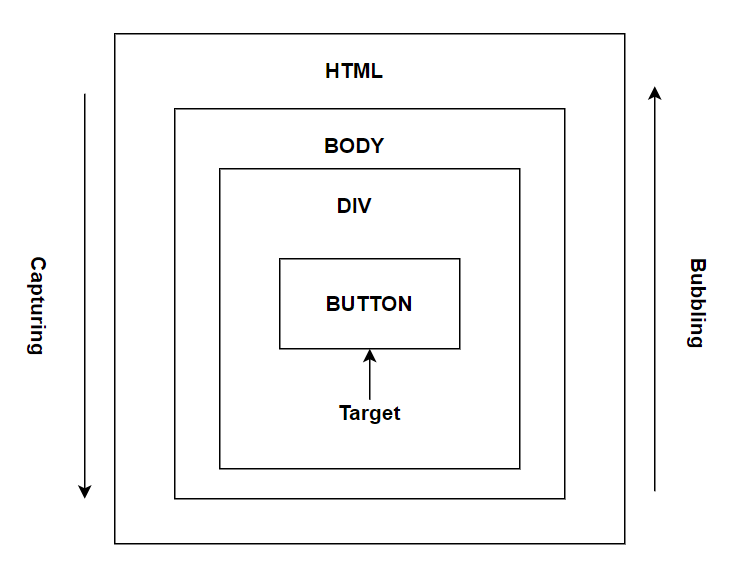
What are the real world use cases of proxy?
Proxies are not used in regular day to day JavaScript work but they enabled many exciting programming patterns. Some of the real world use cases are listed below,
- Vue3 used proxy concept to implement reactive state
- SolidJS implemented reactive stores
- Immerjs built upon proxy to track updates to immutable updates
- ZenStack improved Prisma ORM for access control layer
What are hidden classes?
Since JavaScript is a dynamic programming language, you can add or remove properties and methods from objects on the fly at runtime. This nature of JavaScript increases the dynamic dictionary lookups(because objects implemented as HashTables in memory) for retrieving a property on an object.
Let's consider the following example to see how the additional properties age and gender added at runtime.
function Person(name) {
this.name = name;
}
var person1 = new Person("John");
var person2 = new Person("Randy");
person1.age = 40;
person1.gender = "Male";
person2.gender = "Female";
person2.age = 50;
As a result, this behavior leads to lower JavaScript performance compared to the contiguous buffer method used in non-dynamic languages. The V8 engine provided a solution named hidden classes to optimize the access time when retrieving a property on an object. This optimization is achieved by sharing hidden classes among objects created in a similar fashion. These hidden classes are attached to each and every object to track its shape.
When V8 engine sees the constructor function(e.g, Person) is declared, it creates a hidden class (let's say Class01) without any offsets. Once the first property assignment statement (this.name = name) is executed, V8 engine will create a new hidden class (let's say Class02), inheriting all properties from the previous hidden class (Class01), and assign the property to offset 0. This process enables compiler to skip dictionary lookup when you try to retrieve the same property(i.e, name). Instead, V8 will directly point to Class02. The same procedure happens when you add new properties to the object.
For example, adding age and gender properties to Person constructor leads to transition of hidden classes(Class02 -> Class03 -> Class04). If you create a second object(Person2) based on the same Person object, both Class01 and Class02 hidden classes are going to be shared. However, the hidden classes Class03 and Class04 cannot be shared because second object has been modified with a different order of properties assignment.
Since both the objects(person1 and person2) do not share the hidden classes, now V8 engine cannot use Inline Caching technique for the faster access of properties.
What is inline caching?
Inline caching is an optimization technique based on the observation that repeated calls to same function tends to occur on same type of objects. The V8 compiler stores a cache of the type of objects that were passed as a parameter in recent method calls. Upon next time when same function is called, compiler can directly search for the type in cache.
Let's consider an example where the compiler stores the shape type in cache for repeated calls in the loop.
let shape = { width: 30, height: 20 }; // Compiler store the type in cache as { width: <int>, height: <int>} after repeated calls
function area(obj) {
//Calculate area
}
for (let i = 0; i < 100; i++) {
area(shape);
}
After few successful calls of the same area method to its same hidden class, V8 engine omits the hidden class lookup and simply adds the offset of the property to the object pointer itself. As a result, it increases the execution speed.
There are mainly 3 types of inline caching possible:
- Monomorphic: This is a optimized caching technique in which there can be always same type of objects passed.
- Polymorphic: This ia slightly optimized caching technique in which limited number of different types of objects can be passed.
- Megamorphic: It is an unoptimized caching in which any number of different objects can be passed.
What are the different ways to execute external scripts?
There are three different ways to execute external scripts,
-
async: The script is downloaded in parallel to parsing the page, and executed as soon as it is available even before parsing completes. The parsing of the page is going to be interuppted once the script is downloaded completely and then the script is executed. Thereafter, the parsing of the remaining page will continue.
The syntax for async usage is as shown below,
<script src="demo.js" async></script> -
defer: The script is downloaded in parallel to parsing the page, and executed after the page has finished parsing.
The syntax for defer usage is as shown below,
<script src="demo.js" defer></script> -
Neither async or defer: The script is downloaded and executed immediately by blocking parsing of the page until the script execution is completed.
Note: You should only use either async or defer attribute if the src attribute is present.
What is Lexical Scope?
Lexical scope is the ability for a function scope to access variables from the parent scope.
<script>
function x(){
var a=10;
function y(){
console.log(a); // will print a , because of lexical scope, it will first look 'a' in
//its local memory space and then in its parent functions memory space
}
y();
}
x();
</script>
How to detect system dark mode in javascript?
The combination of Window.matchMedia() utility method along with media query is used to check if the user has selected a dark color scheme in their operating system settings or not. The CSS media query prefers-color-scheme needs to be passed to identify system color theme.
The following javascript code describes the usage,
const hasDarkColorScheme = () =>
window.matchMedia &&
window.matchMedia("(prefers-color-scheme: dark)").matches;
You can also watch changes to system color scheme using addEventListener,
window
.matchMedia("(prefers-color-scheme: dark)")
.addEventListener("change", (event) => {
const theme = event.matches ? "dark" : "light";
});
Note: The matchMedia method returns MediaQueryList object stores information from a media query.
What is the purpose of requestAnimationFrame method?
The requestAnimationFrame() method in JavaScript is used to schedule a function to be called before the next repaint of the browser window, allowing you to create smooth, efficient animations. It's primarily used for animations and visual updates, making it an essential tool for improving performance when you're animating elements on the web.
const element = document.getElementById("myElement");
function animate() {
let currentPosition = parseInt(window.getComputedStyle(element).left, 10);
// Move the element 2px per frame
currentPosition += 2;
element.style.left = currentPosition + "px";
// If the element hasn't moved off-screen, request the next frame
if (currentPosition < window.innerWidth) {
requestAnimationFrame(animate);
}
}
// Start the animation
requestAnimationFrame(animate);
What is the difference between substring and substr methods?
Both substring and substr are used to extract parts of a string, but there are subtle differences between the substring() and substr() methods in terms of syntax and behavior.
-
substring(start, end)- Parameters:
start: The index to start extracting (inclusive).end: The index to stop extracting (exclusive).
- Behavior:
- If
start > end, it swaps the arguments. - Negative values are treated as
0.
- If
let str = "Hello World"; console.log(str.substring(0, 5)); // "Hello" console.log(str.substring(5, 0)); // "Hello" (swapped) console.log(str.substring(-3, 4)); // "Hell" (negative = 0) - Parameters:
-
substr(start, length)(Deprecated)- Parameters:
start: The index to start extracting.length: The number of characters to extract.
- Behavior:
- If
startis negative, it counts from the end of the string. - If
lengthis omitted, it extracts to the end of the string.
- If
let str = "Hello World"; console.log(str.substr(0, 5)); // "Hello" console.log(str.substr(-5, 3)); // "Wor" (starts from 'W')`Note: substr() is considered a legacy feature in ECMAScript, so it is best to avoid using it if possible.
- Parameters:
How to find the number of parameters expected by a function?
The function's object has a length property which tells you how many formal parameters expected by a function. This is a static value defined by the function, not the number of arguments the function is called with(arguments.length). The basic usage of length propery is,
function multiply(x, y) {
return x * y;
}
function sum(a, b, c) {
return a + b + c;
}
console.log(multiply.length); //2
console.log(sum.length); //3
But there are few important rules which needs to be noted while using length property.
- Default values: Only the parameters which exists before a default value are considered.
function sum(a, b = 2, c = 3) {
return a + b + c; } console.log(sum.length); // 1
2. **Rest params:** The rest parameters are excluded with in length property.
```javascript
function sum(a, b, ...moreArgs) {
let total = a + b;
for (const arg of moreArgs) {
total += arg;
}
return total;
}
console.log(sum.length); // 2
-
Destructuring patterns: Each destructuring pattern counted as a single parameter.
function func([a, b], { x, y }) {
console.log(a + b, x, y); }
console.log(func.length); // 2
**Note:** The Function constructor is itself a function object and it has a length property of 1.
What is globalThis, and what is the importance of it?
Nowadays JavaScript language is used in a wide variety of environments and each environment has its own object model. Due to this fact, there are different ways(syntax) to access the global object.
- In web browser, the global object is accessible via
window,self, orframes. - In Node environment, you have to use
global. - In Web workers, the global object is available through
self.
The globalThis property provides a standard way of accessing the global object without writing various code snippet to support multiple environments. For example, the global object retuned from multiple environments as shown below,
//1. browser environment
console.log(globalThis); // => Window {...}
//2. node.js environment
console.log(globalThis); // => Object [global] {...}
//3. web worker environment
console.log(globalThis); // => DedicatedWorkerGlobalScope {...}
What are the array mutation methods?
JavaScript array methods can be categorized into two groups:
- Mutating methods: These are the methods that directly modify the original array.
- Non-mutating methods: These methods return a new array without altering the original one.
There are 9 methods in total that mutate the arrays,
- push: Adds one or more elements to the end of the array and returns the new length.
- pop: Removes the last element from the array and returns that element.
- unshift: Adds one or more elements to the beginning of the array and returns the new length..
- shift: Removes the first element from the array and returns that element.
- splice: Adds or removes elements from the array at a specific index position.
- sort: Sorts the elements of the array in-place based on a given sorting criteria.
- reverse: Reverses the order of elements in the given array.
- fill: Fills all elements of the array with a specific value.
- copyWithIn: Copies a sequence of elements within the array to a specified target index in the same array.
What is module scope in JavaScript?
Module scope is a feature introduced with ES6 (ES2015) modules that creates a scope specific to a module file, isolating variables and functions declared within it from the global scope and other modules. Variables and functions declared in a module are private by default and can only be accessed by other modules if they are explicitly exported.
Key characteristics of module scope:
- Variables declared in a module are scoped to that module only.
- Each module has its own top-level scope
- Variables and functions need to be explicitly exported to be used in other modules
- The global scope cannot access module variables unless they are explicitly exported and imported
- Modules are always executed in strict mode
// moduleA.js
// This variable is PRIVATE to moduleA. It's like a tool inside a closed box.
const privateVariable = "I am private";
// This variable is PUBLIC because it's exported. Others can use it when they import moduleA.
export const publicVariable = "I am public";
// PUBLIC function because it's exported. But it can still access privateVariable inside moduleA.
export function publicFunction() {
console.log(privateVariable); // ✅ This works because we're inside the same module.
return "Hello from publicFunction!";
}
// moduleB.js
// Importing PUBLIC items from moduleA.
import { publicVariable, publicFunction } from "./moduleA.js";
console.log(publicVariable); // ✅ "I am public" - Works because it's exported.
console.log(publicFunction()); // ✅ "Hello from publicFunction!" - Works as well.
// ❌ This will cause an ERROR because privateVariable was NOT exported from moduleA.
// console.log(privateVariable); // ❌ ReferenceError: privateVariable is not defined
Common use cases and benefits:
- Encapsulation of module-specific code
- Prevention of global scope pollution
- Better code organization and maintenance
- Explicit dependency management
- Protection of private implementation details
What are shadowing and illegal shadowing?
Both shadowing and illegal shadowing refer to how variable names can "hide" or override others within nested scopes.
Shadowing occurs when a variable declared within a certain scope (like a function or block) has the same name as a variable declared in an outer scope. The inner variable shadows the outer one — meaning, the inner variable takes precedence in its own scope.
Let's take an example where the inner a inside func() shadows the outer variable a.
let a = 10;
function func() {
let a = 20; // Shadows the outer 'a'
console.log(a); // 20
}
func();
console.log(a); // 10
Illegal shadowing in JavaScript refers to a syntax error that happens when you try to declare a block-scoped variable (let or const) with the same name as a variable declared using var in the same or an overlapping scope.
For example, if you declare both block-scoped variable and function scoped variable using the same name inside a function causes an illegal shadowing.
function test() {
var a = 10;
let a = 20; // SyntaxError: Identifier 'a' has already been declared
}
As an another example, if you declare a variable with let or const in an outer scope, and then try to redeclare it with var inside a nested block, JavaScript throws an error — even though var is supposed to be function-scoped. Since the var appears in a block, it ends up trying to overwrite the let in the outer scope, which causes a conflict.
let a = 10;
{
var a = 20; // SyntaxError: Identifier 'a' has already been declared
console.log(a);
}
Why is it important to remove event listeners after use?
In JavaScript, you need to be mindful of removing event listeners to avoid memory leaks — especially in long-lived apps like single-page applications (SPAs) or when working with frameworks/libraries. Eventhough JavaScript has automatic garbage collection, memory leaks can still happen if:
- A DOM element is removed, but a listener still references it.
- A callback (event listener) holds a reference to a large object or closure that can't be cleaned up.
- Global objects like window, document etc retain listeners indefinitely unless manually removed.
So if you add any event listeners to DOM element, it is a good practice to remove it after its usage as shown below,
const button = document.getElementById("btn");
function handleClick() {
console.log("Clicked!");
}
button.addEventListener("click", handleClick);
// Always remove when done
button.removeEventListener("click", handleClick);
What is structuredClone and how is it used for deep copying objects?
In JavaScript, structuredClone() is a built-in method used to create a deep copy of a value. It safely clones nested objects, arrays, Maps, Sets, Dates, TypedArrays, and even circular references — without sharing references to the original value. This prevents accidental mutations and makes it useful for state management and data processing.
For example, the below snippet demonstrates deep cloning of a nested object,
```javascript
const originalObject = {
name: "Deep Copy Test",
nested: {
value: 10,
list: [1, 2, 3]
}, };
const deepCopy = structuredClone(originalObject);
// Modify cloned value deepCopy.nested.value = 99; deepCopy.nested.list.push(4); console.log(originalObject.nested.value); // 10 console.log(deepCopy.nested.value); // 99 console.log(originalObject.nested.list); // [1, 2, 3] console.log(deepCopy.nested.list); // [1, 2, 3, 4]
What is the difference between const and Object.freeze
The main difference is that const applies to variables (bindings), while Object.freeze() applies to values (objects).
const: Prevents the reassignment of a variable identifier. It ensures that the variable name always points to the same memory reference. However, if the variable holds an object or array, the contents of that object can still be modified.Object.freeze(): Prevents the modification of an object's properties. It makes the object immutable (you cannot add, remove, or change properties), but it does not affect the variable assignment itself (unless the variable is also declared withconst).
Example:
// Case 1: Using const (Reassignment prevented, Mutation allowed)
const person = { name: "John" };
person.name = "Doe"; // ✅ Allowed: The object is mutable
console.log(person.name); // "Doe"
// person = { name: "Jane" }; // ❌ Error: Assignment to constant variable
// Case 2: Using Object.freeze (Reassignment allowed, Mutation prevented)
let profile = { name: "John" };
Object.freeze(profile);
profile.name = "Doe"; // ❌ Ignored (or throws TypeError in strict mode)
console.log(profile.name); // "John"
profile = { name: "Jane" }; // ✅ Allowed: 'profile' is declared with 'let'
console.log(profile.name); // "Jane"
**[⬆ Back to Top](#table-of-contents)**
<!-- QUESTIONS_END -->
### Coding Exercise
#### 1. What is the output of below code
```javascript
var car = new Vehicle("Honda", "white", "2010", "UK");
console.log(car);
function Vehicle(model, color, year, country) {
this.model = model;
this.color = color;
this.year = year;
this.country = country;
}
- 1: Undefined
- 2: ReferenceError
- 3: null
- 4: {model: "Honda", color: "white", year: "2010", country: "UK"}
Answer
Answer: 4
The function declarations are hoisted similar to any variables. So the placement for Vehicle function declaration doesn't make any difference.
2. What is the output of below code
function foo() {
let x = (y = 0);
x++;
y++;
return x;
}
console.log(foo(), typeof x, typeof y);
- 1: 1, undefined and undefined
- 2: ReferenceError: X is not defined
- 3: 1, undefined and number
- 4: 1, number and number
Answer
Answer: 3
Of course the return value of foo() is 1 due to the increment operator. But the statement let x = y = 0 declares a local variable x. Whereas y declared as a global variable accidentally. This statement is equivalent to,
let x;
window.y = 0;
x = window.y;
Since the block scoped variable x is undefined outside of the function, the type will be undefined too. Whereas the global variable y is available outside the function, the value is 0 and type is number.
3. What is the output of below code
function main() {
console.log("A");
setTimeout(function print() {
console.log("B");
}, 0);
console.log("C");
}
main();
- 1: A, B and C
- 2: B, A and C
- 3: A and C
- 4: A, C and B
Answer
Answer: 4
The statements order is based on the event loop mechanism. The order of statements follows the below order,
- At first, the main function is pushed to the stack.
- Then the browser pushes the first statement of the main function( i.e, A's console.log) to the stack, executing and popping out immediately.
- But
setTimeoutstatement moved to Browser API to apply the delay for callback. - In the meantime, C's console.log added to stack, executed and popped out.
- The callback of
setTimeoutmoved from Browser API to message queue. - The
mainfunction popped out from stack because there are no statements to execute - The callback moved from message queue to the stack since the stack is empty.
- The
console.logfor B is added to the stack and display on the console.
4. What is the output of below equality check
console.log(0.1 + 0.2 === 0.3);
- 1: false
- 2: true
Answer
Answer: 1
This is due to the float point math problem. Since the floating point numbers are encoded in binary format, the addition operations on them lead to rounding errors. Hence, the comparison of floating points doesn't give expected results. You can find more details about the explanation here 0.30000000000000004.com/
5. What is the output of below code
var y = 1;
if (function f() {}) {
y += typeof f;
}
console.log(y);
- 1: 1function
- 2: 1object
- 3: ReferenceError
- 4: 1undefined
Answer
Answer: 4
The main points in the above code snippets are,
- You can see function expression instead function declaration inside if statement. So it always returns true.
- Since it is not declared(or assigned) anywhere, f is undefined and typeof f is undefined too.
In other words, it is same as
var y = 1;
if ("foo") {
y += typeof f;
}
console.log(y);
Note: It returns 1object for MS Edge browser
6. What is the output of below code
function foo() {
return;
{
message: "Hello World";
}
}
console.log(foo());
- 1: Hello World
- 2: Object {message: "Hello World"}
- 3: Undefined
- 4: SyntaxError
Answer
Answer: 3
This is a semicolon issue. Normally semicolons are optional in JavaScript. So if there are any statements(in this case, return) missing semicolon, it is automatically inserted immediately. Hence, the function returned as undefined.
Whereas if the opening curly brace is along with the return keyword then the function is going to be returned as expected.
function foo() {
return {
message: "Hello World",
};
}
console.log(foo()); // {message: "Hello World"}
7. What is the output of below code
var myChars = ["a", "b", "c", "d"];
delete myChars[0];
console.log(myChars);
console.log(myChars[0]);
console.log(myChars.length);
- 1: [empty, 'b', 'c', 'd'], empty, 3
- 2: [null, 'b', 'c', 'd'], empty, 3
- 3: [empty, 'b', 'c', 'd'], undefined, 4
- 4: [null, 'b', 'c', 'd'], undefined, 4
Answer
Answer: 3
The delete operator will delete the object property but it will not reindex the array or change its length. So the number or elements or length of the array won't be changed.
If you try to print myChars then you can observe that it doesn't set an undefined value, rather the property is removed from the array. The newer versions of Chrome use empty instead of undefined to make the difference a bit clearer.
8. What is the output of below code in latest Chrome
var array1 = new Array(3);
console.log(array1);
var array2 = [];
array2[2] = 100;
console.log(array2);
var array3 = [, , ,];
console.log(array3);
- 1: [undefined × 3], [undefined × 2, 100], [undefined × 3]
- 2: [empty × 3], [empty × 2, 100], [empty × 3]
- 3: [null × 3], [null × 2, 100], [null × 3]
- 4: [], [100], []
Answer
Answer: 2
The latest chrome versions display sparse array(they are filled with holes) using this empty x n notation. Whereas the older versions have undefined x n notation.
Note: The latest version of FF displays n empty slots notation.
9. What is the output of below code
const obj = {
prop1: function () {
return 0;
},
prop2() {
return 1;
},
["prop" + 3]() {
return 2;
},
};
console.log(obj.prop1());
console.log(obj.prop2());
console.log(obj.prop3());
- 1: 0, 1, 2
- 2: 0, { return 1 }, 2
- 3: 0, { return 1 }, { return 2 }
- 4: 0, 1, undefined
Answer
Answer: 1
ES6 provides method definitions and property shorthands for objects. So both prop2 and prop3 are treated as regular function values.
10. What is the output of below code
console.log(1 < 2 < 3);
console.log(3 > 2 > 1);
- 1: true, true
- 2: true, false
- 3: SyntaxError, SyntaxError,
- 4: false, false
Answer
Answer: 2
The important point is that if the statement contains the same operators(e.g, < or >) then it can be evaluated from left to right. The first statement follows the below order,
- console.log(1 < 2 < 3);
- console.log(true < 3);
- console.log(1 < 3); // True converted as
1during comparison - True
Whereas the second statement follows the below order,
- console.log(3 > 2 > 1);
- console.log(true > 1);
- console.log(1 > 1); // False converted as
0during comparison - False
11. What is the output of below code in non-strict mode
function printNumbers(first, second, first) {
console.log(first, second, first);
}
printNumbers(1, 2, 3);
- 1: 1, 2, 3
- 2: 3, 2, 3
- 3: SyntaxError: Duplicate parameter name not allowed in this context
- 4: 1, 2, 1
Answer
Answer: 2
In non-strict mode, the regular JavaScript functions allow duplicate named parameters. The above code snippet has duplicate parameters on 1st and 3rd parameters. The value of the first parameter is mapped to the third argument which is passed to the function. Hence, the 3rd argument overrides the first parameter.
Note: In strict mode, duplicate parameters will throw a Syntax Error.
12. What is the output of below code
const printNumbersArrow = (first, second, first) => {
console.log(first, second, first);
};
printNumbersArrow(1, 2, 3);
- 1: 1, 2, 3
- 2: 3, 2, 3
- 3: SyntaxError: Duplicate parameter name not allowed in this context
- 4: 1, 2, 1
Answer
Answer: 3
Unlike regular functions, the arrow functions doesn't not allow duplicate parameters in either strict or non-strict mode. So you can see SyntaxError in the console.
13. What is the output of below code
const arrowFunc = () => arguments.length;
console.log(arrowFunc(1, 2, 3));
- 1: ReferenceError: arguments is not defined
- 2: 3
- 3: undefined
- 4: null
Answer
Answer: 1
Arrow functions do not have an arguments, super, this, or new.target bindings. So any reference to arguments variable tries to resolve to a binding in a lexically enclosing environment. In this case, the arguments variable is not defined outside of the arrow function. Hence, you will receive a reference error.
Where as the normal function provides the number of arguments passed to the function
const func = function () {
return arguments.length;
};
console.log(func(1, 2, 3));
But If you still want to use an arrow function then rest operator on arguments provides the expected arguments
const arrowFunc = (...args) => args.length;
console.log(arrowFunc(1, 2, 3));
14. What is the output of below code
console.log(String.prototype.trimLeft.name === "trimLeft");
console.log(String.prototype.trimLeft.name === "trimStart");
- 1: True, False
- 2: False, True
Answer
Answer: 2
In order to be consistent with functions like String.prototype.padStart, the standard method name for trimming the whitespaces is considered as trimStart. Due to web web compatibility reasons, the old method name 'trimLeft' still acts as an alias for 'trimStart'. Hence, the prototype for 'trimLeft' is always 'trimStart'
15. What is the output of below code
console.log(Math.max());
- 1: undefined
- 2: Infinity
- 3: 0
- 4: -Infinity
Answer
Answer: 4
-Infinity is the initial comparant because almost every other value is bigger. So when no arguments are provided, -Infinity is going to be returned. Note: Zero number of arguments is a valid case.
16. What is the output of below code
console.log(10 == [10]);
console.log(10 == [[[[[[[10]]]]]]]);
- 1: True, True
- 2: True, False
- 3: False, False
- 4: False, True
Answer
Answer: 1
As per the comparison algorithm in the ECMAScript specification(ECMA-262), the above expression converted into JS as below
10 === Number([10].valueOf().toString()); // 10
So it doesn't matter about number brackets([]) around the number, it is always converted to a number in the expression.
17. What is the output of below code
console.log(10 + "10");
console.log(10 - "10");
- 1: 20, 0
- 2: 1010, 0
- 3: 1010, 10-10
- 4: NaN, NaN
Answer
Answer: 2
The concatenation operator(+) is applicable for both number and string types. So if any operand is string type then both operands concatenated as strings. Whereas subtract(-) operator tries to convert the operands as number type.
18. What is the output of below code
console.log([0] == false);
if ([0]) {
console.log("I'm True");
} else {
console.log("I'm False");
}
- 1: True, I'm True
- 2: True, I'm False
- 3: False, I'm True
- 4: False, I'm False
Answer
Answer: 1
In comparison operators, the expression [0] converted to Number([0].valueOf().toString()) which is resolved to false. Whereas [0] just becomes a truthy value without any conversion because there is no comparison operator.
19. What is the output of below code
console.log([1, 2] + [3, 4]);
- 1: [1,2,3,4]
- 2: [1,2][3,4]
- 3: SyntaxError
- 4: 1,23,4
Answer
Answer: 4
The + operator is not meant or defined for arrays. So it converts arrays into strings and concatenates them.
20. What is the output of below code
const numbers = new Set([1, 1, 2, 3, 4]);
console.log(numbers);
const browser = new Set("Firefox");
console.log(browser);
- 1: {1, 2, 3, 4}, {"F", "i", "r", "e", "f", "o", "x"}
- 2: {1, 2, 3, 4}, {"F", "i", "r", "e", "o", "x"}
- 3: [1, 2, 3, 4], ["F", "i", "r", "e", "o", "x"]
- 4: {1, 1, 2, 3, 4}, {"F", "i", "r", "e", "f", "o", "x"}
Answer
Answer: 1
Since Set object is a collection of unique values, it won't allow duplicate values in the collection. At the same time, it is case sensitive data structure.
21. What is the output of below code
console.log(NaN === NaN);
- 1: True
- 2: False
Answer
Answer: 2
JavaScript follows IEEE 754 spec standards. As per this spec, NaNs are never equal for floating-point numbers.
22. What is the output of below code
let numbers = [1, 2, 3, 4, NaN];
console.log(numbers.indexOf(NaN));
- 1: 4
- 2: NaN
- 3: SyntaxError
- 4: -1
Answer
Answer: 4
The indexOf uses strict equality operator(===) internally and NaN === NaN evaluates to false. Since indexOf won't be able to find NaN inside an array, it returns -1 always.
But you can use Array.prototype.findIndex method to find out the index of NaN in an array or You can use Array.prototype.includes to check if NaN is present in an array or not.
let numbers = [1, 2, 3, 4, NaN];
console.log(numbers.findIndex(Number.isNaN)); // 4
console.log(numbers.includes(NaN)); // true
23. What is the output of below code
let [a, ...b, c] = [1, 2, 3, 4, 5];
console.log(a, b, c);
- 1: 1, [2, 3, 4, 5]
- 2: 1, {2, 3, 4, 5}
- 3: SyntaxError
- 4: 1, [2, 3, 4]
Answer
Answer: 3
When using rest parameters, trailing commas are not allowed and will throw a SyntaxError. If you remove the trailing comma and last element then it displays 1st answer
let [a, ...b] = [1, 2, 3, 4, 5];
console.log(a, b); // 1, [2, 3, 4, 5]
25. What is the output of below code
async function func() {
return 10;
}
console.log(func());
- 1: Promise {<fulfilled>: 10}
- 2: 10
- 3: SyntaxError
- 4: Promise {<rejected>: 10}
Answer
Answer: 1
Async functions always return a promise. But even if the return value of an async function is not explicitly a promise, it will be implicitly wrapped in a promise. The above async function is equivalent to below expression,
function func() {
return Promise.resolve(10);
}
26. What is the output of below code
async function func() {
await 10;
}
console.log(func());
- 1: Promise {<fulfilled>: 10}
- 2: 10
- 3: SyntaxError
- 4: Promise {<resolved>: undefined}
Answer
Answer: 4
The await expression returns value 10 with promise resolution and the code after each await expression can be treated as existing in a .then callback. In this case, there is no return expression at the end of the function. Hence, the default return value of undefined is returned as the resolution of the promise. The above async function is equivalent to below expression,
function func() {
return Promise.resolve(10).then(() => undefined);
}
27. What is the output of below code
function delay() {
return new Promise(resolve => setTimeout(resolve, 2000));
}
async function delayedLog(item) {
await delay();
console.log(item);
}
async function processArray(array) {
array.forEach(item => {
await delayedLog(item);
})
}
processArray([1, 2, 3, 4]);
- 1: SyntaxError
- 2: 1, 2, 3, 4
- 3: 4, 4, 4, 4
- 4: 4, 3, 2, 1
Answer
Answer: 1
Even though “processArray” is an async function, the anonymous function that we use for forEach is synchronous. If you use await inside a synchronous function then it throws a syntax error.
28. What is the output of below code
function delay() {
return new Promise((resolve) => setTimeout(resolve, 2000));
}
async function delayedLog(item) {
await delay();
console.log(item);
}
async function process(array) {
array.forEach(async (item) => {
await delayedLog(item);
});
console.log("Process completed!");
}
process([1, 2, 3, 5]);
- 1: 1 2 3 5 and Process completed!
- 2: 5 5 5 5 and Process completed!
- 3: Process completed! and 5 5 5 5
- 4: Process completed! and 1 2 3 5
Answer
Answer: 4
The forEach method will not wait until all items are finished but it just runs the tasks and goes next. Hence, the last statement is displayed first followed by a sequence of promise resolutions.
But you control the array sequence using for..of loop,
async function processArray(array) {
for (const item of array) {
await delayedLog(item);
}
console.log("Process completed!");
}
29. What is the output of below code
var set = new Set();
set.add("+0").add("-0").add(NaN).add(undefined).add(NaN);
console.log(set);
- 1: Set(4) {"+0", "-0", NaN, undefined}
- 2: Set(3) {"+0", NaN, undefined}
- 3: Set(5) {"+0", "-0", NaN, undefined, NaN}
- 4: Set(4) {"+0", NaN, undefined, NaN}
Answer
Answer: 1
Set has few exceptions from equality check,
- All NaN values are equal
- Both +0 and -0 considered as different values
30. What is the output of below code
const sym1 = Symbol("one");
const sym2 = Symbol("one");
const sym3 = Symbol.for("two");
const sym4 = Symbol.for("two");
console.log(sym1 === sym2, sym3 === sym4);
- 1: true, true
- 2: true, false
- 3: false, true
- 4: false, false
Answer
Answer: 3
Symbol follows below conventions,
- Every symbol value returned from Symbol() is unique irrespective of the optional string.
Symbol.for()function creates a symbol in a global symbol registry list. But it doesn't necessarily create a new symbol on every call, it checks first if a symbol with the given key is already present in the registry and returns the symbol if it is found. Otherwise a new symbol created in the registry.
Note: The symbol description is just useful for debugging purposes.
31. What is the output of below code
const sym1 = new Symbol("one");
console.log(sym1);
- 1: SyntaxError
- 2: one
- 3: Symbol('one')
- 4: Symbol
Answer
Answer: 1
Symbol is a just a standard function and not an object constructor(unlike other primitives new Boolean, new String and new Number). So if you try to call it with the new operator will result in a TypeError
32. What is the output of below code
let myNumber = 100;
let myString = "100";
if (!typeof myNumber === "string") {
console.log("It is not a string!");
} else {
console.log("It is a string!");
}
if (!typeof myString === "number") {
console.log("It is not a number!");
} else {
console.log("It is a number!");
}
- 1: SyntaxError
- 2: It is not a string!, It is not a number!
- 3: It is not a string!, It is a number!
- 4: It is a string!, It is a number!
Answer
Answer: 4
The return value of typeof myNumber or typeof myString is always a truthy value (either "number" or "string"). The ! operator operates on either typeof myNumber or typeof myString, converting them to boolean values. Since the value of both !typeof myNumber and !typeof myString is false, the if condition fails, and control goes to else block.
To make the ! operator operate on the equality expression, one needs to add parentheses:
if (!(typeof myNumber === "string"))
Or simply use the inequality operator:
if (typeof myNumber !== "string")
33. What is the output of below code
console.log(
JSON.stringify({ myArray: ["one", undefined, function () {}, Symbol("")] })
);
console.log(
JSON.stringify({ [Symbol.for("one")]: "one" }, [Symbol.for("one")])
);
- 1: {"myArray":['one', undefined, {}, Symbol]}, {}
- 2: {"myArray":['one', null,null,null]}, {}
- 3: {"myArray":['one', null,null,null]}, "{ [Symbol.for('one')]: 'one' }, [Symbol.for('one')]"
- 4: {"myArray":['one', undefined, function(){}, Symbol('')]}, {}
Answer
Answer: 2
The symbols has below constraints,
- The undefined, Functions, and Symbols are not valid JSON values. So those values are either omitted (in an object) or changed to null (in an array). Hence, it returns null values for the value array.
- All Symbol-keyed properties will be completely ignored. Hence it returns an empty object({}).
34. What is the output of below code
class A {
constructor() {
console.log(new.target.name);
}
}
class B extends A {
constructor() {
super();
}
}
new A();
new B();
- 1: A, A
- 2: A, B
Answer
Answer: 2
Using constructors, new.target refers to the constructor (points to the class definition of class which is initialized) that was directly invoked by new. This also applies to the case if the constructor is in a parent class and was delegated from a child constructor.
35. What is the output of below code
const [x, ...y, z] = [1, 2, 3, 4];
console.log(x, y, z);
- 1: 1, [2, 3], 4
- 2: 1, [2, 3, 4], undefined
- 3: 1, [2], 3
- 4: SyntaxError
Answer
Answer: 4
It throws a syntax error because the rest element should not have a trailing comma. You should always consider using a rest operator as the last element.
36. What is the output of below code
const { a: x = 10, b: y = 20 } = { a: 30 };
console.log(x);
console.log(y);
- 1: 30, 20
- 2: 10, 20
- 3: 10, undefined
- 4: 30, undefined
Answer
Answer: 1
The object property follows below rules,
- The object properties can be retrieved and assigned to a variable with a different name
- The property assigned a default value when the retrieved value is
undefined
37. What is the output of below code
function area({ length = 10, width = 20 }) {
console.log(length * width);
}
area();
- 1: 200
- 2: Error
- 3: undefined
- 4: 0
Answer
Answer: 2
If you leave out the right-hand side assignment for the destructuring object, the function will look for at least one argument to be supplied when invoked. Otherwise you will receive an error Error: Cannot read property 'length' of undefined as mentioned above.
You can avoid the error with either of the below changes,
- Pass at least an empty object:
function area({ length = 10, width = 20 }) {
console.log(length * width);
}
area({});
- Assign default empty object:
function area({ length = 10, width = 20 } = {}) {
console.log(length * width);
}
area();
38. What is the output of below code
const props = [
{ id: 1, name: "John" },
{ id: 2, name: "Jack" },
{ id: 3, name: "Tom" },
];
const [, , { name }] = props;
console.log(name);
- 1: Tom
- 2: Error
- 3: undefined
- 4: John
Answer
Answer: 1
It is possible to combine Array and Object destructuring. In this case, the third element in the array props accessed first followed by name property in the object.
39. What is the output of below code
function checkType(num = 1) {
console.log(typeof num);
}
checkType();
checkType(undefined);
checkType("");
checkType(null);
- 1: number, undefined, string, object
- 2: undefined, undefined, string, object
- 3: number, number, string, object
- 4: number, number, number, number
Answer
Answer: 3
If the function argument is set implicitly(not passing argument) or explicitly to undefined, the value of the argument is the default parameter. Whereas for other falsy values('' or null), the value of the argument is passed as a parameter.
Hence, the result of function calls categorized as below,
- The first two function calls logs number type since the type of default value is number
- The type of '' and null values are string and object type respectively.
40. What is the output of below code
function add(item, items = []) {
items.push(item);
return items;
}
console.log(add("Orange"));
console.log(add("Apple"));
- 1: ['Orange'], ['Orange', 'Apple']
- 2: ['Orange'], ['Apple']
Answer
Answer: 2
Since the default argument is evaluated at call time, a new object is created each time the function is called. So in this case, the new array is created and an element pushed to the default empty array.
41. What is the output of below code
function greet(greeting, name, message = greeting + " " + name) {
console.log([greeting, name, message]);
}
greet("Hello", "John");
greet("Hello", "John", "Good morning!");
- 1: SyntaxError
- 2: ['Hello', 'John', 'Hello John'], ['Hello', 'John', 'Good morning!']
Answer
Answer: 2
Since parameters defined earlier are available to later default parameters, this code snippet doesn't throw any error.
42. What is the output of below code
function outer(f = inner()) {
function inner() {
return "Inner";
}
}
outer();
- 1: ReferenceError
- 2: Inner
Answer
Answer: 1
The functions and variables declared in the function body cannot be referred from default value parameter initializers. If you still try to access, it throws a run-time ReferenceError(i.e, inner is not defined).
43. What is the output of below code
function myFun(x, y, ...manyMoreArgs) {
console.log(manyMoreArgs);
}
myFun(1, 2, 3, 4, 5);
myFun(1, 2);
- 1: [3, 4, 5], undefined
- 2: SyntaxError
- 3: [3, 4, 5], []
- 4: [3, 4, 5], [undefined]
Answer
Answer: 3
The rest parameter is used to hold the remaining parameters of a function and it becomes an empty array if the argument is not provided.
44. What is the output of below code
const obj = { key: "value" };
const array = [...obj];
console.log(array);
- 1: ['key', 'value']
- 2: TypeError
- 3: []
- 4: ['key']
Answer
Answer: 2
Spread syntax can be applied only to iterable objects. By default, Objects are not iterable, but they become iterable when used in an Array, or with iterating functions such as map(), reduce(), and assign(). If you still try to do it, it still throws TypeError: obj is not iterable.
45. What is the output of below code
function* myGenFunc() {
yield 1;
yield 2;
yield 3;
}
var myGenObj = new myGenFunc();
console.log(myGenObj.next().value);
- 1: 1
- 2: undefined
- 3: SyntaxError
- 4: TypeError
Answer
Answer: 4
Generators are not constructible type. But if you still proceed to do, there will be an error saying "TypeError: myGenFunc is not a constructor"
46. What is the output of below code
function* yieldAndReturn() {
yield 1;
return 2;
yield 3;
}
var myGenObj = yieldAndReturn();
console.log(myGenObj.next());
console.log(myGenObj.next());
console.log(myGenObj.next());
- 1: { value: 1, done: false }, { value: 2, done: true }, { value: undefined, done: true }
- 2: { value: 1, done: false }, { value: 2, done: false }, { value: undefined, done: true }
- 3: { value: 1, done: false }, { value: 2, done: true }, { value: 3, done: true }
- 4: { value: 1, done: false }, { value: 2, done: false }, { value: 3, done: true }
Answer
Answer: 1
A return statement in a generator function will make the generator finish. If a value is returned, it will be set as the value property of the object and done property to true. When a generator is finished, subsequent next() calls return an object of this form: {value: undefined, done: true}.
47. What is the output of below code
const myGenerator = (function* () {
yield 1;
yield 2;
yield 3;
})();
for (const value of myGenerator) {
console.log(value);
break;
}
for (const value of myGenerator) {
console.log(value);
}
- 1: 1,2,3 and 1,2,3
- 2: 1,2,3 and 4,5,6
- 3: 1 and 1
- 4: 1
Answer
Answer: 4
The generator should not be re-used once the iterator is closed. i.e, Upon exiting a loop(on completion or using break & return), the generator is closed and trying to iterate over it again does not yield any more results. Hence, the second loop doesn't print any value.
48. What is the output of below code
const num = 0o38;
console.log(num);
- 1: SyntaxError
- 2: 38
Answer
Answer: 1
If you use an invalid number(outside of 0-7 range) in the octal literal, JavaScript will throw a SyntaxError. In ES5, it treats the octal literal as a decimal number.
49. What is the output of below code
const squareObj = new Square(10);
console.log(squareObj.area);
class Square {
constructor(length) {
this.length = length;
}
get area() {
return this.length * this.length;
}
set area(value) {
this.area = value;
}
}
- 1: 100
- 2: ReferenceError
Answer
Answer: 2
Unlike function declarations, class declarations are not hoisted. i.e, First You need to declare your class and then access it, otherwise it will throw a ReferenceError "Uncaught ReferenceError: Square is not defined".
Note: Class expressions also applies to the same hoisting restrictions of class declarations.
50. What is the output of below code
function Person() {}
Person.prototype.walk = function () {
return this;
};
Person.run = function () {
return this;
};
let user = new Person();
let walk = user.walk;
console.log(walk());
let run = Person.run;
console.log(run());
- 1: undefined, undefined
- 2: Person, Person
- 3: SyntaxError
- 4: Window, Window
Answer
Answer: 4
When a regular or prototype method is called without a value for this, the methods return an initial this value if the value is not undefined. Otherwise global window object will be returned. In our case, the initial this value is undefined so both methods return window objects.
51. What is the output of below code
class Vehicle {
constructor(name) {
this.name = name;
}
start() {
console.log(`${this.name} vehicle started`);
}
}
class Car extends Vehicle {
start() {
console.log(`${this.name} car started`);
super.start();
}
}
const car = new Car("BMW");
console.log(car.start());
- 1: SyntaxError
- 2: BMW vehicle started, BMW car started
- 3: BMW car started, BMW vehicle started
- 4: BMW car started, BMW car started
Answer
Answer: 3
The super keyword is used to call methods of a superclass. Unlike other languages the super invocation doesn't need to be a first statement. i.e, The statements will be executed in the same order of code.
52. What is the output of below code
const USER = { age: 30 };
USER.age = 25;
console.log(USER.age);
- 1: 30
- 2: 25
- 3: Uncaught TypeError
- 4: SyntaxError
Answer
Answer: 2
Even though we used constant variables, the content of it is an object and the object's contents (e.g properties) can be altered. Hence, the change is going to be valid in this case.
53. What is the output of below code
console.log("🙂" === "🙂");
- 1: false
- 2: true
Answer
Answer: 2
Emojis are unicodes and the unicode for smile symbol is "U+1F642". The unicode comparison of same emojies is equivalent to string comparison. Hence, the output is always true.
54. What is the output of below code?
console.log(typeof typeof typeof true);
- 1: string
- 2: boolean
- 3: NaN
- 4: number
Answer
Answer: 1
The typeof operator on any primitive returns a string value. So even if you apply the chain of typeof operators on the return value, it is always string.
55. What is the output of below code?
let zero = new Number(0);
if (zero) {
console.log("If");
} else {
console.log("Else");
}
- 1: If
- 2: Else
- 3: NaN
- 4: SyntaxError
Answer
Answer: 1
- The type of operator on new Number always returns object. i.e, typeof new Number(0) --> object.
- Objects are always truthy in if block
Hence the above code block always goes to if section.
55. What is the output of below code in non strict mode?
let msg = "Good morning!!";
msg.name = "John";
console.log(msg.name);
- 1: ""
- 2: Error
- 3: John
- 4: Undefined
Answer
Answer: 4
It returns undefined for non-strict mode and returns Error for strict mode. In non-strict mode, the wrapper object is going to be created and get the mentioned property. But the object get disappeared after accessing the property in next line.
56. What is the output of below code?
let count = 10;
(function innerFunc() {
if (count === 10) {
let count = 11;
console.log(count);
}
console.log(count);
})();
- 1: 11, 10
- 2: 11, 11
- 3: 10, 11
- 4: 10, 10
Answer
Answer: 1
11 and 10 is logged to the console.
The innerFunc is a closure which captures the count variable from the outerscope. i.e, 10. But the conditional has another local variable count which overwrites the ourter count variable. So the first console.log displays value 11.
Whereas the second console.log logs 10 by capturing the count variable from outerscope.
57. What is the output of below code ?
- 1: console.log(true && 'hi');
- 2: console.log(true && 'hi' && 1);
- 3: console.log(true && '' && 0);
Answer
- 1: hi
- 2: 1
- 3: ''
Reason : The operator returns the value of the first falsy operand encountered when evaluating from left to right, or the value of the last operand if they are all truthy.
Note: Below these values are consider as falsy value
- 1: 0
- 2: ''
- 3: null
- 4: undefined
- 5: NAN
58. What is the output of below code ?
let arr = [1, 2, 3];
let str = "1,2,3";
console.log(arr == str);
- 1: false
- 2: Error
- 3: true
Answer
Answer: 3
Arrays have their own implementation of toString method that returns a comma-separated list of elements. So the above code snippet returns true. In order to avoid conversion of array type, we should use === for comparison.
59. What is the output of below code?
getMessage();
var getMessage = () => {
console.log("Good morning");
};
- 1: Good morning
- 2: getMessage is not a function
- 3: getMessage is not defined
- 4: Undefined
Answer
Answer: 2
Hoisting will move variables and functions to be the top of scope. Even though getMessage is an arrow function the above function will considered as a variable due to it's variable declaration or assignment. So the variables will have undefined value in memory phase and throws an error 'getMessage is not a function' at the code execution phase.
60. What is the output of below code?
let quickPromise = Promise.resolve();
quickPromise.then(() => console.log("promise finished"));
console.log("program finished");
- 1: program finished
- 2: Cannot predict the order
- 3: program finished, promise finished
- 4: promise finished, program finished
Answer
Answer: 3
Even though a promise is resolved immediately, it won't be executed immediately because its .then/catch/finally handlers or callbacks(aka task) are pushed into the queue. Whenever the JavaScript engine becomes free from the current program, it pulls a task from the queue and executes it. This is the reason why last statement is printed first before the log of promise handler.
Note: We call the above queue as "MicroTask Queue"
61. What is the output of below code?
console
.log("First line")
[("a", "b", "c")].forEach((element) => console.log(element));
console.log("Third line");
- 1:
First line, then printa, b, cin a new line, and finally printThird lineas next line - 2:
First line, then printa, b, cin a first line, and printThird lineas next line - 3: Missing semi-colon error
- 4: Cannot read properties of undefined
Answer
Answer: 4
When JavaScript encounters a line break without a semicolon, the JavaScript parser will automatically add a semicolon based on a set of rules called Automatic Semicolon Insertion which determines whether line break as end of statement or not to insert semicolon. But it does not assume a semicolon before square brackets [...]. So the first two lines considered as a single statement as below.
console
.log("First line")
[("a", "b", "c")].forEach((element) => console.log(element));
Hence, there will be cannot read properties of undefined error while applying the array square bracket on log function.
62. Write a function that returns a random HEX color
Solution 1 (Iterative generation)
const HEX_ALPHABET = [
"0",
"1",
"2",
"3",
"4",
"5",
"6",
"7",
"8",
"9",
"a",
"b",
"c",
"d",
"e",
"f",
];
const HEX_PREFIX = "#";
const HEX_LENGTH = 6;
function generateRandomHex() {
let randomHex = "";
for (let i = 0; i < HEX_LENGTH; i++) {
const randomIndex = Math.floor(Math.random() * HEX_ALPHABET.length);
randomHex += HEX_ALPHABET[randomIndex];
}
return HEX_PREFIX + randomHex;
}
Solution 2 (One-liner)
const HEX_PREFIX = "#";
const HEX_RADIX = 16;
const HEX_LENGTH = 6;
function generateRandomHex() {
return (
HEX_PREFIX +
Math.floor(Math.random() * 0xffffff)
.toString(HEX_RADIX)
.padStart(HEX_LENGTH, "0")
);
}
63. What is the output of below code?
var of = ["of"];
for (var of of of) {
console.log(of);
}
- 1: of
- 2: SyntaxError: Unexpected token of
- 3: SyntaxError: Identifier 'of' has already been declared
- 4: ReferenceError: of is not defined
Answer
Answer: 1
In JavaScript, of is not considered as a reserved keyword. So the variable declaration with of is accepted and prints the array value of using for..of loop.
But if you use reserved keyword such as in then there will be a syntax error saying SyntaxError: Unexpected token in,
var in = ['in'];
for(var in in in) {
console.log(in[in]);
}
64. What is the output of below code?
const numbers = [11, 25, 31, 23, 33, 18, 200];
numbers.sort();
console.log(numbers);
- 1: [11, 18, 23, 25, 31, 33, 200]
- 2: [11, 18, 200, 23, 25, 31, 33]
- 3: [11, 25, 31, 23, 33, 18, 200]
- 4: Cannot sort numbers
Answer
Answer: 2
By default, the sort method sorts elements alphabetically. This is because elemented converted to strings and strings compared in UTF-16 code units order. Hence, you will see the above numbers not sorted as expected. In order to sort numerically just supply a comparator function which handles numeric sorts.
const numbers = [11, 25, 31, 23, 33, 18, 200];
numbers.sort((a, b) => a - b);
console.log(numbers);
Note: Sort() method changes the original array.
65. What is the output order of below code?
setTimeout(() => {
console.log("1");
}, 0);
Promise.resolve("hello").then(() => console.log("2"));
console.log("3");
- 1: 1, 2, 3
- 2: 1, 3, 2
- 3: 3, 1, 2
- 4: 3, 2, 1
Answer
Answer: 4
When the JavaScript engine parses the above code, the first two statements are asynchronous which will be executed later and third statement is synchronous statement which will be moved to callstack, executed and prints the number 3 in the console. Next, Promise is native in ES6 and it will be moved to Job queue which has high priority than callback queue in the execution order. At last, since setTimeout is part of WebAPI the callback function moved to callback queue and executed. Hence, you will see number 2 printed first followed by 1.
66. What is the output of below code?
console.log(name);
console.log(message());
var name = "John";
(function message() {
console.log("Hello John: Welcome");
});
- 1: John, Hello John: Welcome
- 2: undefined, Hello John, Welcome
- 3: Reference error: name is not defined, Reference error: message is not defined
- 4: undefined, Reference error: message is not defined
Answer
Answer: 4
IIFE(Immediately Invoked Function Expression) is just like any other function expression which won't be hoisted. Hence, there will be a reference error for message call. The behavior would be the same with below function expression of message1,
console.log(name);
console.log(message());
var name = 'John';
var message = function () {
console.log('Hello John: Welcome');
});
67. What is the output of below code?
message();
function message() {
console.log("Hello");
}
function message() {
console.log("Bye");
}
- 1: Reference error: message is not defined
- 2: Hello
- 3: Bye
- 4: Compile time error
Answer
Answer: 3
As part of hoisting, initially JavaScript Engine or compiler will store first function in heap memory but later rewrite or replaces with redefined function content.
68. What is the output of below code?
var currentCity = "NewYork";
var changeCurrentCity = function () {
console.log("Current City:", currentCity);
var currentCity = "Singapore";
console.log("Current City:", currentCity);
};
changeCurrentCity();
- 1: NewYork, Singapore
- 2: NewYork, NewYork
- 3: undefined, Singapore
- 4: Singapore, Singapore
Answer
Answer: 3
Due to hositing feature, the variables declared with var will have undefined value in the creation phase so the outer variable currentCity will get same undefined value. But after few lines of code JavaScript engine found a new function call(changeCurrentCity()) to update the current city with var re-declaration. Since each function call will create a new execution context, the same variable will have undefined value before the declaration and new value(Singapore) after the declaration. Hence, the value undefined print first followed by new value Singapore in the execution phase.
69. What is the output of below code in an order?
function second() {
var message;
console.log(message);
}
function first() {
var message = "first";
second();
console.log(message);
}
var message = "default";
first();
console.log(message);
- 1: undefined, first, default
- 2: default, default, default
- 3: first, first, default
- 4: undefined, undefined, undefined
Answer
Answer: 1
Each context(global or functional) has it's own variable environment and the callstack of variables in a LIFO order. So you can see the message variable value from second, first functions in an order followed by global context message variable value at the end.
70. What is the output of below code?
var expressionOne = function functionOne() {
console.log("functionOne");
};
functionOne();
- 1: functionOne is not defined
- 2: functionOne
- 3: console.log("functionOne")
- 4: undefined
Answer
Answer: 1
The function call functionOne is not going to be part of scope chain and it has it's own execution context with the enclosed variable environment. i.e, It won't be accessed from global context. Hence, there will be an error while invoking the function as functionOne is not defined.
71. What is the output of below code?
const user = {
name: "John",
eat() {
console.log(this);
var eatFruit = function () {
console.log(this);
};
eatFruit();
},
};
user.eat();
- 1: {name: "John", eat: f}, {name: "John", eat: f}
- 2: Window {...}, Window {...}
- 3: {name: "John", eat: f}, undefined
- 4: {name: "John", eat: f}, Window {...}
Answer
Answer: 4
this keyword is dynamic scoped but not lexically scoped . In other words, it doesn't matter where this has been written but how it has been invoked really matter. In the above code snippet, the user object invokes eat function so this keyword refers to user object but eatFruit has been invoked by eat function and this will have default Window object.
The above pit fall fixed by three ways,
- In ES6, the arrow function will make
thiskeyword as lexically scoped. Since the surrounding object ofthisobject isuserobject, theeatFruitfunction will containuserobject forthisobject.
const user = {
name: "John",
eat() {
console.log(this);
var eatFruit = () => {
console.log(this);
};
eatFruit();
},
};
user.eat();
The next two solutions have been used before ES6 introduced.
- It is possible create a reference of
thisinto a separate variable and use that new variable inplace ofthiskeyword insideeatFruitfunction. This is a common practice in jQuery and AngularJS before ES6 introduced.
const user = {
name: "John",
eat() {
console.log(this);
var self = this;
var eatFruit = () => {
console.log(self);
};
eatFruit();
},
};
user.eat();
- The
eatFruitfunction can bind explicitly withthiskeyword where it refersWindowobject.
const user = {
name: "John",
eat() {
console.log(this);
var eatFruit = function () {
console.log(this);
};
return eatFruit.bind(this);
},
};
user.eat()();
72. What is the output of below code?
let message = "Hello World!";
message[0] = "J";
console.log(message);
let name = "John";
name = name + " Smith";
console.log(name);
- 1: Jello World!, John Smith
- 2: Jello World!, John
- 3: Hello World!, John Smith
- 4: Hello World!, John
Answer
Answer: 3
In JavaScript, primitives are immutable i.e. there is no way to change a primitive value once it gets created. So when you try to update the string's first character, there is no change in the string value and prints the same initial value Hello World!. Whereas in the later example, the concatenated value is re-assigned to the same variable which will result into creation of new memory block with the reference pointing to John Smith value and the old memory block value(John) will be garbage collected.
73. What is the output of below code?
let user1 = {
name: "Jacob",
age: 28,
};
let user2 = {
name: "Jacob",
age: 28,
};
console.log(user1 === user2);
- 1: True
- 2: False
- 3: Compile time error
Answer
Answer: 2
In JavaScript, the variables such as objects, arrays and functions comes under pass by reference. When you try to compare two objects with same content, it is going to compare memory address or reference of those variables. These variables always create separate memory blocks hence the comparison is always going to return false value.
74. What is the output of below code?
function greeting() {
setTimeout(function () {
console.log(message);
}, 5000);
const message = "Hello, Good morning";
}
greeting();
- 1: Undefined
- 2: Reference error:
- 3: Hello, Good morning
- 4: null
Answer
Answer: 3
The variable message is still treated as closure(since it has been used in inner function) eventhough it has been declared after setTimeout function. The function with in setTimeout function will be sent to WebAPI and the variable declaration executed with in 5 seconds with the assigned value. Hence, the text declared for the variable will be displayed.
75. What is the output of below code?
const a = new Number(10);
const b = 10;
console.log(a === b);
- 1: False
- 2: True
Answer
Answer: 1
Eventhough both variables a and b refer a number value, the first declaration is based on constructor function and the type of the variable is going to be object type. Whereas the second declaration is primitive assignment with a number and the type is number type. Hence, the equality operator === will output false value.
76. What is the type of below function?
function add(a, b) {
console.log("The input arguments are: ", a, b);
return a + b;
}
- 1: Pure function
- 2: Impure function
Answer
Answer: 2
Eventhough the above function returns the same result for the same arguments(input) that are passed in the function, the console.log() statement causes a function to have side effects because it affects the state of an external code. i.e, the console object's state and depends on it to perform the job. Hence, the above function considered as impure function.
77. What is the output of below code?
const promiseOne = new Promise((resolve, reject) => setTimeout(resolve, 4000));
const promiseTwo = new Promise((resolve, reject) => setTimeout(reject, 4000));
Promise.all([promiseOne, promiseTwo]).then((data) => console.log(data));
- 1: [{status: "fulfilled", value: undefined}, {status: "rejected", reason: undefined}]
- 2: [{status: "fulfilled", value: undefined}, Uncaught(in promise)]
- 3: Uncaught (in promise)
- 4: [Uncaught(in promise), Uncaught(in promise)]
Answer
Answer: 3
The above promises settled at the same time but one of them resolved and other one rejected. When you use .all method on these promises, the result will be short circuted by throwing an error due to rejection in second promise. But If you use .allSettled method then result of both the promises will be returned irrespective of resolved or rejected promise status without throwing any error.
Promise.allSettled([promiseOne, promiseTwo]).then((data) => console.log(data));
78. What is the output of below code?
try {
setTimeout(() => {
console.log("try block");
throw new Error(`An exception is thrown`);
}, 1000);
} catch (err) {
console.log("Error: ", err);
}
- 1: try block, Error: An exception is thrown
- 2: Error: An exception is thrown
- 3: try block, Uncaught Error: Exception is thrown
- 4: Uncaught Error: Exception is thrown
Answer
Answer: 3
If you put setTimeout and setInterval methods inside the try clause and an exception is thrown, the catch clause will not catch any of them. This is because the try...catch statement works synchronously, and the function in the above code is executed asynchronously after a certain period of time. Hence, you will see runtime exception without catching the error. To resolve this issue, you have to put the try...catch block inside the function as below,
setTimeout(() => {
try {
console.log("try block");
throw new Error(`An exception is thrown`);
} catch (err) {
console.log("Error: ", err);
}
}, 1000);
You can use .catch() function in promises to avoid these issues with asynchronous code.
79. What is the output of below code?
let a = 10;
if (true) {
let a = 20;
console.log(a, "inside");
}
console.log(a, "outside");
- 1: 20, "inside" and 20, "outside"
- 2: 20, "inside" and 10, "outside"
- 3: 10, "inside" and 10, "outside"
- 4: 10, "inside" and 20, "outside"
Answer
Answer: 2
The variable "a" declared inside "if" has block scope and does not affect the value of the outer "a" variable.
80. What is the output of below code?
let arr = [1, 2, 3, 4, 5, -6, 7];
arr.length = 0;
console.log(arr);
- 1: 0
- 2: Undefined
- 3: null
- 4: [ ]
Answer
Answer: 4
The length of the array 'arr' has been set to 0, so the array becomes empty.
81. How do you verify two strings are anagrams or not?
An anagram is a word or phrase formed by rearranging all the letters of a different word or phrase exactly once. For example, the anagrams of "eat" word are "tea" and "ate".
You can split each word into characters, followed by sort action and later join them back. After that you can compare those two words to verify whether those two words are anagrams or not.
function verifyAnagrams(word1, word2) {
return word1.split("").sort().join("") === word2.split("").sort().join("");
}
console.log(verifyAnagrams("eat", "ate"));
82. What is the output of below code?
printHello();
printMessage();
function printHello() {
console.log("Hello");
function printMessage() {
console.log("Good day");
}
}
- 1: Hello, Good day
- 2: Reference Error: printHello is not defined, Reference Error: printMessage is not defined
- 3: Reference Error: printHello is not defined, Good day
- 4: Hello, Reference Error: printMessage is not defined
Answer
Answer: 4
The function printHello is hoisted to the top of the global scope and prints "Hello" to the console. Even printMessage function is hoisted, but it is lifted to the local scope(in "printHello") it was declared in. That is the reason you will endup with reference error for second function call.
But if the second function is invoked in the first function itself, there won't be any reference error.
printHello();
function printHello() {
printMessage();
console.log("Hello");
function printMessage() {
console.log("Good day");
}
}
83. What is the time taken to execute below timeout callback?
console.log("Start code");
setTimeout(function () {
console.log("Callback code");
}, 5000);
console.log("After callback");
let startTime = new Date().getTime();
let endTime = startTime;
while (endTime <= startTime + 10000) {
endTime = new Date().getTime();
}
console.log("End code");
- 1: > 10 sec
- 2: Immediately
- 3: < 10 sec
- 4: <= 5sec
Answer
Answer: 1
Even though there is a timer of 5 seconds supplied to setTimeout callback, it won't get executed until the main thread is free and finished executing the remaining part of the code. In this example, the remaining code(while loop) takes 10seconds to finish it's execution. In the mean time, the callback will be stored in callback queue upon completion of its 5 seconds timer. After 10 seconds, the callback will be moved to callstack because the callstack is empty by poping out global execution context.
84. What is the output of below code?
let arr = ["wöchentlich", "Woche", "wäre", "Wann"];
console.log(arr.sort());
- 1: ['wöchentlich','Woche', 'wäre', 'Wann']
- 2: ['Wann', 'wäre', 'Woche', 'wöchentlich']
- 3: ['Wann', 'Woche', 'wäre', 'wöchentlich']
- 4: ['wäre', 'Wann', 'wöchentlich','Woche']
Answer
Answer: 3
JavaScript has a native method sort that allows sorting an array of elements in-place. It will treat each element as a string and sort it alphabetically. But if you try to sort an array of strings which has non-ASCII characters, you will receive a strange result. This is because characters with an accent have higher character codes.
In this case, the sort order of an array is ['Wann', 'Woche', 'wäre', 'wöchentlich'].
If you want to sort an array of string values which has non-ASCII characters in an ascending order, there are two possible options like localeCompare and Intl.Collator provided by ECMAScript Internationalization API.
localeCompare:
let arr = ["wöchentlich", "Woche", "wäre", "Wann"];
console.log(arr.sort((a, b) => a.localeCompare(b))); //['Wann', 'wäre', 'Woche', 'wöchentlich']
Intl.Collator:
let arr = ["wöchentlich", "Woche", "wäre", "Wann"];
console.log(arr.sort(Intl.Collator().compare)); //['Wann', 'wäre', 'Woche', 'wöchentlich']
85. What is the output of below code?
function func(a, b = 2) {
console.log(arguments.length);
}
func(undefined);
func();
- 1: 1, 0
- 2: 0, 0
- 3: 0, 1
- 4: 1, 1
Answer
Answer: 1
If a function is called with undefined, the undefined value is treated as a parameter. But if the function is not passed with any parameters, the arguments object doesn't include any argument eventhough the function has default function parameter. Hence, the function invocation with undefined has one argument and function call without any arguments has 0 arguments.
86. What is the output of below code?
const numbers = [1, 2, 3];
// Count how many numbers are odd
let xorAccumulator = numbers.reduce((sum, value) => {
return sum + (value % 2);
}, 0);
// IIFE applying XOR of each element shifted by its index
(function(arr) {
for (let index = 0; index < arr.length; index++) {
xorAccumulator ^= (arr[index] << index);
}
})(numbers);
console.log(xorAccumulator);
- 1: 5
- 2: 7
- 3: 11
- 4: 1
Answer
Answer: 3
This question is really showcasing how JavaScript mixes array reduction with low-level bitwise tricks. The code first uses .reduce() to turn the array into a single value by counting how many elements are odd, then an IIFE immediately kicks in and loops through the array again, shifting each number left by its index and XOR-ing it into the accumulator. The whole vibe is about understanding how reduction works for summarizing arrays and how bit shifting plus XOR can transform values in a way that feels mathematical rather than typical JS.