Q1
What is React?
React (aka React.js or ReactJS) is an open-source front-end JavaScript library for building user interfaces based on components. It's used for handling the view layer in web and mobile applications, and allows developers to create reusable UI components and manage the state of those components efficiently.
React was created by Jordan Walke, a software engineer at Facebook (now Meta). It was first deployed on Facebook's News Feed in 2011 and on Instagram in 2012. The library was open-sourced in May 2013 and has since become one of the most popular JavaScript libraries for building modern user interfaces.
-
What is the history behind React evolution?
The history of ReactJS started in 2010 with the creation of XHP. XHP is a PHP extension which improved the syntax of the language such that XML document fragments become valid PHP expressions and the primary purpose was used to create custom and reusable HTML elements.
The main principle of this extension was to make front-end code easier to understand and to help avoid cross-site scripting attacks. The project was successful to prevent the malicious content submitted by the scrubbing user.
But there was a different problem with XHP in which dynamic web applications require many roundtrips to the server, and XHP did not solve this problem. Also, the whole UI was re-rendered for small change in the application. Later, the initial prototype of React is created with the name FaxJ by Jordan inspired from XHP. Finally after sometime React has been introduced as a new library into JavaScript world.
See deep-dive answer
The evolution of React has a fascinating history that spans over a decade:2010-2011: The Origins
- The journey began with XHP, a PHP extension created at Facebook that allowed HTML components to be used in PHP code
- XHP improved front-end code readability and helped prevent cross-site scripting (XSS) attacks
- However, XHP had limitations with dynamic web applications, requiring frequent server roundtrips and complete UI re-renders for small changes
2011-2012: Early Development
- Jordan Walke created the first prototype called FaxJS (later renamed to React), inspired by XHP's component model
- The key innovation was bringing XHP's component model to JavaScript with performance improvements
- React introduced the Virtual DOM concept to solve the performance issues of full page re-renders
- First deployed internally on Facebook's News Feed in 2011 and Instagram in 2012
2013: Public Release
- React was officially open-sourced at JSConf US in May 2013
- Initial public reception was mixed, with some developers skeptical about the JSX syntax and the approach of mixing markup with JavaScript
2014-2015: Growing Adoption
- React Native was announced in 2015, extending React's paradigm to mobile app development
- The ecosystem began to grow with tools like Redux for state management
- Companies beyond Facebook began adopting React for production applications
2016-2018: Maturation
- React 16 ("Fiber") was released in 2017 with a complete rewrite of the core architecture
- Introduction of new features like Error Boundaries, Portals, and improved server-side rendering
- React 16.3 introduced the Context API for easier state management
2019-Present: Modern React
- React Hooks were introduced in React 16.8 (February 2019), revolutionizing state management in functional components
- React 17 (October 2020) focused on making React upgrades easier
- React 18 (March 2022) introduced concurrent rendering and automatic batching
- React continues to evolve with Server Components, the new React compiler (React Forget), and other performance improvements
Note: JSX, React's syntax extension, was indeed inspired by XHP's approach of embedding XML-like syntax in code.
Q2
What are the major features of React?
React offers a powerful set of features that have made it one of the most popular JavaScript libraries for building user interfaces:
Core Features:
-
Component-Based Architecture: React applications are built using components - independent, reusable pieces of code that return HTML via a render function. This modular approach enables better code organization, reusability, and maintenance.
-
Virtual DOM: React creates an in-memory data structure cache, computes the resulting differences, and efficiently updates only the changed parts in the browser DOM. This approach significantly improves performance compared to direct DOM manipulation.
-
JSX (JavaScript XML): A syntax extension that allows writing HTML-like code in JavaScript. JSX makes the code more readable and expressive while providing the full power of JavaScript.
-
Unidirectional Data Flow: React follows a one-way data binding model where data flows from parent to child components. This makes the code more predictable and easier to debug.
-
Declarative UI: React allows you to describe what your UI should look like for a given state, and it handles the DOM updates when the underlying data changes.
Advanced Features:
-
React Hooks: Introduced in React 16.8, hooks allow using state and other React features in functional components without writing classes.
-
Context API: Provides a way to share values between components without explicitly passing props through every level of the component tree.
-
Error Boundaries: Components that catch JavaScript errors anywhere in their child component tree and display fallback UI instead of crashing.
-
Server-Side Rendering (SSR): Enables rendering React components on the server before sending HTML to the client, improving performance and SEO.
-
Concurrent Mode: A set of new features (in development) that help React apps stay responsive and gracefully adjust to the user's device capabilities and network speed.
-
React Server Components: A new feature that allows components to be rendered entirely on the server, reducing bundle size and improving performance.
-
Suspense: A feature that lets your components "wait" for something before rendering, supporting code-splitting and data fetching with cleaner code.
These features collectively make React powerful for building everything from small widgets to complex, large-scale web applications.
Q3
What is JSX?
JSX stands for JavaScript XML and it is an XML-like syntax extension to ECMAScript. Basically it just provides the syntactic sugar for the React.createElement(type, props, ...children) function, giving us expressiveness of JavaScript along with HTML like template syntax.
In the example below, the text inside <h1> tag is returned as JavaScript function to the render function.
export default function App() {
  return <h1 className="greeting">{"Hello, this is a JSX Code!"}</h1>;
}
If you don't use JSX syntax then the respective JavaScript code should be written as below,
import { createElement } from "react";

export default function App() {
  return createElement(
    "h1",
    { className: "greeting" },
    "Hello, this is a JSX Code!"
  );
}
See Class
class App extends React.Component {
  render() {
    return <h1 className="greeting">{"Hello, this is a JSX Code!"}</h1>;
  }
}
Note: JSX is stricter than HTML
Q4
What is the difference between an Element and a Component?
Element:
-
A React Element is a plain JavaScript object that describes what you want to see on the UI. It represents a DOM node or a component at a specific point in time.
-
Elements are immutable: once created, you cannot change their properties. Instead, you create new elements to reflect updates.
-
Elements can be nested within other elements through their
props. -
Creating an element is a fast, lightweight operation—it does not create any actual DOM nodes or render anything to the screen directly.
Example (without JSX):
const element = React.createElement("button", { id: "login-btn" }, "Login");Equivalent JSX syntax:
<button id="login-btn">Login</button>The object returned by
React.createElement:{ type: 'button', props: { id: 'login-btn', children: 'Login' } }Elements are then passed to the React DOM renderer (e.g.,
ReactDOM.render()), which translates them to actual DOM nodes.
Component:
-
A Component is a function or class that returns an element (or a tree of elements) to describe part of the UI. Components can accept inputs (called props) and manage their own state (in case of class or function components with hooks).
-
Components allow you to split the UI into independent, reusable pieces, each isolated and composable.
-
You can define a component using a function or a class:
Example (Function Component with JSX):
const Button = ({ handleLogin }) => (
  <button id="login-btn" onClick={handleLogin}>
    Login
  </button>
);
When JSX is compiled, it's transformed into a tree of
React.createElementcalls:const Button = ({ handleLogin }) => React.createElement( "button", { id: "login-btn", onClick: handleLogin }, "Login" );
In summary:
- Elements are the smallest building blocks in React—objects that describe what you want to see.
- Components are functions or classes that return elements and encapsulate logic, structure, and behavior for parts of your UI.
Think of elements as the instructions for creating UI, and components as reusable blueprints that combine logic and structure to generate those instructions.
Q5
How to create components in React?
Components are the building blocks of creating User Interfaces(UI) in React. There are two possible ways to create a component.
-
Function Components: This is the simplest way to create a component. Those are pure JavaScript functions that accept props object as the one and only one parameter and return React elements to render the output:
function Greeting({ message }) { return <h1>{`Hello, ${message}`}</h1>; } -
Class Components: You can also use ES6 class to define a component. The above function component can be written as a class component:
class Greeting extends React.Component {
  render() {
    return <h1>{`Hello, ${this.props.message}`}</h1>;
  }
}
Q6
When to use a Class Component over a Function Component?
After the addition of Hooks(i.e. React 16.8 onwards) it is always recommended to use Function components over Class components in React. Because you could use state, lifecycle methods and other features that were only available in class component present in function component too.
But even there are two reasons to use Class components over Function components.
- If you need a React functionality whose Function component equivalent is not present yet, like Error Boundaries.
- In older versions, If the component needs state or lifecycle methods then you need to use class component.
So the summary to this question is as follows:
Use Function Components:
- If you don't need state or lifecycle methods, and your component is purely presentational.
- For simplicity, readability, and modern code practices, especially with the use of React Hooks for state and side effects.
Use Class Components:
- If you need to manage state or use lifecycle methods.
- In scenarios where backward compatibility or integration with older code is necessary.
Note: You can also use reusable react error boundary third-party component without writing any class. i.e, No need to use class components for Error boundaries.
The usage of Error boundaries from the above library is quite straight forward.
Note when using react-error-boundary: ErrorBoundary is a client component. You can only pass props to it that are serializable or use it in files that have a
"use client";directive.
"use client";

import { ErrorBoundary } from "react-error-boundary";

<ErrorBoundary fallback={<div>Something went wrong</div>}>
  <ExampleApplication />
</ErrorBoundary>;
Q7
What are Pure Components?
Pure components are the components which render the same output for the same state and props. In function components, you can achieve these pure components through memoized React.memo() API wrapping around the component. This API prevents unnecessary re-renders by comparing the previous props and new props using shallow comparison. So it will be helpful for performance optimizations.
But at the same time, it won't compare the previous state with the current state because function component itself prevents the unnecessary rendering by default when you set the same state again.
The syntactic representation of memoized components looks like below,
const MemoizedComponent = memo(SomeComponent, arePropsEqual?);
Below is the example of how child component(i.e., EmployeeProfile) prevents re-renders for the same props passed by parent component(i.e.,EmployeeRegForm).
import { memo, useState } from "react";

const EmployeeProfile = memo(function EmployeeProfile({ name, email }) {
  return (
    <>
      <p>Name:{name}</p>
      <p>Email: {email}</p>
    </>
  );
});
export default function EmployeeRegForm() {
  const [name, setName] = useState("");
  const [email, setEmail] = useState("");
  return (
    <>
      <label>
        Name:{" "}
        <input value={name} onChange={(e) => setName(e.target.value)} />
      </label>
      <label>
        Email:{" "}
        <input value={email} onChange={(e) => setEmail(e.target.value)} />
      </label>
      <hr />
      <EmployeeProfile name={name} />
    </>
  );
}
In the above code, the email prop has not been passed to child component. So there won't be any re-renders for email prop change.
In class components, the components extending React.PureComponent instead of React.Component become the pure components. When props or state changes, PureComponent will do a shallow comparison on both props and state by invoking shouldComponentUpdate() lifecycle method.
Note: React.memo() is a higher-order component.
Q8
What is state in React?
State of a component is an object that holds some information that may change over the lifetime of the component. The important point is whenever the state object changes, the component re-renders. It is always recommended to make our state as simple as possible and minimize the number of stateful components.
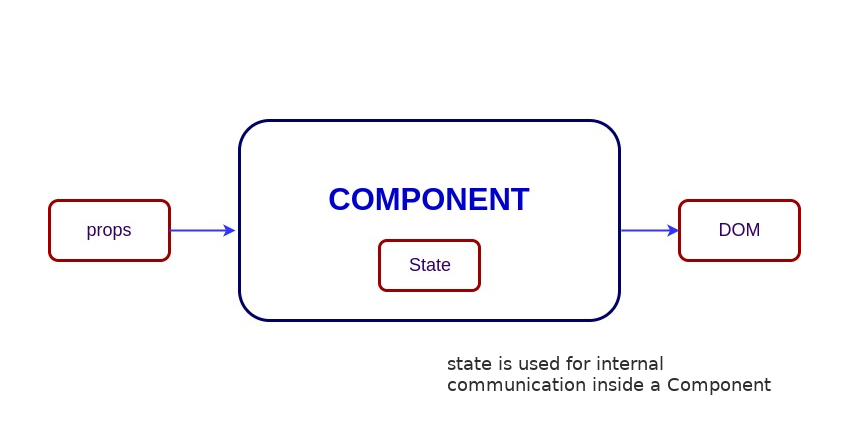
Let's take an example of User component with message state. Here, useState hook has been used to add state to the User component and it returns an array with current state and function to update it.
import { useState } from "react";

function User() {
  const [message, setMessage] = useState("Welcome to React world");

  return (
    <div>
      <h1>{message}</h1>
    </div>
  );
}
Whenever React calls your component or access useState hook, it gives you a snapshot of the state for that particular render.
See Class
import React from "react";
class User extends React.Component {
  constructor(props) {
    super(props);

    this.state = {
      message: "Welcome to React world",
    };
  }

  render() {
    return (
      <div>
        <h1>{this.state.message}</h1>
      </div>
    );
  }
}
State is similar to props, but it is private and fully controlled by the component ,i.e., it is not accessible to any other component till the owner component decides to pass it.
Q9
What are props in React?
Props are inputs to components. They are single values or objects containing a set of values that are passed to components on creation similar to HTML-tag attributes. Here, the data is passed down from a parent component to a child component.
The primary purpose of props in React is to provide following component functionality:
- Pass custom data to your component.
- Trigger state changes.
- Use via
this.props.reactPropinside component'srender()method.
For example, let us create an element with reactProp property:
<Element reactProp={"1"} />
This reactProp (or whatever you came up with) attribute name then becomes a property attached to React's native props object which originally already exists on all components created using React library.
props.reactProp;
For example, the usage of props in function component looks like below:
import React from "react";
import ReactDOM from "react-dom";

const ChildComponent = (props) => {
  return (
    <div>
      <p>{props.name}</p>
      <p>{props.age}</p>
      <p>{props.gender}</p>
    </div>
  );
};

const ParentComponent = () => {
  return (
    <div>
      <ChildComponent name="John" age="30" gender="male" />
      <ChildComponent name="Mary" age="25" geneder="female" />
    </div>
  );
};
The properties from props object can be accessed directly using destructing feature from ES6 (ECMAScript 2015). It is also possible to fallback to default value when the prop value is not specified. The above child component can be simplified like below.
const ChildComponent = ({ name, age, gender = "male" }) => {
  return (
<div>
  <p>{name}</p>
  <p>{age}</p>
  <p>{gender}</p>
</div>
  );
};
Note: The default value won't be used if you pass null or 0 value. i.e, default value is only used if the prop value is missed or undefined value has been passed.
See Class
The Props accessed in Class Based Component as belowimport React from "react";
import ReactDOM from "react-dom";
class ChildComponent extends React.Component {
render() {
return (
<div>
<p>{this.props.name}</p>
<p>{this.props.age}</p>
<p>{this.props.gender}</p>
</div>
);
}
}
class ParentComponent extends React.Component {
render() {
return (
<div>
<ChildComponent name="John" age="30" gender="male" />
<ChildComponent name="Mary" age="25" gender="female" />
</div>
);
}
}
Q10
What is the difference between state and props?
In React, both state and props are plain JavaScript objects, but they serve different purposes and have distinct behaviors:
State
- Definition:
State is a data structure that is managed within a component. It represents information that can change over the lifetime of the component. - Mutability:
State is mutable, meaning it can be changed using the setter function (setStatein class components or the updater function fromuseStatein functional components). - Scope:
State is local to the component where it is defined. Only that component can modify its own state. - Usage:
State is typically used for data that needs to change in response to user actions, network responses, or other dynamic events. - Re-rendering:
Updating the state triggers a re-render of the component and its descendants.
Props
- Definition:
Props (short for “properties”) are inputs to a component, provided by its parent component. - Mutability:
Props are read-only. A component cannot modify its own props; they are immutable from the component’s perspective. - Scope:
Props are used to pass data and event handlers down the component tree, enabling parent components to configure or communicate with their children. - Usage:
Props are commonly used to make components reusable and configurable. They allow the same component to be rendered with different data or behavior. - Analogy:
Think of props as arguments to a function, whereas state is like variables declared inside the function.
Summary Table
| Feature | State | Props |
|---|---|---|
| Managed by | The component itself | Parent component |
| Mutable | Yes | No (read-only) |
| Scope | Local to the component | Passed from parent to child |
| Usage | Manage dynamic data and UI changes | Configure and customize component |
| Update | Using setState/useState | Cannot be updated by the component |
Q11
What is the difference between HTML and React event handling?
Below are some of the main differences between HTML and React event handling,
-
In HTML, the event name usually represents in lowercase as a convention:
<button onclick="activateLasers()"></button>Whereas in React it follows camelCase convention:
<button onClick={activateLasers}> -
In HTML, you can return
falseto prevent default behavior:<a href="#" onclick='console.log("The link was clicked."); return false;' />Whereas in React you must call
preventDefault()explicitly:function handleClick(event) { event.preventDefault(); console.log("The link was clicked."); } -
In HTML, you need to invoke the function by appending
()Whereas in react you should not append()with the function name. (refer "activateLasers" function in the first point for example)
Q12
What are synthetic events in React?
SyntheticEvent is a cross-browser wrapper around the browser's native event. Its API is same as the browser's native event, including stopPropagation() and preventDefault(), except the events work identically across all browsers. The native events can be accessed directly from synthetic events using nativeEvent attribute.
Let's take an example of BookStore title search component with the ability to get all native event properties
function BookStore() {
  function handleTitleChange(e) {
    console.log("The new title is:", e.target.value);
    console.log('Synthetic event:', e); // React SyntheticEvent
    console.log('Native event:', e.nativeEvent); // Browser native event
    e.stopPropagation();
    e.preventDefault();
  }

  return <input name="title" onChange={handleTitleChange} />;
}
List of common synthetic events are:
onClickonChangeonSubmitonKeyDown,onKeyUponFocus,onBluronMouseEnter,onMouseLeaveonTouchStart,onTouchEnd
Q13
What are inline conditional expressions?
You can use either if statements or ternary expressions which are available in JS(and JSX in React) to conditionally execute or render expressions. Apart from these approaches, you can also embed any expressions in JSX by wrapping them in curly braces and then followed by JS logical operator &&. It is helpful to render elements conditionally within a single line and commonly used for concise logic, especially in JSX rendering.
<h1>Hello!</h1>;
{
  messages.length > 0 && !isLogin ? (
    <h2>You have {messages.length} unread messages.</h2>
  ) : (
    <h2>You don't have unread messages.</h2>
  );
}
Q14
What is "key" prop and what is the benefit of using it in arrays of elements?
A key is a special attribute you should include when mapping over arrays to render data. Key prop helps React identify which items have changed, are added, or are removed.
Keys should be unique among its siblings. Most often we use ID from our data as key:
const todoItems = todos.map((todo) => <li key={todo.id}>{todo.text}</li>);
When you don't have stable IDs for rendered items, you may use the item index as a key as a last resort:
const todoItems = todos.map((todo, index) => (
  <li key={index}>{todo.text}</li>
));
Benefits of key:
- Enables React to efficiently update and re-render components.
- Prevents unnecessary re-renders by reusing components when possible.
- Helps maintain internal state of list items correctly.
Note:
- Using indexes for keys is not recommended if the order of items may change. This can negatively impact performance and may cause issues with component state.
- If you extract list item as separate component then apply keys on list component instead of
litag. - There will be a warning message in the console if the
keyprop is not present on list items. - The key attribute accepts either string or number and internally convert it as string type.
- Don't generate the key on the fly something like
key={Math.random()}. Because the keys will never match up between re-renders and DOM created everytime.
Q15
What is Virtual DOM?
The Virtual DOM (VDOM) is a lightweight, in-memory representation of Real DOM used by libraries like React to optimize UI rendering. The representation of a UI is kept in memory and synced with the "real" DOM. It's a step that happens between the render function being called and the displaying of elements on the screen. This entire process is called reconciliation.
Q16
How Virtual DOM works?
The Virtual DOM works in five simple steps.
1. Initial Render
When a UI component renders for the first time, it returns JSX. React uses this structure to create a Virtual DOM tree, which is a lightweight copy of the actual DOM. This Virtual DOM is then used to build and render the Real DOM in the browser.
2. State or Props Change
When the component's state or props change, React creates a new Virtual DOM reflecting the updated UI. However, it doesn't immediately update the Real DOM; instead, it works in memory to prepare for an efficient update.

3. Diffing Algorithm
React then compares the new Virtual DOM with the previous one using a process called diffing. It determines what has changed between the two versions and identifies the minimal set of updates needed.

4. Reconciliation
Based on the diffing results, React decides which parts of the Real DOM should be updated. It avoids re-rendering the entire DOM and instead updates only the elements that actually changed.

5. Efficient DOM Updates
This entire process—working with the Virtual DOM, diffing, and selective updating—makes the UI rendering much faster and more efficient than manipulating the Real DOM directly.
Q17
What is the difference between Shadow DOM and Virtual DOM?
The Shadow DOM is a browser technology designed primarily for scoping variables and CSS in web components. The Virtual DOM is a concept implemented by libraries in JavaScript on top of browser APIs.
The key differences in a table format shown below:
| Feature | Shadow DOM | Virtual DOM |
|---|---|---|
| Purpose | Encapsulation for Web Components | Efficient UI rendering |
| Managed by | Browser | JS frameworks (e.g., React) |
| DOM Type | Part of real DOM (scoped) | In-memory representation |
| Encapsulation | Yes | No |
| Use Case | Web Components, scoped styling | UI diffing and minimal DOM updates |
Q18
What is React Fiber?
React Fiber is the new reconciliation engine in React, introduced in React 16. It’s a complete rewrite of React’s core algorithm(old stack-based algorithm) for rendering and updating the UI. Fiber enhances React’s ability to handle asynchronous rendering, prioritized updates(assign priority to different types of updates), and interruption(ability to pause, abort, or reuse work) of rendering work, enabling smoother and more responsive user interfaces.
Q19
What is the main goal of React Fiber?
The goal of React Fiber is to increase its suitability for areas like animation, layout, and gestures. Its headline feature is incremental rendering: the ability to split rendering work into chunks and spread it out over multiple frames.
Its main goals are:
- Incremental Rendering – Breaks work into chunks for smoother updates.
- Interruptible Rendering – Pauses and resumes rendering to keep the UI responsive.
- Prioritization – Handles high-priority updates (e.g. animations) before low-priority ones.
- Concurrency Support – Enables working on multiple UI versions simultaneously.
- Better Error Handling – Supports component-level error boundaries.
- Suspense Support – Allows waiting for async data before rendering.
- Improved DevTools – Enables better debugging and performance tracking.
Q20
What are controlled components?
A controlled component is a React component that fully manages the form element's state(e.g, elements like <input>, <textarea>, or <select>)) using React's internal state mechanism. i.e, The component does not manage its own internal state — instead, React acts as the single source of truth for form data.
The controlled components will be implemented using the below steps,
- Initialize the state using
useStatehooks in function components or inside constructor for class components. - Set the value of the form element to the respective state variable.
- Create an event handler(
onChange) to handle the user input changes throughuseState's updater function orsetStatefrom class component. - Attach the above event handler to form element's change or click events
Note: React re-renders the component every time the input value changes.
For example, the name input field updates the username using handleChange event handler as below,
import React, { useState } from "react";

function UserProfile() {
const [username, setUsername] = useState("");

const handleChange = (e) => {
setUsername(e.target.value);
};

return (
<form>
  <label>
    Name:
    <input type="text" value={username} onChange={handleChange} />
  </label>
</form>
);
}
In these components, DOM does not hold the actual data instead React does.
Benefits:
- Easy to implement validation, conditional formatting, or live feedback.
- Full control over form data.
- Easier to test and debug because the data is centralized in the component’s state.
Q21
What are uncontrolled components?
The Uncontrolled components are form elements (like <input>, <textarea>, or <select>) that manage their own state internally via the DOM, rather than through React state.
You can query the DOM using a ref to find its current value when you need it. This is a bit more like traditional HTML.
The uncontrolled components will be implemented using the below steps,
- Create a ref using
useRefreact hook in function component orReact.createRef()in class based component. - Attach this
refto the form element. - The form element value can be accessed directly through
refin event handlers orcomponentDidMountfor class components
In the below UserProfile component, the username input is accessed using ref.
import React, { useRef } from "react";

function UserProfile() {
  const usernameRef = useRef(null);

  const handleSubmit = (event) => {
    event.preventDefault();
    console.log("The submitted username is: " + usernameRef.current.value);
  };

  return (
    <form onSubmit={handleSubmit}>
      <label>
        Username:
        <input type="text" ref={usernameRef} />
      </label>
      <button type="submit">Submit</button>
    </form>
  );
}
Note: Here, DOM is in charge of the value. React only accesses the value when needed (via ref).
Benefits:
- Less boilerplate — no need for
useStateandonChange. - Useful for quick form setups or when integrating with non-React code.
- Slightly better performance in very large forms (fewer re-renders).
In most cases, it's recommend to use controlled components to implement forms. In a controlled component, form data is handled by a React component. The alternative is uncontrolled components, where form data is handled by the DOM itself.
See Class
class UserProfile extends React.Component {
  constructor(props) {
    super(props);
    this.handleSubmit = this.handleSubmit.bind(this);
    this.input = React.createRef();
  }

  handleSubmit(event) {
    alert("A name was submitted: " + this.input.current.value);
    event.preventDefault();
  }

  render() {
    return (
      <form onSubmit={this.handleSubmit}>
        <label>
          {"Name:"}
          <input type="text" ref={this.input} />
        </label>
        <input type="submit" value="Submit" />
      </form>
    );
  }
}
Q22
What is the difference between createElement and cloneElement?
Both React.createElement and React.cloneElement are used to work with React elements, but they serve different purposes.
createElement:
Creates a new React element from scratch. JSX elements will be transpiled to React.createElement() functions to create React elements which are going to be used for the object representation of UI.
Syntax:
React.createElement(type, props, ...children)
Example:
React.createElement('button', { className: 'btn' }, 'Click Me')
cloneElement:
The cloneElement method is used to clone an existing React element and optionally adds or overrides props.
Syntax:
React.cloneElement(element, newProps, ...children)
Example:
const button = <button className="btn">Click Me</button>;
const cloned = React.cloneElement(button, { className: 'btn-primary' });
// Result: <button className="btn-primary">Click Me</button>
Q23
What is Lifting State Up in React?
When several components need to share the same changing data then it is recommended to lift the shared state up to their closest common ancestor. That means if two child components share the same data from its parent, then move the state to parent instead of maintaining local state in both of the child components.
Q24
What are Higher-Order Components?
A higher-order component (HOC) is a function that takes a component and returns a new enhanced component with additional props, behavior, or data. It’s a design pattern based on React’s compositional nature, allowing you to reuse logic across multiple components without modifying their internals.
We consider HOCs pure components because they don’t mutate or copy behavior from the original component—they simply wrap it, enhance it, and pass through the necessary props. The wrapped component remains decoupled and reusable.
const EnhancedComponent = higherOrderComponent(WrappedComponent);
Let's take an example of a withAuth higher-order component (HOC) in React. This HOC will check if a user is authenticated and either render the wrapped component if authenticated or redirect (or show a message) if not.
withAuth HOC Example:
import React from 'react';
import { Navigate } from 'react-router-dom'; // For redirection (assuming React Router v6)

const isAuthenticated = () => {
  // e.g., check for a valid token in localStorage or context
  return !!localStorage.getItem('authToken');
};

function withAuth(WrappedComponent) {
  return function AuthenticatedComponent(props) {
    if (!isAuthenticated()) {
      // User is NOT authenticated, redirect to login page
      return <Navigate to="/login" replace />;
    }

    // User is authenticated, render the wrapped component
    return <WrappedComponent {...props} />;
  };
}

export default withAuth;
Usage
import React from 'react';
import withAuth from './withAuth';

function Dashboard() {
  return <h1>Welcome to the Dashboard!</h1>;
}

// Wrap Dashboard with withAuth HOC
export default withAuth(Dashboard);
HOC can be used for many use cases:
- Code reuse, logic and bootstrap abstraction (e.g., fetching data, permissions, theming).
- Render hijacking (e.g., conditional rendering or layout changes).
- State abstraction and manipulation(e.g., handling form logic).
- Props manipulation(e.g., injecting additional props or filtering them).
Some of the real-world examples of HOCs in react eco-system:
- connect() from react-redux
- withRouter() from React Router v5
- withTranslation() from react-i18next
- withApollo() from Apollo client
- withFormik from Formik library
- withTheme from styled components
Q25
What is children prop?
The children prop is a special prop in React used to pass elements between the opening and closing tags of a component. It is commonly used in layout and wrapper componnents.
A simple usage of children prop looks as below,
function MyDiv({ children }){
    return (
      <div>
        {children}
      </div>;
    );
}

export default function Greeting() {
  return (
    <MyDiv>
      <span>{"Hello"}</span>
      <span>{"World"}</span>
    </MyDiv>
  );
}
Here, everything inside <MyDiv>...</MyDiv> is passed as children to the custom div component.
The children can be text, JSX elements, fragments, arrays and functions(for advance use case like render props).
See Class
const MyDiv = React.createClass({
  render: function () {
    return <div>{this.props.children}</div>;
  },
});

ReactDOM.render(
  <MyDiv>
    <span>{"Hello"}</span>
    <span>{"World"}</span>
  </MyDiv>,
  node
);
Note: There are several methods available in the legacy React API to work with this prop. These include React.Children.map, React.Children.forEach, React.Children.count, React.Children.only, React.Children.toArray.
Q26
How to write comments in React?
The comments in React/JSX are similar to JavaScript Multiline comments but are wrapped in curly braces.
Single-line comments:
<div>
  {/* Single-line comments(In vanilla JavaScript, the single-line comments are represented by double slash(//)) */}
  {`Welcome ${user}, let's play React`}
</div>
Multi-line comments:
<div>
  {/* Multi-line comments for more than
   one line */}
  {`Welcome ${user}, let's play React`}
</div>
You can use // and /* */ in JS logic, hooks, and functions.
Q27
What is reconciliation?
Reconciliation is the process through which React updates the Browser DOM and makes React work faster. React use a diffing algorithm so that component updates are predictable and faster. React would first calculate the difference between the real DOM and the copy of DOM (Virtual DOM) when there's an update of components.
React stores a copy of Browser DOM which is called Virtual DOM. When we make changes or add data, React creates a new Virtual DOM and compares it with the previous one. This comparison is done by Diffing Algorithm.
Now React compares the Virtual DOM with Real DOM. It finds out the changed nodes and updates only the changed nodes in Real DOM leaving the rest nodes as it is. This process is called Reconciliation.
Q28
Does the lazy function support named exports?
No, currently React.lazy function supports default exports only. If you would like to import modules which are named exports, you can create an intermediate module that reexports it as the default. It also ensures that tree shaking keeps working and don’t pull unused components.
Let's take a component file which exports multiple named components,
// MoreComponents.js
export const SomeComponent = /* ... */;
export const UnusedComponent = /* ... */;
and reexport MoreComponents.js components in an intermediate file IntermediateComponent.js
// IntermediateComponent.js
export { SomeComponent as default } from "./MoreComponents.js";
Now you can import the module using lazy function as below,
import React, { lazy } from "react";
const SomeComponent = lazy(() => import("./IntermediateComponent.js"));
Q29
Why React uses `className` over `class` attribute?
React uses className instead of class because of a JavaScript naming conflict with the class keyword.
-
classis a reserved keyword in JavaScript In JavaScript, class is used to define ES6 classes:class Person { constructor(name) { this.name = name; } }If you try to use class as a variable or property name, it will throw a syntax error. Since JSX is just JavaScript with XML-like syntax, using class directly in JSX would break the parser.
-
JSX Is JavaScript
When you write JSX like this:
<div class="btn">Click</div>It will be compiled to:
React.createElement('div', { class: 'btn' }, 'Click');But
classis invalid in this object literal context (since it clashes with the JS keyword), hence React instead uses className.<div className="btn">Click</div>which compiles to:
React.createElement('div', { className: 'btn' }, 'Click');React then translates
classNametoclassin the final HTML DOM. -
Aligns with DOM APIs In vanilla JavaScript, you interact with element classes using:
element.className = 'my-class';React follows this convention, staying consistent with the DOM API's property name rather than HTML’s attribute.
Q30
What are fragments?
It's a common pattern or practice in React for a component to return multiple elements. Fragments let you group a list of children without adding extra nodes to the DOM.
You need to use either <Fragment> or a shorter syntax having empty tag (<></>).
Below is the example of how to use fragment inside Story component.
function Story({ title, description, date }) {
  return (
    <Fragment>
      <h2>{title}</h2>
      <p>{description}</p>
      <p>{date}</p>
    </Fragment>
  );
}
It is also possible to render list of fragments inside a loop with the mandatory key attribute supplied.
function StoryBook() {
  return stories.map((story) => (
    <Fragment key={story.id}>
      <h2>{story.title}</h2>
      <p>{story.description}</p>
      <p>{story.date}</p>
    </Fragment>
  ));
}
Usually, you don't need to use <Fragment> until there is a need of key attribute. The usage of shorter syntax looks like below.
function Story({ title, description, date }) {
  return (
    <>
      <h2>{title}</h2>
      <p>{description}</p>
      <p>{date}</p>
    </>
  );
}
Q31
Why fragments are better than container divs?
Below are the list of reasons to prefer fragments over container DOM elements,
- Fragments are a bit faster and use less memory by not creating an extra DOM node. This only has a real benefit on very large and deep trees.
- Some CSS mechanisms like Flexbox and CSS Grid have a special parent-child relationships, and adding divs in the middle makes it hard to keep the desired layout.
- The DOM Inspector is less cluttered.
Q32
What are portals in React?
A Portal is a React feature that enables rendering children into a DOM node that exists outside the parent component's DOM hierarchy, while still preserving the React component hierarchy. Portals help avoid CSS stacking issues—for example, elements with position: fixed may not behave as expected inside a parent with transform. Portals solve this by rendering content (like modals or tooltips) outside such constrained DOM contexts.
ReactDOM.createPortal(child, container);
child: Any valid React node (e.g., JSX, string, fragment).container: A real DOM node (e.g.,document.getElementById('modal-root')).
Even though the content renders elsewhere in the DOM, it still behaves like a normal child in React. It has access to context, state, and event handling.
Example:- Modal:
function Modal({ children }) {
  return ReactDOM.createPortal(
    <div className="modal">{children}</div>,
    document.body)
  );
}
The above code will render the modal content into the body element in the HTML, not inside the component's usual location.
Q33
What are stateless components?
If the behaviour of a component is independent of its state then it can be a stateless component. You can use either a function or a class for creating stateless components. But unless you need to use a lifecycle hook in your components, you should go for function components. There are a lot of benefits if you decide to use function components here; they are easy to write, understand, and test, a little faster, and you can avoid the this keyword altogether.
Q34
What are stateful components?
If the behaviour of a component is dependent on the state of the component then it can be termed as stateful component. These stateful components are either function components with hooks or class components.
Let's take an example of function stateful component which update the state based on click event,
import React, {useState} from 'react';

const App = (props) => {
const [count, setCount] = useState(0);
handleIncrement() {
  setCount(count+1);
}

return (
  <>
    <button onClick={handleIncrement}>Increment</button>
    <span>Counter: {count}</span>
  </>
  )
}
See Class
The equivalent class stateful component with a state that gets initialized in the `constructor`.
class App extends Component {
  constructor(props) {
    super(props);
    this.state = { count: 0 };
  }

  handleIncrement() {
    setState({ count: this.state.count + 1 });
  }

  render() {
    <>
      <button onClick={() => this.handleIncrement}>Increment</button>
      <span>Count: {count}</span>
    </>;
  }
}
Q35
How to apply validation on props in React?
When the application is running in development mode, React will automatically check all props that we set on components to make sure they have correct type. If the type is incorrect, React will generate warning messages in the console. It's disabled in production mode due to performance impact. The mandatory props are defined with isRequired.
The set of predefined prop types:
PropTypes.numberPropTypes.stringPropTypes.arrayPropTypes.objectPropTypes.funcPropTypes.nodePropTypes.elementPropTypes.boolPropTypes.symbolPropTypes.any
We can define propTypes for User component as below:
import React from "react";
import PropTypes from "prop-types";

class User extends React.Component {
  static propTypes = {
    name: PropTypes.string.isRequired,
    age: PropTypes.number.isRequired,
  };

  render() {
    return (
      <>
        <h1>{`Welcome, ${this.props.name}`}</h1>
        <h2>{`Age, ${this.props.age}`}</h2>
      </>
    );
  }
}
Note: In React v15.5 PropTypes were moved from React.PropTypes to prop-types library.
The Equivalent Functional Component
import React from "react";
import PropTypes from "prop-types";

function User({ name, age }) {
  return (
    <>
      <h1>{`Welcome, ${name}`}</h1>
      <h2>{`Age, ${age}`}</h2>
    </>
  );
}

User.propTypes = {
  name: PropTypes.string.isRequired,
  age: PropTypes.number.isRequired,
};
Q36
What are the advantages of React?
Below are the list of main advantages of React,
- Increases the application's performance with Virtual DOM.
- JSX makes code easy to read and write.
- It renders both on client and server side (SSR).
- Easy to integrate with frameworks (Angular, Backbone) since it is only a view library.
- Easy to write unit and integration tests with tools such as Jest.
Q37
What are the limitations of React?
Apart from the advantages, there are few limitations of React too,
- React is just a view library, not a full framework.
- There is a learning curve for beginners who are new to web development.
- Integrating React into a traditional MVC framework requires some additional configuration.
- The code complexity increases with inline templating and JSX.
- Too many smaller components leading to over engineering or boilerplate.
Q38
What are the recommended ways for static type checking?
Normally we use PropTypes library (React.PropTypes moved to a prop-types package since React v15.5) for type checking in the React applications. For large code bases, it is recommended to use static type checkers such as Flow or TypeScript, that perform type checking at compile time and provide auto-completion features.
Q39
What is the use of `react-dom` package?
The react-dom package provides DOM-specific methods that can be used at the top level of your app. Most of the components are not required to use this module. Some of the methods of this package are:
render()hydrate()unmountComponentAtNode()findDOMNode()createPortal()
Q40
What is ReactDOMServer?
The ReactDOMServer object enables you to render components to static markup (typically used on node server). This object is mainly used for server-side rendering (SSR). The following methods can be used in both the server and browser environments:
renderToString()renderToStaticMarkup()
For example, you generally run a Node-based web server like Express, Hapi, or Koa, and you call renderToString to render your root component to a string, which you then send as response.
// using Express
import { renderToString } from "react-dom/server";
import MyPage from "./MyPage";

app.get("/", (req, res) => {
  res.write(
    "<!DOCTYPE html><html><head><title>My Page</title></head><body>"
  );
  res.write('<div id="content">');
  res.write(renderToString(<MyPage />));
  res.write("</div></body></html>");
  res.end();
});
Q41
How to use innerHTML in React?
The dangerouslySetInnerHTML attribute is React's replacement for using innerHTML in the browser DOM. Just like innerHTML, it is risky to use this attribute considering cross-site scripting (XSS) attacks. You just need to pass a __html object as key and HTML text as value.
In this example MyComponent uses dangerouslySetInnerHTML attribute for setting HTML markup:
function createMarkup() {
  return { __html: "First · Second" };
}

function MyComponent() {
  return <div dangerouslySetInnerHTML={createMarkup()} />;
}
Q42
How to use styles in React?
The style attribute accepts a JavaScript object with camelCased properties rather than a CSS string. This is consistent with the DOM style JavaScript property, is more efficient, and prevents XSS security holes.
const divStyle = {
  color: "blue",
  backgroundImage: "url(" + imgUrl + ")",
};

function HelloWorldComponent() {
  return <div style={divStyle}>Hello World!</div>;
}
Style keys are camelCased in order to be consistent with accessing the properties on DOM nodes in JavaScript (e.g. node.style.backgroundImage).
Q43
How events are different in React?
Handling events in React elements has some syntactic differences:
- React event handlers are named using camelCase, rather than lowercase.
- With JSX you pass a function as the event handler, rather than a string.
Q44
What is the impact of indexes as keys?
Keys should be stable, predictable, and unique so that React can keep track of elements.
In the below code snippet each element's key will be based on ordering, rather than tied to the data that is being represented. This limits the optimizations that React can do and creates confusing bugs in the application.
{
  todos.map((todo, index) => <Todo {...todo} key={index} />);
}
If you use element data for unique key, assuming todo.id is unique to this list and stable, React would be able to reorder elements without needing to reevaluate them as much.
{
  todos.map((todo) => <Todo {...todo} key={todo.id} />);
}
Note: If you don't specify key prop at all, React will use index as a key's value while iterating over an array of data.
Q45
How do you conditionally render components?
In some cases you want to render different components depending on some state. JSX does not render false or undefined, so you can use conditional short-circuiting to render a given part of your component only if a certain condition is true.
const MyComponent = ({ name, address }) => (
  <div>
    <h2>{name}</h2>
    {address && <p>{address}</p>}
  </div>
);
If you need an if-else condition then use ternary operator.
const MyComponent = ({ name, address }) => (
  <div>
    <h2>{name}</h2>
    {address ? <p>{address}</p> : <p>{"Address is not available"}</p>}
  </div>
);
Q46
Why we need to be careful when spreading props on DOM elements?
When we spread props we run into the risk of adding unknown HTML attributes, which is a bad practice. Instead we can use prop destructuring with ...rest operator, so it will add only required props.
For example,
const ComponentA = () => (
  <ComponentB isDisplay={true} className={"componentStyle"} />
);

const ComponentB = ({ isDisplay, ...domProps }) => (
  <div {...domProps}>{"ComponentB"}</div>
);
Q47
How do you memoize a component?
There are memoize libraries available which can be used on function components.
For example moize library can memoize the component in another component.
import moize from "moize";
import Component from "./components/Component"; // this module exports a non-memoized component

const MemoizedFoo = moize.react(Component);

const Consumer = () => {
  <div>
    {"I will memoize the following entry:"}
    <MemoizedFoo />
  </div>;
};
Update: Since React v16.6.0, we have a React.memo. It provides a higher order component which memoizes component unless the props change. To use it, simply wrap the component using React.memo before you use it.
const MemoComponent = React.memo(function MemoComponent(props) {
  /* render using props */
});
OR;
export default React.memo(MyFunctionComponent);
Q48
How you implement Server Side Rendering or SSR?
React is already equipped to handle rendering on Node servers. A special version of the DOM renderer is available, which follows the same pattern as on the client side.
import ReactDOMServer from "react-dom/server";
import App from "./App";

ReactDOMServer.renderToString(<App />);
This method will output the regular HTML as a string, which can be then placed inside a page body as part of the server response. On the client side, React detects the pre-rendered content and seamlessly picks up where it left off.
Q49
How to enable production mode in React?
You should use Webpack's DefinePlugin method to set NODE_ENV to production, by which it strip out things like propType validation and extra warnings. Apart from this, if you minify the code, for example, Uglify's dead-code elimination to strip out development only code and comments, it will drastically reduce the size of your bundle.
Q50
Do Hooks replace render props and higher order components?
Both render props and higher-order components render only a single child but in most of the cases Hooks are a simpler way to serve this by reducing nesting in your tree.
Q51
What is a switching component?
A switching component is a component that renders one of many components. We need to use object to map prop values to components.
For example, a switching component to display different pages based on page prop:
import HomePage from "./HomePage";
import AboutPage from "./AboutPage";
import ServicesPage from "./ServicesPage";
import ContactPage from "./ContactPage";

const PAGES = {
  home: HomePage,
  about: AboutPage,
  services: ServicesPage,
  contact: ContactPage,
};

const Page = (props) => {
  const Handler = PAGES[props.page] || ContactPage;

  return <Handler {...props} />;
};

// The keys of the PAGES object can be used in the prop types to catch dev-time errors.
Page.propTypes = {
  page: PropTypes.oneOf(Object.keys(PAGES)).isRequired,
};
Q52
What are React Mixins?
Mixins are a way to totally separate components to have a common functionality. Mixins should not be used and can be replaced with higher-order components or decorators.
One of the most commonly used mixins is PureRenderMixin. You might be using it in some components to prevent unnecessary re-renders when the props and state are shallowly equal to the previous props and state:
const PureRenderMixin = require("react-addons-pure-render-mixin");

const Button = React.createClass({
  mixins: [PureRenderMixin],
  // ...
});
Q53
What are the Pointer Events supported in React?
Pointer Events provide a unified way of handling all input events. In the old days we had a mouse and respective event listeners to handle them but nowadays we have many devices which don't correlate to having a mouse, like phones with touch surface or pens. We need to remember that these events will only work in browsers that support the Pointer Events specification.
The following event types are now available in React DOM:
onPointerDownonPointerMoveonPointerUponPointerCancelonGotPointerCaptureonLostPointerCaptureonPointerEnteronPointerLeaveonPointerOveronPointerOut
Q54
Why should component names start with capital letter?
If you are rendering your component using JSX, the name of that component has to begin with a capital letter otherwise React will throw an error as an unrecognized tag. This convention is because only HTML elements and SVG tags can begin with a lowercase letter.
function SomeComponent {
  // Code goes here
}
You can define function component whose name starts with lowercase letter, but when it's imported it should have a capital letter. Here lowercase is fine:
function myComponent {
  render() {
    return <div />;
  }
}

export default myComponent;
While when imported in another file it should start with capital letter:
import MyComponent from "./myComponent";
Q55
Are custom DOM attributes supported in React v16?
Yes. In the past, React used to ignore unknown DOM attributes. If you wrote JSX with an attribute that React doesn't recognize, React would just skip it.
For example, let's take a look at the below attribute:
<div mycustomattribute={"something"} />
Would render an empty div to the DOM with React v15:
<div />
In React v16 any unknown attributes will end up in the DOM:
<div mycustomattribute="something" />
This is useful for supplying browser-specific non-standard attributes, trying new DOM APIs, and integrating with opinionated third-party libraries.
Q56
How to loop inside JSX?
You can simply use Array.prototype.map with ES6 arrow function syntax.
For example, the items array of objects is mapped into an array of components:
<tbody>
  {items.map((item) => (
    <SomeComponent key={item.id} name={item.name} />
  ))}
</tbody>
But you can't iterate using for loop:
<tbody>
  for (let i = 0; i < items.length; i++) {
    <SomeComponent key={items[i].id} name={items[i].name} />
  }
</tbody>
This is because JSX tags are transpiled into function calls, and you can't use statements inside expressions. This may change thanks to do expressions which are stage 1 proposal.
Q57
How do you access props in attribute quotes?
React (or JSX) doesn't support variable interpolation inside an attribute value. The below representation won't work:
<img className="image" src="/images/reactjs/{this.props.image}" />
But you can put any JS expression inside curly braces as the entire attribute value. So the below expression works:
<img className="image" src={"images/" + this.props.image} />
Using template strings will also work:
<img className="image" src={`images/${this.props.image}`} />
Q58
What is React proptype array with shape?
If you want to pass an array of objects to a component with a particular shape then use React.PropTypes.shape() as an argument to React.PropTypes.arrayOf().
ReactComponent.propTypes = {
  arrayWithShape: React.PropTypes.arrayOf(
    React.PropTypes.shape({
      color: React.PropTypes.string.isRequired,
      fontSize: React.PropTypes.number.isRequired,
    })
  ).isRequired,
};
Q59
How to conditionally apply class attributes?
You shouldn't use curly braces inside quotes because it is going to be evaluated as a string.
<div className="btn-panel {this.props.visible ? 'show' : 'hidden'}">
Instead you need to move curly braces outside (don't forget to include spaces between class names):
<div className={'btn-panel ' + (this.props.visible ? 'show' : 'hidden')}>
Template strings will also work:
<div className={`btn-panel ${this.props.visible ? 'show' : 'hidden'}`}>
Q60
What is the difference between React and ReactDOM?
The react package contains React.createElement(), React.Component, React.Children, and other helpers related to elements and component classes. You can think of these as the isomorphic or universal helpers that you need to build components. The react-dom package contains ReactDOM.render(), and in react-dom/server we have server-side rendering support with ReactDOMServer.renderToString() and ReactDOMServer.renderToStaticMarkup().
Q61
Why ReactDOM is separated from React?
The React team worked on extracting all DOM-related features into a separate library called ReactDOM. React v0.14 is the first release in which the libraries are split. By looking at some of the packages, react-native, react-art, react-canvas, and react-three, it has become clear that the beauty and essence of React has nothing to do with browsers or the DOM.
To build more environments that React can render to, React team planned to split the main React package into two: react and react-dom. This paves the way to writing components that can be shared between the web version of React and React Native.
Q62
How to use React label element?
If you try to render a <label> element bound to a text input using the standard for attribute, then it produces HTML missing that attribute and prints a warning to the console.
<label for={'user'}>{'User'}</label>
<input type={'text'} id={'user'} />
Since for is a reserved keyword in JavaScript, use htmlFor instead.
<label htmlFor={'user'}>{'User'}</label>
<input type={'text'} id={'user'} />
Q63
How to combine multiple inline style objects?
You can use spread operator in regular React:
<button style={{ ...styles.panel.button, ...styles.panel.submitButton }}>
  {"Submit"}
</button>
If you're using React Native then you can use the array notation:
<button style={[styles.panel.button, styles.panel.submitButton]}>
  {"Submit"}
</button>
Q64
How to re-render the view when the browser is resized?
You can use the useState hook to manage the width and height state variables, and the useEffect hook to add and remove the resize event listener. The [] dependency array passed to useEffect ensures that the effect only runs once (on mount) and not on every re-render.
import React, { useState, useEffect } from "react";
function WindowDimensions() {
  const [dimensions, setDimensions] = useState({
    width: window.innerWidth,
    height: window.innerHeight,
  });

  useEffect(() => {
    function handleResize() {
      setDimensions({
        width: window.innerWidth,
        height: window.innerHeight,
      });
    }
    window.addEventListener("resize", handleResize);
    return () => window.removeEventListener("resize", handleResize);
  }, []);

  return (
    <span>
      {dimensions.width} x {dimensions.height}
    </span>
  );
}
Using Class Component
You can listen to the resize event in componentDidMount() and then update the dimensions (width and height). You should remove the listener in componentWillUnmount() method.
class WindowDimensions extends React.Component {
  constructor(props) {
    super(props);
    this.updateDimensions = this.updateDimensions.bind(this);
  }

  componentWillMount() {
    this.updateDimensions();
  }

  componentDidMount() {
    window.addEventListener("resize", this.updateDimensions);
  }

  componentWillUnmount() {
    window.removeEventListener("resize", this.updateDimensions);
  }

  updateDimensions() {
    this.setState({
      width: window.innerWidth,
      height: window.innerHeight,
    });
  }

  render() {
    return (
      <span>
        {this.state.width} x {this.state.height}
      </span>
    );
  }
}
Q65
How to pretty print JSON with React?
We can use <pre> tag so that the formatting of the JSON.stringify() is retained:
const data = { name: "John", age: 42 };

function User {
    return <pre>{JSON.stringify(data, null, 2)}</pre>;
}

const container = createRoot(document.getElementById("container"));

container.render(<User />);
See Class
const data = { name: "John", age: 42 };

class User extends React.Component {
  render() {
    return <pre>{JSON.stringify(data, null, 2)}</pre>;
  }
}

React.render(<User />, document.getElementById("container"));
Q66
Why can't you update props in React?
The React philosophy is that props should be immutable(read only) and top-down. This means that a parent can send any prop values to a child, but the child can't modify received props.
Q67
How to focus an input element on page load?
You need to use useEffect hook to set focus on input field during page load time for functional component.
import React, { useEffect, useRef } from "react";

const App = () => {
  const inputElRef = useRef(null);

  useEffect(() => {
    inputElRef.current.focus();
  }, []);

  return (
    <div>
      <input defaultValue={"Won't focus"} />
      <input ref={inputElRef} defaultValue={"Will focus"} />
    </div>
  );
};

ReactDOM.render(<App />, document.getElementById("app"));
See Class
You can do it by creating _ref_ for `input` element and using it in `componentDidMount()`:
class App extends React.Component {
  componentDidMount() {
    this.nameInput.focus();
  }

  render() {
    return (
      <div>
        <input defaultValue={"Won't focus"} />
        <input
          ref={(input) => (this.nameInput = input)}
          defaultValue={"Will focus"}
        />
      </div>
    );
  }
}

ReactDOM.render(<App />, document.getElementById("app"));
Q68
How can we find the version of React at runtime in the browser?
You can use React.version to get the version.
const REACT_VERSION = React.version;

ReactDOM.render(
  <div>{`React version: ${REACT_VERSION}`}</div>,
  document.getElementById("app")
);
Q69
How to add Google Analytics for React Router?
Add a listener on the history object to record each page view:
history.listen(function (location) {
  window.ga("set", "page", location.pathname + location.search);
  window.ga("send", "pageview", location.pathname + location.search);
});
Q70
How do you apply vendor prefixes to inline styles in React?
React does not apply vendor prefixes automatically. You need to add vendor prefixes manually.
<div
  style={{
    transform: "rotate(90deg)",
    WebkitTransform: "rotate(90deg)", // note the capital 'W' here
    msTransform: "rotate(90deg)", // 'ms' is the only lowercase vendor prefix
  }}
/>
Q71
How to import and export components using React and ES6?
You should use default for exporting the components
import User from "user";

export default function MyProfile {
    return <User type="customer">//...</User>;
}
See Class
```jsx harmony import React from "react"; import User from "user";
export default class MyProfile extends React.Component {
render() {
return
</p>
</details>

With the export specifier, the MyProfile is going to be the member and exported to this module and the same can be imported without mentioning the name in other components.
Q72
What are the exceptions on React component naming?
The component names should start with an uppercase letter but there are few exceptions to this convention. The lowercase tag names with a dot (property accessors) are still considered as valid component names. For example, the below tag can be compiled to a valid component,
     render() {
          return (
            <obj.component/> // `React.createElement(obj.component)`
          )
    }
Q73
Is it possible to use async/await in plain React?
Yes, you can use async/await in plain React, as long as your JavaScript environment supports ES2017+. Nowadays most modern browsers and build tools support ES2017+ version. If you're using Create React App, Next.js, Remix, or any modern React setup, async/await is supported out of the box through Babel.
Example Usage
import { useEffect, useState } from 'react';

function UserProfile() {
  const [user, setUser] = useState(null);

  useEffect(() => {
    const fetchUser = async () => {
      const response = await fetch('/api/user');
      const data = await response.json();
      setUser(data);
    };

    fetchUser();
  }, []);

  return user ? <div>Hello, {user.name}</div> : <div>Loading...</div>;
}
But If you're not using a bundler like Webpack or Babel, you will need Babel and transform-async-to-generator plugin. However, React Native ships with Babel and a set of transforms.
Q74
What are the common folder structures for React?
There are two common practices for React project file structure.
- Grouping by features or routes:
One common way to structure projects is locate CSS, JS, and tests together, grouped by feature or route.
```
common/
├─ Avatar.js
├─ Avatar.css
├─ APIUtils.js
└─ APIUtils.test.js
feed/
├─ index.js
├─ Feed.js
├─ Feed.css
├─ FeedStory.js
├─ FeedStory.test.js
└─ FeedAPI.js
profile/
├─ index.js
├─ Profile.js
├─ ProfileHeader.js
├─ ProfileHeader.css
└─ ProfileAPI.js
```
2. Grouping by file type:
Another popular way to structure projects is to group similar files together.

```
api/
├─ APIUtils.js
├─ APIUtils.test.js
├─ ProfileAPI.js
└─ UserAPI.js
components/
├─ Avatar.js
├─ Avatar.css
├─ Feed.js
├─ Feed.css
├─ FeedStory.js
├─ FeedStory.test.js
├─ Profile.js
├─ ProfileHeader.js
└─ ProfileHeader.css
```
Q75
What are the popular packages for animation?
React Transition Group and React Motion are popular animation packages in React ecosystem.
Q76
What is the benefit of styles modules?
It is recommended to avoid hard coding style values in components. Any values that are likely to be used across different UI components should be extracted into their own modules.
For example, these styles could be extracted into a separate component:
export const colors = {
  white,
  black,
  blue,
};

export const space = [0, 8, 16, 32, 64];
And then imported individually in other components:
import { space, colors } from "./styles";
Q77
What are the popular React-specific linters?
ESLint is a popular JavaScript linter. There are plugins available that analyse specific code styles. One of the most common for React is an npm package called eslint-plugin-react. By default, it will check a number of best practices, with rules checking things from keys in iterators to a complete set of prop types.
Another popular plugin is eslint-plugin-jsx-a11y, which will help fix common issues with accessibility. As JSX offers slightly different syntax to regular HTML, issues with alt text and tabindex, for example, will not be picked up by regular plugins.
React Router
Q78
What is React Router?
React Router is a powerful routing library built on top of React that helps you add new screens and flows to your application incredibly quickly, all while keeping the URL in sync with what's being displayed on the page.
Q79
How React Router is different from history library?
React Router is a wrapper around the history library which handles interaction with the browser's window.history with its browser and hash histories. It also provides memory history which is useful for environments that don't have global history, such as mobile app development (React Native) and unit testing with Node.
Q80
What are the `<Router>` components of React Router v6?
React Router v6 provides below 4 <Router> components:
<BrowserRouter>:Uses the HTML5 history API for standard web apps.<HashRouter>:Uses hash-based routing for static servers.<MemoryRouter>:Uses in-memory routing for testing and non-browser environments.<StaticRouter>:Provides static routing for server-side rendering (SSR).
The above components will create browser, hash, memory and static history instances. React Router v6 makes the properties and methods of the history instance associated with your router available through the context in the router object.
Q81
What is the purpose of `push()` and `replace()` methods of `history`?
A history instance has two methods for navigation purpose.
push()replace()
If you think of the history as an array of visited locations, push() will add a new location to the array and replace() will replace the current location in the array with the new one.
Q82
How do you programmatically navigate using React Router v4?
There are three different ways to achieve programmatic routing/navigation within components.
-
Using the
withRouter()higher-order function:The
withRouter()higher-order function will inject the history object as a prop of the component. This object providespush()andreplace()methods to avoid the usage of context.import { withRouter } from "react-router-dom"; // this also works with 'react-router-native' const Button = withRouter(({ history }) => ( <button type="button" onClick={() => { history.push("/new-location"); }} > {"Click Me!"} </button> )); -
Using
<Route>component and render props pattern:The
<Route>component passes the same props aswithRouter(), so you will be able to access the history methods through the history prop.import { Route } from "react-router-dom"; const Button = () => ( <Route render={({ history }) => ( <button type="button" onClick={() => { history.push("/new-location"); }} > {"Click Me!"} </button> )} /> ); -
Using context:
This option is not recommended and treated as unstable API.
const Button = (props, context) => (
  <button
    type="button"
    onClick={() => {
      context.history.push("/new-location");
    }}
  >
    {"Click Me!"}
  </button>
);

Button.contextTypes = {
  history: React.PropTypes.shape({
    push: React.PropTypes.func.isRequired,
  }),
};
Q83
How to get query parameters in React Router v4?
The ability to parse query strings was taken out of React Router v4 because there have been user requests over the years to support different implementation. So the decision has been given to users to choose the implementation they like. The recommended approach is to use query strings library.
const queryString = require("query-string");
const parsed = queryString.parse(props.location.search);
You can also use URLSearchParams if you want something native:
const params = new URLSearchParams(props.location.search);
const foo = params.get("name");
You should use a polyfill for IE11.
Q84
Why you get "Router may have only one child element" warning?
You have to wrap your Route's in a <Switch> block because <Switch> is unique in that it renders a route exclusively.
At first you need to add Switch to your imports:
import { Switch, Router, Route } from "react-router";
Then define the routes within <Switch> block:
<Router>
  <Switch>
    <Route {/* ... */} />
    <Route {/* ... */} />
  </Switch>
</Router>
Q85
How to pass params to `history.push` method in React Router v4?
While navigating you can pass props to the history object:
this.props.history.push({
  pathname: "/template",
  search: "?name=sudheer",
  state: { detail: response.data },
});
The search property is used to pass query params in push() method.
Q86
How to implement _default_ or _NotFound_ page?
A <Switch> renders the first child <Route> that matches. A <Route> with no path always matches. So you just need to simply drop path attribute as below
<Switch>
  <Route exact path="/" component={Home} />
  <Route path="/user" component={User} />
  <Route component={NotFound} />
</Switch>
Q87
How to get history on React Router v4?
Below are the list of steps to get history object on React Router v4,
-
Create a module that exports a
historyobject and import this module across the project.For example, create
history.jsfile:import { createBrowserHistory } from "history"; export default createBrowserHistory({ /* pass a configuration object here if needed */ }); -
You should use the
<Router>component instead of built-in routers. Import the abovehistory.jsinsideindex.jsfile:import { Router } from "react-router-dom"; import history from "./history"; import App from "./App"; ReactDOM.render( <Router history={history}> <App /> </Router>, holder ); -
You can also use push method of
historyobject similar to built-in history object:// some-other-file.js import history from "./history"; history.push("/go-here");
Q88
How to perform automatic redirect after login?
The react-router package provides <Redirect> component in React Router. Rendering a <Redirect> will navigate to a new location. Like server-side redirects, the new location will override the current location in the history stack.
import { Redirect } from "react-router";

export default function Login {
    if (this.state.isLoggedIn === true) {
      return <Redirect to="/your/redirect/page" />;
    } else {
      return <div>{"Login Please"}</div>;
    }
}
See Class
import React, { Component } from "react";
import { Redirect } from "react-router";

export default class LoginComponent extends Component {
  render() {
    if (this.state.isLoggedIn === true) {
      return <Redirect to="/your/redirect/page" />;
    } else {
      return <div>{"Login Please"}</div>;
    }
  }
}
Q89
What is React Intl?
The React Intl library makes internationalization in React straightforward, with off-the-shelf components and an API that can handle everything from formatting strings, dates, and numbers, to pluralization. React Intl is part of FormatJS which provides bindings to React via its components and API.
Q90
What are the main features of React Intl?
Below are the main features of React Intl,
- Display numbers with separators.
- Display dates and times correctly.
- Display dates relative to "now".
- Pluralize labels in strings.
- Support for 150+ languages.
- Runs in the browser and Node.
- Built on standards.
Q91
What are the two ways of formatting in React Intl?
The library provides two ways to format strings, numbers, and dates:
-
Using react components:
<FormattedMessage id={"account"} defaultMessage={"The amount is less than minimum balance."} /> -
Using an API:
const messages = defineMessages({
  accountMessage: {
    id: "account",
    defaultMessage: "The amount is less than minimum balance.",
  },
});

formatMessage(messages.accountMessage);
Q92
How to use `<FormattedMessage>` as placeholder using React Intl?
The <Formatted... /> components from react-intl return elements, not plain text, so they can't be used for placeholders, alt text, etc. In that case, you should use lower level API formatMessage(). You can inject the intl object into your component using injectIntl() higher-order component and then format the message using formatMessage() available on that object.
import React from "react";
import { injectIntl, intlShape } from "react-intl";

const MyComponent = ({ intl }) => {
  const placeholder = intl.formatMessage({ id: "messageId" });
  return <input placeholder={placeholder} />;
};

MyComponent.propTypes = {
  intl: intlShape.isRequired,
};

export default injectIntl(MyComponent);
Q93
How to access current locale with React Intl?
You can get the current locale in any component of your application using injectIntl():
import { injectIntl, intlShape } from "react-intl";

const MyComponent = ({ intl }) => (
  <div>{`The current locale is ${intl.locale}`}</div>
);

MyComponent.propTypes = {
  intl: intlShape.isRequired,
};

export default injectIntl(MyComponent);
Q94
How to format date using React Intl?
The injectIntl() higher-order component will give you access to the formatDate() method via the props in your component. The method is used internally by instances of FormattedDate and it returns the string representation of the formatted date.
import { injectIntl, intlShape } from "react-intl";

const stringDate = this.props.intl.formatDate(date, {
  year: "numeric",
  month: "numeric",
  day: "numeric",
});

const MyComponent = ({ intl }) => (
  <div>{`The formatted date is ${stringDate}`}</div>
);

MyComponent.propTypes = {
  intl: intlShape.isRequired,
};

export default injectIntl(MyComponent);
Q95
What is Shallow Renderer in React testing?
Shallow rendering is useful for writing unit test cases in React. It lets you render a component one level deep and assert facts about what its render method returns, without worrying about the behavior of child components, which are not instantiated or rendered.
For example, if you have the following component:
function MyComponent() {
  return (
    <div>
      <span className={"heading"}>{"Title"}</span>
      <span className={"description"}>{"Description"}</span>
    </div>
  );
}
Then you can assert as follows:
import ShallowRenderer from "react-test-renderer/shallow";

// in your test
const renderer = new ShallowRenderer();
renderer.render(<MyComponent />);

const result = renderer.getRenderOutput();

expect(result.type).toBe("div");
expect(result.props.children).toEqual([
  <span className={"heading"}>{"Title"}</span>,
  <span className={"description"}>{"Description"}</span>,
]);
Q96
What is `TestRenderer` package in React?
This package provides a renderer that can be used to render components to pure JavaScript objects, without depending on the DOM or a native mobile environment. This package makes it easy to grab a snapshot of the platform view hierarchy (similar to a DOM tree) rendered by a ReactDOM or React Native without using a browser or jsdom.
import TestRenderer from "react-test-renderer";

const Link = ({ page, children }) => <a href={page}>{children}</a>;

const testRenderer = TestRenderer.create(
  <Link page={"https://www.facebook.com/"}>{"Facebook"}</Link>
);

console.log(testRenderer.toJSON());
// {
//   type: 'a',
//   props: { href: 'https://www.facebook.com/' },
//   children: [ 'Facebook' ]
// }
Q97
What is the purpose of ReactTestUtils package?
ReactTestUtils are provided in the with-addons package and allow you to perform actions against a simulated DOM for the purpose of unit testing.
Q98
What is Jest?
Jest is a JavaScript unit testing framework created by Facebook based on Jasmine and provides automated mock creation and a jsdom environment. It's often used for testing components.
Q99
What are the advantages of Jest over Jasmine?
There are couple of advantages compared to Jasmine:
- Automatically finds tests to execute in your source code.
- Automatically mocks dependencies when running your tests.
- Allows you to test asynchronous code synchronously.
- Runs your tests with a fake DOM implementation (via
jsdom) so that your tests can be run on the command line. - Runs tests in parallel processes so that they finish sooner.
Q100
Give a simple example of Jest test case
Let's write a test for a function that adds two numbers in sum.js file:
const sum = (a, b) => a + b;

export default sum;
Create a file named sum.test.js which contains actual test:
import sum from "./sum";

test("adds 1 + 2 to equal 3", () => {
  expect(sum(1, 2)).toBe(3);
});
And then add the following section to your package.json:
{
  "scripts": {
    "test": "jest"
  }
}
Finally, run yarn test or npm test and Jest will print a result:
$ yarn test
PASS ./sum.test.js
✓ adds 1 + 2 to equal 3 (2ms)
React Redux
Q101
What is flux?
Flux is an application architecture (not a framework or library) designed by Facebook to manage data flow in React applications. It was created as an alternative to the traditional MVC (Model-View-Controller) pattern, and it emphasizes a unidirectional data flow to make state changes more predictable and easier to debug.
Flux complements React by organizing the way data moves through your application, especially in large-scale or complex projects.
Core Concepts of Flux
Flux operates using four key components, each with a specific responsibility:
- Actions
- Plain JavaScript objects or functions that describe what happened (e.g., user interactions or API responses).
- Example:
{ type: 'ADD_TODO', payload: 'Buy milk' }
- Dispatcher
- A central hub that receives actions and dispatches them to the appropriate stores.
- There is only one dispatcher in a Flux application.
- Stores
- Hold the application state and business logic.
- Respond to actions from the dispatcher and update themselves accordingly.
- They emit change events that views can listen to.
- Views (React Components)
- Subscribe to stores and re-render when the data changes.
- They can also trigger new actions (e.g., on user input).
The workflow between dispatcher, stores and views components with distinct inputs and outputs as follows:
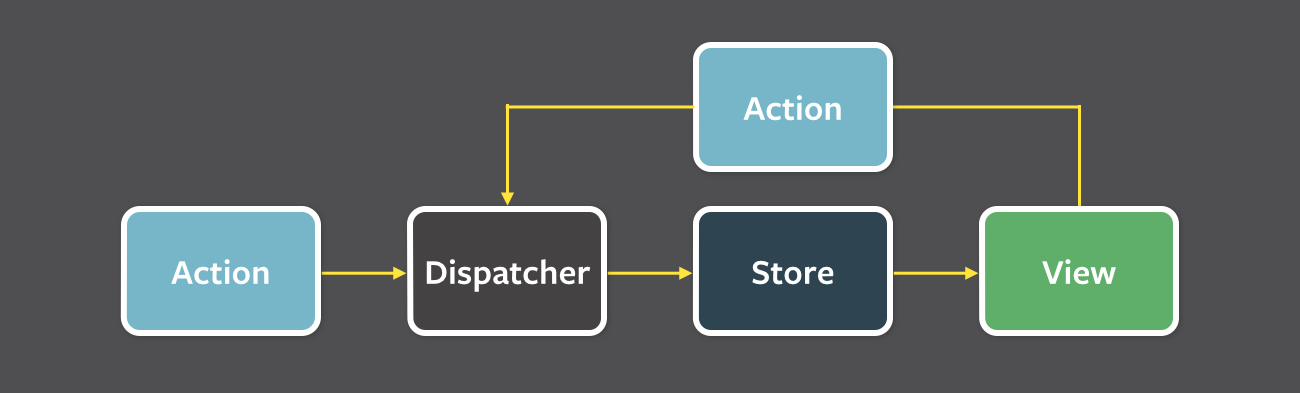
Q102
What is Redux?
Redux is a predictable state container for JavaScript applications, most commonly used with React. It helps you manage and centralize your application’s state in a single source of truth, enabling easier debugging, testing, and maintenance—especially in large or complex applications. Redux core is tiny library(about 2.5kB gzipped) and has no dependencies.
Q103
What are the core principles of Redux?
Redux follows three fundamental principles:
- Single source of truth: The state of your whole application is stored in an object tree within a single store. The single state tree makes it easier to keep track of changes over time and debug or inspect the application.
const store = createStore(reducer);
- State is read-only: The only way to change the state is to emit an action, an object describing what happened. This ensures that neither the views nor the network callbacks will ever write directly to the state.
const action = { type: 'INCREMENT' };
store.dispatch(action);
- Changes are made with pure functions(Reducers): To specify how the state tree is transformed by actions, you write reducers. Reducers are just pure functions that take the previous state and an action as parameters, and return the next state.
function counter(state = 0, action) {
  switch (action.type) {
    case 'INCREMENT':
      return state + 1;
    case 'DECREMENT':
      return state - 1;
    default:
      return state;
  }
}
Q104
What are the downsides of Redux compared to Flux?
While Redux offers a powerful and predictable state management solution, it comes with a few trade-offs when compared to Flux. These include:
- Immutability is essential
Redux enforces a strict immutability model for state updates, which differs from Flux’s more relaxed approach. This means you must avoid mutating state directly. Many Redux-related libraries assume immutability, so your team must be disciplined in writing pure update logic. You can use tools likeredux-immutable-state-invariant,Immer, orImmutable.jsto help enforce this practice, especially during development. - Careful selection of complementary packages
Redux is more minimal by design and provides extension points such as middleware and store enhancers. This has led to a large ecosystem, but it also means you must thoughtfully choose and configure additional packages for features like undo/redo, persistence, or form handling—something Flux explicitly leaves out but may be simpler to manage in smaller setups. - Limited static type integration
While Flux has mature support for static type checking with tools like Flow, Redux’s type integration is less seamless. Although TypeScript is commonly used with Redux now, early Flow support was limited, and more boilerplate was required for static type safety. This may affect teams that rely heavily on type systems for large codebases.
Q105
What is the difference between `mapStateToProps()` and `mapDispatchToProps()`?
mapStateToProps() is a utility which helps your component get updated state (which is updated by some other components):
const mapStateToProps = (state) => {
  return {
    todos: getVisibleTodos(state.todos, state.visibilityFilter),
  };
};
mapDispatchToProps() is a utility which will help your component to fire an action event (dispatching action which may cause change of application state):
const mapDispatchToProps = (dispatch) => {
  return {
    onTodoClick: (id) => {
      dispatch(toggleTodo(id));
    },
  };
};
It is recommended to always use the “object shorthand” form for the mapDispatchToProps.
Redux wraps it in another function that looks like (…args) => dispatch(onTodoClick(…args)), and pass that wrapper function as a prop to your component.
const mapDispatchToProps = {
  onTodoClick,
};
Q106
Can I dispatch an action in reducer?
Dispatching an action within a reducer is an anti-pattern. Your reducer should be without side effects, simply digesting the action payload and returning a new state object. Adding listeners and dispatching actions within the reducer can lead to chained actions and other side effects.
Q107
How to access Redux store outside a component?
You just need to export the store from the module where it created with createStore(). Also, it shouldn't pollute the global window object.
store = createStore(myReducer);

export default store;
Q108
What are the drawbacks of MVW pattern?
- DOM manipulation is very expensive which causes applications to behave slow and inefficient.
- Due to circular dependencies, a complicated model was created around models and views.
- Lot of data changes happens for collaborative applications(like Google Docs).
- No way to do undo (travel back in time) easily without adding so much extra code.
Q109
Are there any similarities between Redux and RxJS?
These libraries are very different for very different purposes, but there are some vague similarities.
Redux is a tool for managing state throughout the application. It is usually used as an architecture for UIs. Think of it as an alternative to (half of) Angular. RxJS is a reactive programming library. It is usually used as a tool to accomplish asynchronous tasks in JavaScript. Think of it as an alternative to Promises. Redux uses the Reactive paradigm because the Store is reactive. The Store observes actions from a distance, and changes itself. RxJS also uses the Reactive paradigm, but instead of being an architecture, it gives you basic building blocks, Observables, to accomplish this pattern.
Q110
How to reset state in Redux?
You need to write a root reducer in your application which delegate handling the action to the reducer generated by combineReducers().
For example, let us take rootReducer() to return the initial state after USER_LOGOUT action. As we know, reducers are supposed to return the initial state when they are called with undefined as the first argument, no matter the action.
const appReducer = combineReducers({
  /* your app's top-level reducers */
});

const rootReducer = (state, action) => {
  if (action.type === "USER_LOGOUT") {
    state = undefined;
  }

  return appReducer(state, action);
};
In case of using redux-persist, you may also need to clean your storage. redux-persist keeps a copy of your state in a storage engine. First, you need to import the appropriate storage engine and then, to parse the state before setting it to undefined and clean each storage state key.
const appReducer = combineReducers({
  /* your app's top-level reducers */
});

const rootReducer = (state, action) => {
  if (action.type === "USER_LOGOUT") {
    Object.keys(state).forEach((key) => {
      storage.removeItem(`persist:${key}`);
    });

    state = undefined;
  }

  return appReducer(state, action);
};
Q111
What is the difference between React context and React Redux?
You can use Context in your application directly and is going to be great for passing down data to deeply nested components which what it was designed for.
Whereas Redux is much more powerful and provides a large number of features that the Context API doesn't provide. Also, React Redux uses context internally but it doesn't expose this fact in the public API.
Q112
Why are Redux state functions called reducers?
Reducers always return the accumulation of the state (based on all previous and current actions). Therefore, they act as a reducer of state. Each time a Redux reducer is called, the state and action are passed as parameters. This state is then reduced (or accumulated) based on the action, and then the next state is returned. You could reduce a collection of actions and an initial state (of the store) on which to perform these actions to get the resulting final state.
Q113
How to make AJAX request in Redux?
You can use redux-thunk middleware which allows you to define async actions.
Let's take an example of fetching specific account as an AJAX call using fetch API:
export function fetchAccount(id) {
  return (dispatch) => {
    dispatch(setLoadingAccountState()); // Show a loading spinner
    fetch(`/account/${id}`, (response) => {
      dispatch(doneFetchingAccount()); // Hide loading spinner
      if (response.status === 200) {
        dispatch(setAccount(response.json)); // Use a normal function to set the received state
      } else {
        dispatch(someError);
      }
    });
  };
}

function setAccount(data) {
  return { type: "SET_Account", data: data };
}
Q114
Should I keep all component's state in Redux store?
Keep your data in the Redux store, and the UI related state internally in the component.
Q115
What is the proper way to access Redux store?
The best way to access your store in a component is to use the connect() function, that creates a new component that wraps around your existing one. This pattern is called Higher-Order Components, and is generally the preferred way of extending a component's functionality in React. This allows you to map state and action creators to your component, and have them passed in automatically as your store updates.
Let's take an example of <FilterLink> component using connect:
import { connect } from "react-redux";
import { setVisibilityFilter } from "../actions";
import Link from "../components/Link";

const mapStateToProps = (state, ownProps) => ({
  active: ownProps.filter === state.visibilityFilter,
});

const mapDispatchToProps = (dispatch, ownProps) => ({
  onClick: () => dispatch(setVisibilityFilter(ownProps.filter)),
});

const FilterLink = connect(mapStateToProps, mapDispatchToProps)(Link);

export default FilterLink;
Due to it having quite a few performance optimizations and generally being less likely to cause bugs, the Redux developers almost always recommend using connect() over accessing the store directly (using context API).
function MyComponent {
  someMethod() {
    doSomethingWith(this.context.store);
  }
}
Q116
What is the difference between component and container in React Redux?
Component is a class or function component that describes the presentational part of your application.
Container is an informal term for a component that is connected to a Redux store. Containers subscribe to Redux state updates and dispatch actions, and they usually don't render DOM elements; they delegate rendering to presentational child components.
Q117
What is the purpose of the constants in Redux?
Constants allows you to easily find all usages of that specific functionality across the project when you use an IDE. It also prevents you from introducing silly bugs caused by typos – in which case, you will get a ReferenceError immediately.
Normally we will save them in a single file (constants.js or actionTypes.js).
export const ADD_TODO = "ADD_TODO";
export const DELETE_TODO = "DELETE_TODO";
export const EDIT_TODO = "EDIT_TODO";
export const COMPLETE_TODO = "COMPLETE_TODO";
export const COMPLETE_ALL = "COMPLETE_ALL";
export const CLEAR_COMPLETED = "CLEAR_COMPLETED";
In Redux, you use them in two places:
-
During action creation:
Let's take
actions.js:import { ADD_TODO } from "./actionTypes"; export function addTodo(text) { return { type: ADD_TODO, text }; } -
In reducers:
Let's create
reducer.js:import { ADD_TODO } from "./actionTypes"; export default (state = [], action) => { switch (action.type) { case ADD_TODO: return [ ...state, { text: action.text, completed: false, }, ]; default: return state; } };
Q118
What are the different ways to write `mapDispatchToProps()`?
There are a few ways of binding action creators to dispatch() in mapDispatchToProps().
Below are the possible options:
const mapDispatchToProps = (dispatch) => ({
  action: () => dispatch(action()),
});
const mapDispatchToProps = (dispatch) => ({
  action: bindActionCreators(action, dispatch),
});
const mapDispatchToProps = { action };
The third option is just a shorthand for the first one.
Q119
What is the use of the `ownProps` parameter in `mapStateToProps()` and `mapDispatchToProps()`?
If the ownProps parameter is specified, React Redux will pass the props that were passed to the component into your connect functions. So, if you use a connected component:
import ConnectedComponent from "./containers/ConnectedComponent";

<ConnectedComponent user={"john"} />;
The ownProps inside your mapStateToProps() and mapDispatchToProps() functions will be an object:
{
  user: "john";
}
You can use this object to decide what to return from those functions.
Q120
How to structure Redux top level directories?
Most of the applications has several top-level directories as below:
- Components: Used for dumb components unaware of Redux.
- Containers: Used for smart components connected to Redux.
- Actions: Used for all action creators, where file names correspond to part of the app.
- Reducers: Used for all reducers, where files name correspond to state key.
- Store: Used for store initialization.
This structure works well for small and medium size apps.
Q121
What is redux-saga?
redux-saga is a library that aims to make side effects (asynchronous things like data fetching and impure things like accessing the browser cache) in React/Redux applications easier and better.
It is available in NPM:
$ npm install --save redux-saga
Q122
What is the mental model of redux-saga?
Saga is like a separate thread in your application, that's solely responsible for side effects. redux-saga is a redux middleware, which means this thread can be started, paused and cancelled from the main application with normal Redux actions, it has access to the full Redux application state and it can dispatch Redux actions as well.
Q123
What are the differences between `call()` and `put()` in redux-saga?
Both call() and put() are effect creator functions. call() function is used to create effect description, which instructs middleware to call the promise. put() function creates an effect, which instructs middleware to dispatch an action to the store.
Let's take example of how these effects work for fetching particular user data.
function* fetchUserSaga(action) {
  // `call` function accepts rest arguments, which will be passed to `api.fetchUser` function.
  // Instructing middleware to call promise, it resolved value will be assigned to `userData` variable
  const userData = yield call(api.fetchUser, action.userId);

  // Instructing middleware to dispatch corresponding action.
  yield put({
    type: "FETCH_USER_SUCCESS",
    userData,
  });
}
Q124
What is Redux Thunk?
Redux Thunk middleware allows you to write action creators that return a function instead of an action. The thunk can be used to delay the dispatch of an action, or to dispatch only if a certain condition is met. The inner function receives the store methods dispatch() and getState() as parameters.
Q125
What are the differences between `redux-saga` and `redux-thunk`?
Both Redux Thunk and Redux Saga take care of dealing with side effects. In most of the scenarios, Thunk uses Promises to deal with them, whereas Saga uses Generators. Thunk is simple to use and Promises are familiar to many developers, Sagas/Generators are more powerful but you will need to learn them. But both middleware can coexist, so you can start with Thunks and introduce Sagas when/if you need them.
Q126
What is Redux DevTools?
Redux DevTools is a live-editing time travel environment for Redux with hot reloading, action replay, and customizable UI. If you don't want to bother with installing Redux DevTools and integrating it into your project, consider using Redux DevTools Extension for Chrome and Firefox.
Q127
What are the features of Redux DevTools?
Some of the main features of Redux DevTools are below,
- Lets you inspect every state and action payload.
- Lets you go back in time by cancelling actions.
- If you change the reducer code, each staged action will be re-evaluated.
- If the reducers throw, you will see during which action this happened, and what the error was.
- With
persistState()store enhancer, you can persist debug sessions across page reloads.
Q128
What are Redux selectors and why use them?
Selectors are functions that take Redux state as an argument and return some data to pass to the component.
For example, to get user details from the state:
const getUserData = (state) => state.user.data;
These selectors have two main benefits,
- The selector can compute derived data, allowing Redux to store the minimal possible state
- The selector is not recomputed unless one of its arguments changes
Q129
What is Redux Form?
Redux Form works with React and Redux to enable a form in React to use Redux to store all of its state. Redux Form can be used with raw HTML5 inputs, but it also works very well with common UI frameworks like Material UI, React Widgets and React Bootstrap.
Q130
What are the main features of Redux Form?
Some of the main features of Redux Form are:
- Field values persistence via Redux store.
- Validation (sync/async) and submission.
- Formatting, parsing and normalization of field values.
Q131
How to add multiple middlewares to Redux?
You can use applyMiddleware().
For example, you can add redux-thunk and logger passing them as arguments to applyMiddleware():
import { createStore, applyMiddleware } from "redux";
const createStoreWithMiddleware = applyMiddleware(
  ReduxThunk,
  logger
)(createStore);
Q132
How to set initial state in Redux?
You need to pass initial state as second argument to createStore:
const rootReducer = combineReducers({
  todos: todos,
  visibilityFilter: visibilityFilter,
});

const initialState = {
  todos: [{ id: 123, name: "example", completed: false }],
};

const store = createStore(rootReducer, initialState);
Q133
How Relay is different from Redux?
Relay is similar to Redux in that they both use a single store. The main difference is that relay only manages state originated from the server, and all access to the state is used via GraphQL queries (for reading data) and mutations (for changing data). Relay caches the data for you and optimizes data fetching for you, by fetching only changed data and nothing more.
Q134
What is an action in Redux?
Actions are plain JavaScript objects or payloads of information that send data from your application to your store. They are the only source of information for the store. Actions must have a type property that indicates the type of action being performed.
For example, let's take an action which represents adding a new todo item:
{
  type: ADD_TODO,
  text: 'Add todo item'
}
React Native
Q135
What is the difference between React Native and React?
React is a JavaScript library, supporting both front end web and being run on the server, for building user interfaces and web applications.
React Native is a mobile framework that compiles to native app components, allowing you to build native mobile applications (iOS, Android, and Windows) in JavaScript that allows you to use React to build your components, and implements React under the hood.
Q136
How to test React Native apps?
React Native can be tested only in mobile simulators like iOS and Android. You can run the app in your mobile using expo app (https://expo.io) Where it syncs using QR code, your mobile and computer should be in same wireless network.
Q137
How to do logging in React Native?
You can use console.log, console.warn, etc. As of React Native v0.29 you can simply run the following to see logs in the console:
$ react-native log-ios
$ react-native log-android
Q138
How to debug your React Native?
Follow the below steps to debug React Native app:
- Run your application in the iOS simulator.
- Press
Command + Dand a webpage should open up athttp://localhost:8081/debugger-ui. - Enable Pause On Caught Exceptions for a better debugging experience.
- Press
Command + Option + Ito open the Chrome Developer tools, or open it viaView->Developer->Developer Tools. - You should now be able to debug as you normally would.
React supported libraries & Integration
Q139
What is reselect and how it works?
Reselect is a selector library (for Redux) which uses memoization concept. It was originally written to compute derived data from Redux-like applications state, but it can't be tied to any architecture or library.
Reselect keeps a copy of the last inputs/outputs of the last call, and recomputes the result only if one of the inputs changes. If the same inputs are provided twice in a row, Reselect returns the cached output. It's memoization and cache are fully customizable.
Q140
What is Flow?
Flow is a static type checker designed to find type errors in JavaScript. Flow types can express much more fine-grained distinctions than traditional type systems. For example, Flow helps you catch errors involving null, unlike most type systems.
Q141
What is the difference between Flow and PropTypes?
Flow is a static analysis tool (static checker) which uses a superset of the language, allowing you to add type annotations to all of your code and catch an entire class of bugs at compile time.
PropTypes is a basic type checker (runtime checker) which has been patched onto React. It can't check anything other than the types of the props being passed to a given component. If you want more flexible typechecking for your entire project Flow/TypeScript are appropriate choices.
Q142
How to use Font Awesome icons in React?
The below steps followed to include Font Awesome in React:
-
Install
font-awesome:$ npm install --save font-awesome -
Import
font-awesomein yourindex.jsfile:import "font-awesome/css/font-awesome.min.css"; -
Add Font Awesome classes in
className:function MyComponent { return <div><i className={'fa fa-spinner'} /></div> }
Q143
What is React Dev Tools?
React Developer Tools let you inspect the component hierarchy, including component props and state. It exists both as a browser extension (for Chrome and Firefox), and as a standalone app (works with other environments including Safari, IE, and React Native).
The official extensions available for different browsers or environments.
- Chrome extension
- Firefox extension
- Standalone app (Safari, React Native, etc)
Q144
Why is DevTools not loading in Chrome for local files?
If you opened a local HTML file in your browser (file://...) then you must first open Chrome Extensions and check Allow access to file URLs.
Q145
How to use Polymer in React?
You need to follow below steps to use Polymer in React,
-
Create a Polymer element:
<link rel="import" href="../../bower_components/polymer/polymer.html" />; Polymer({ is: "calendar-element", ready: function () { this.textContent = "I am a calendar"; }, }); -
Create the Polymer component HTML tag by importing it in a HTML document, e.g. import it in the
index.htmlof your React application:<link rel="import" href="./src/polymer-components/calendar-element.html" /> -
Use that element in the JSX file:
export default function MyComponent {
  return <calendar-element />;
}
Q146
What are the advantages of React over Vue.js?
React has the following advantages over Vue.js:
- Gives more flexibility in large apps developing.
- Easier to test.
- Suitable for mobile apps creating.
- More information and solutions available.
Note: The above list of advantages are purely opinionated and it vary based on the professional experience. But they are helpful as base parameters.
Q147
What is the difference between React and Angular?
Let's see the difference between React and Angular in a table format.
| React | Angular |
|---|---|
| React is a library and has only the View layer | Angular is a framework and has complete MVC functionality |
| React handles rendering on the server side | AngularJS renders only on the client side but Angular 2 and above renders on the server side |
| React uses JSX that looks like HTML in JS which can be confusing | Angular follows the template approach for HTML, which makes code shorter and easy to understand |
| React Native, which is a React type to build mobile applications are faster and more stable | Ionic, Angular's mobile native app is relatively less stable and slower |
| In React, data flows only in one way and hence debugging is easy | In Angular, data flows both way i.e it has two-way data binding between children and parent and hence debugging is often difficult |
Note: The above list of differences are purely opinionated and it vary based on the professional experience. But they are helpful as base parameters.
Q148
Why React tab is not showing up in DevTools?
When the page loads, React DevTools sets a global named __REACT_DEVTOOLS_GLOBAL_HOOK__, then React communicates with that hook during initialization. If the website is not using React or if React fails to communicate with DevTools then it won't show up the tab.
Q149
What are Styled Components?
styled-components is a JavaScript library for styling React applications. It removes the mapping between styles and components, and lets you write actual CSS augmented with JavaScript.
Q150
Give an example of Styled Components?
Lets create <Title> and <Wrapper> components with specific styles for each.
import React from "react";
import styled from "styled-components";

// Create a <Title> component that renders an <h1> which is centered, red and sized at 1.5em
const Title = styled.h1`
  font-size: 1.5em;
  text-align: center;
  color: palevioletred;
`;

// Create a <Wrapper> component that renders a <section> with some padding and a papayawhip background
const Wrapper = styled.section`
  padding: 4em;
  background: papayawhip;
`;
These two variables, Title and Wrapper, are now components that you can render just like any other react component.
<Wrapper>
  <Title>{"Lets start first styled component!"}</Title>
</Wrapper>
Q151
What is Relay?
Relay is a JavaScript framework for providing a data layer and client-server communication to web applications using the React view layer.
Q152
What are the main features of Reselect library?
Let's see the main features of Reselect library,
-
Selectors can compute derived data, allowing Redux to store the minimal possible state.
-
Selectors are efficient. A selector is not recomputed unless one of its arguments changes.
-
Selectors are composable. They can be used as input to other selectors.
-
Give an example of Reselect usage?
Let's take calculations and different amounts of a shipment order with the simplified usage of Reselect:
import { createSelector } from "reselect";

const shopItemsSelector = (state) => state.shop.items;
const taxPercentSelector = (state) => state.shop.taxPercent;

const subtotalSelector = createSelector(shopItemsSelector, (items) =>
  items.reduce((acc, item) => acc + item.value, 0)
);

const taxSelector = createSelector(
  subtotalSelector,
  taxPercentSelector,
  (subtotal, taxPercent) => subtotal * (taxPercent / 100)
);

export const totalSelector = createSelector(
  subtotalSelector,
  taxSelector,
  (subtotal, tax) => ({ total: subtotal + tax })
);

let exampleState = {
  shop: {
    taxPercent: 8,
    items: [
      { name: "apple", value: 1.2 },
      { name: "orange", value: 0.95 },
    ],
  },
};

console.log(subtotalSelector(exampleState)); // 2.15
console.log(taxSelector(exampleState)); // 0.172
console.log(totalSelector(exampleState)); // { total: 2.322 }
Q153
Can Redux only be used with React?
Redux can be used as a data store for any UI layer. The most common usage is with React and React Native, but there are bindings available for Angular, Angular 2, Vue, Mithril, and more. Redux simply provides a subscription mechanism which can be used by any other code.
Q154
Do you need to have a particular build tool to use Redux?
Redux is originally written in ES6 and transpiled for production into ES5 with Webpack and Babel. You should be able to use it regardless of your JavaScript build process. Redux also offers a UMD build that can be used directly without any build process at all.
Q155
How Redux Form `initialValues` get updated from state?
You need to add enableReinitialize : true setting.
const InitializeFromStateForm = reduxForm({
  form: "initializeFromState",
  enableReinitialize: true,
})(UserEdit);
If your initialValues prop gets updated, your form will update too.
Q156
How React PropTypes allow different types for one prop?
You can use oneOfType() method of PropTypes.
For example, the height property can be defined with either string or number type as below:
Component.propTypes = {
  size: PropTypes.oneOfType([PropTypes.string, PropTypes.number]),
};
Q157
Can I import an SVG file as react component?
You can import SVG directly as component instead of loading it as a file. This feature is available with [email protected] and higher.
import { ReactComponent as Logo } from "./logo.svg";

const App = () => (
  <div>
    {/* Logo is an actual react component */}
    <Logo />
  </div>
);
Note: Don't forget about the curly braces in the import.
Q158
What is render hijacking in react?
The concept of render hijacking is the ability to control what a component will output from another component. It means that you decorate your component by wrapping it into a Higher-Order component. By wrapping, you can inject additional props or make other changes, which can cause changing logic of rendering. It does not actually enable hijacking, but by using HOC you make your component behave differently.
Q159
How to pass numbers to React component?
We can pass numbers as props to React component using curly braces {} where as strings in double quotes "" or single quotes ''
import React from "react";

const ChildComponent = ({ name, age }) => {
  return (
    <>
      My Name is {name} and Age is {age}
    </>
  );
};

const ParentComponent = () => {
  return (
    <>
      <ChildComponent name="Chetan" age={30} />
    </>
  );
};

export default ParentComponent;
Q160
Do I need to keep all my state into Redux? Should I ever use react internal state?
It is up to the developer's decision, i.e., it is developer's job to determine what kinds of state make up your application, and where each piece of state should live. Some users prefer to keep every single piece of data in Redux, to maintain a fully serializable and controlled version of their application at all times. Others prefer to keep non-critical or UI state, such as “is this dropdown currently open”, inside a component's internal state.
Below are the rules of thumb to determine what kind of data should be put into Redux
- Do other parts of the application care about this data?
- Do you need to be able to create further derived data based on this original data?
- Is the same data being used to drive multiple components?
- Is there value to you in being able to restore this state to a given point in time (ie, time travel debugging)?
- Do you want to cache the data (i.e, use what's in state if it's already there instead of re-requesting it)?
Q161
What is the purpose of registerServiceWorker in React?
React creates a service worker for you without any configuration by default. The service worker is a web API that helps you cache your assets and other files so that when the user is offline or on a slow network, he/she can still see results on the screen, as such, it helps you build a better user experience, that's what you should know about service worker for now. It's all about adding offline capabilities to your site.
import React from "react";
import ReactDOM from "react-dom";
import App from "./App";
import registerServiceWorker from "./registerServiceWorker";

ReactDOM.render(<App />, document.getElementById("root"));
registerServiceWorker();
Q162
What is React memo function?
Class components can be restricted from re-rendering when their input props are the same using PureComponent or shouldComponentUpdate. Now you can do the same with function components by wrapping them in React.memo.
const MyComponent = React.memo(function MyComponent(props) {
  /* only rerenders if props change */
});
Q163
What is React lazy function?
The React.lazy function lets you render a dynamic import as a regular component. It will automatically load the bundle containing the OtherComponent when the component gets rendered. This must return a Promise which resolves to a module with a default export containing a React component.
const OtherComponent = React.lazy(() => import("./OtherComponent"));

function MyComponent() {
  return (
    <div>
      <OtherComponent />
    </div>
  );
}
Note:
React.lazy and Suspense is not yet available for server-side rendering. If you want to do code-splitting in a server rendered app, we still recommend React Loadable.
Q164
How to prevent unnecessary updates using setState?
You can compare the current value of the state with an existing state value and decide whether to rerender the page or not. If the values are the same then you need to return null to stop re-rendering otherwise return the latest state value.
For example, the user profile information is conditionally rendered as follows,
getUserProfile = (user) => {
  const latestAddress = user.address;
  this.setState((state) => {
    if (state.address === latestAddress) {
      return null;
    } else {
      return { title: latestAddress };
    }
  });
};
Q165
How do you render Array, Strings and Numbers in React 16 Version?
Arrays: Unlike older releases, you don't need to make sure render method return a single element in React16. You are able to return multiple sibling elements without a wrapping element by returning an array.
For example, let us take the below list of developers,
const ReactJSDevs = () => {
  return [
    <li key="1">John</li>,
    <li key="2">Jackie</li>,
    <li key="3">Jordan</li>,
  ];
};
You can also merge this array of items in another array component.
const JSDevs = () => {
  return (
    <ul>
      <li>Brad</li>
      <li>Brodge</li>
      <ReactJSDevs />
      <li>Brandon</li>
    </ul>
  );
};
Strings and Numbers: You can also return string and number type from the render method.
render() {
 return 'Welcome to ReactJS questions';
}
// Number
render() {
 return 2018;
}
Q166
What are hooks?
Hooks is a special JavaScript function that allows you use state and other React features without writing a class. This pattern has been introduced as a new feature in React 16.8 and helped to isolate the stateful logic from the components.
Let's see an example of useState hook:
import { useState } from "react";

function Example() {
  // Declare a new state variable, which we'll call "count"
  const [count, setCount] = useState(0);

  return (
    <>
      <p>You clicked {count} times</p>
      <button onClick={() => setCount(count + 1)}>Click me</button>
    </>
  );
}
Note: Hooks can be used inside an existing function component without rewriting the component.
Q167
What rules need to be followed for hooks?
You need to follow two rules in order to use hooks,
- Call Hooks only at the top level of your react functions: You should always use hooks at the top level of react function before any early returns. i.e, You shouldn’t call Hooks inside loops, conditions, or nested functions. This will ensure that Hooks are called in the same order each time a component renders and it preserves the state of Hooks between multiple re-renders due to
useStateanduseEffectcalls.
Let's see the difference using an example, Correct usage::
function UserProfile() {
 // Correct: Hooks called at the top level
 const [name, setName] = useState('John');
 const [country, setCountry] = useState('US');

 return (
   <div>
     <h1>Name: {name}</h1>
     <p>Country: {country}</p>
   </div>
 );
}
Incorrect usage::
function UserProfile() {
 const [name, setName] = useState('John');

 if (name === 'John') {
   // Incorrect: useState is called inside a conditional
   const [country, setCountry] = useState('US');
 }

 return (
   <div>
     <h1>Name: {name}</h1>
     <p>Country: {country}</p> {/* This will throw an error if the name condition isn't met */}
   </div>
 );
}
The useState hook for the country field is being called conditionally within an if block. This can lead to inconsistent state behavior and may cause hooks to be called in a different order on each re-render.
- Call Hooks from React Functions only: You shouldn’t call Hooks from regular JavaScript functions or class components. Instead, you should call them from either function components or custom hooks.
Let's find the difference of correct and incorrect usage with below examples,
Correct usage::
//Example1:
function Counter() {
 // Correct: useState is used inside a functional component
 const [count, setCount] = useState(0);

 return <div>Counter: {count}</div>;
}
//Example2:
function useFetchData(url) {
 const [data, setData] = useState(null);

 useEffect(() => {
   fetch(url)
     .then((response) => response.json())
     .then((data) => setData(data));
 }, [url]);

 return data;
}

function UserProfile() {
 // Correct: Using a custom hook here
 const user = useFetchData('https://some-api.com/user');

 return (
   <div>
     <h1>{user ? user.name : 'Loading profile...'}</h1>
   </div>
 );
}
Incorrect usage::
 //Example1
 function normalFunction() {
   // Incorrect: Can't call hooks in normal functions
   const [count, setCount] = useState(0);
 }

 //Example2
 function fetchData(url) {
   // Incorrect: Hooks can't be used in non-React functions
   const [data, setData] = useState(null);

   useEffect(() => {
     fetch(url)
       .then((response) => response.json())
       .then((data) => setData(data));
   }, [url]);

   return data;
 }
In the above incorrect usage example, both useState and useEffect are used in non-React functions(normalFunction and fetchData), which is not allowed.
Q168
How to ensure hooks followed the rules in your project?
React team released an ESLint plugin called eslint-plugin-react-hooks that enforces Hook's two rules. It is part of Hooks API. You can add this plugin to your project using the below command,
```javascript
npm install eslint-plugin-react-hooks --save-dev
```

And apply the below config in your ESLint config file,

```javascript
// Your ESLint configuration
{
  "plugins": [
    // ...
    "react-hooks"
  ],
  "rules": {
    // ...
    "react-hooks/rules-of-hooks": "error"
  }
}
```

This plugin also provide another important rule through `react-hooks/exhaustive-deps`. It ensures that the dependencies of useEffect, useCallback, and useMemo hooks are correctly listed to avoid potential bugs.

```jsx
useEffect(() => {
  // Forgetting `message` will result in incorrect behavior
  console.log(message);
}, []); // Here `message` should be a dependency
```
The recommended `eslint-config-react-app` preset already includes the hooks rules of this plugin.
For example, the linter enforce proper naming convention for hooks. If you rename your custom hooks which as prefix "use" to something else then linter won't allow you to call built-in hooks such as useState, useEffect etc inside of your custom hook anymore.

**Note:** This plugin is intended to use in Create React App by default.
Q169
What are the differences between Flux and Redux?
Below are the major differences between Flux and Redux
| Flux | Redux |
|---|---|
| State is mutable | State is immutable |
| The Store contains both state and change logic | The Store and change logic are separate |
| There are multiple stores exist | There is only one store exist |
| All the stores are disconnected and flat | Single store with hierarchical reducers |
| It has a singleton dispatcher | There is no concept of dispatcher |
| React components subscribe to the store | Container components uses connect function |
Q170
What are the benefits of React Router V4?
Below are the main benefits of React Router V4 module,
- In React Router v4(version 4), the API is completely about components. A router can be visualized as a single component(
<BrowserRouter>) which wraps specific child router components(<Route>). - You don't need to manually set history. The router module will take care history by wrapping routes with
<BrowserRouter>component. - The application size is reduced by adding only the specific router module(Web, core, or native)
Q171
Can you describe about componentDidCatch lifecycle method signature?
The componentDidCatch lifecycle method is invoked after an error has been thrown by a descendant component. The method receives two parameters,
- error: - The error object which was thrown
- info: - An object with a componentStack key contains the information about which component threw the error.
The method structure would be as follows
componentDidCatch(error, info);
Q172
In which scenarios do error boundaries not catch errors?
Below are the cases in which error boundaries don't work,
- Inside Event handlers
- Asynchronous code using setTimeout or requestAnimationFrame callbacks
- During Server side rendering
- When errors thrown in the error boundary code itself
Q173
What is the behavior of uncaught errors in react 16?
In React 16, errors that were not caught by any error boundary will result in unmounting of the whole React component tree. The reason behind this decision is that it is worse to leave corrupted UI in place than to completely remove it. For example, it is worse for a payments app to display a wrong amount than to render nothing.
Q174
What is the proper placement for error boundaries?
The granularity of error boundaries usage is up to the developer based on project needs. You can follow either of these approaches,
- You can wrap top-level route components to display a generic error message for the entire application.
- You can also wrap individual components in an error boundary to protect them from crashing the rest of the application.
Q175
What is the benefit of component stack trace from error boundary?
Apart from error messages and javascript stack, React16 will display the component stack trace with file names and line numbers using error boundary concept.
For example, BuggyCounter component displays the component stack trace as below,

Q176
What are default props?
The defaultProps can be defined as a property on the component to set the default values for the props. These default props are used when props not supplied(i.e., undefined props), but not for null or 0 as props. That means, If you provide null value then it remains null value. It's the same behavior with 0 as well.
For example, let us create color default prop for the button component,
function MyButton {
  // ...
}

MyButton.defaultProps = {
  color: "red",
};
If props.color is not provided then it will set the default value to 'red'. i.e, Whenever you try to access the color prop it uses the default value
function MyButton() {
  return <MyButton />; // props.color will contain red value
}
Q177
What is the purpose of displayName class property?
The displayName string is used in debugging messages. Usually, you don’t need to set it explicitly because it’s inferred from the name of the function or class that defines the component. You might want to set it explicitly if you want to display a different name for debugging purposes or when you create a higher-order component.
For example, To ease debugging, choose a display name that communicates that it’s the result of a withSubscription HOC.
function withSubscription(WrappedComponent) {
  class WithSubscription extends React.Component {
    /* ... */
  }
  WithSubscription.displayName = `WithSubscription(${getDisplayName(
    WrappedComponent
  )})`;
  return WithSubscription;
}
function getDisplayName(WrappedComponent) {
  return (
    WrappedComponent.displayName || WrappedComponent.name || "Component"
  );
}
Q178
What is the browser support for react applications?
React supports all popular browsers, including Internet Explorer 9 and above, although some polyfills are required for older browsers such as IE 9 and IE 10. If you use es5-shim and es5-sham polyfill then it even support old browsers that doesn't support ES5 methods.
Q179
What is code-splitting?
Code-Splitting is a feature supported by bundlers like Webpack and Browserify which can create multiple bundles that can be dynamically loaded at runtime. The react project supports code splitting via dynamic import() feature.
For example, in the below code snippets, it will make moduleA.js and all its unique dependencies as a separate chunk that only loads after the user clicks the 'Load' button.
moduleA.js
const moduleA = "Hello";

export { moduleA };
App.js
export default function App {
  function handleClick() {
    import("./moduleA")
      .then(({ moduleA }) => {
        // Use moduleA
      })
      .catch((err) => {
        // Handle failure
      });
  };

 return (
   <div>
     <button onClick={this.handleClick}>Load</button>
   </div>
 );
}
See Class
import React, { Component } from "react";

class App extends Component {
 handleClick = () => {
   import("./moduleA")
     .then(({ moduleA }) => {
       // Use moduleA
     })
     .catch((err) => {
       // Handle failure
     });
 };

 render() {
   return (
     <div>
       <button onClick={this.handleClick}>Load</button>
     </div>
   );
 }
}

export default App;
Q180
What are Keyed Fragments?
The Fragments declared with the explicit <React.Fragment> syntax may have keys. The general use case is mapping a collection to an array of fragments as below,
function Glossary(props) {
  return (
    <dl>
      {props.items.map((item) => (
        // Without the `key`, React will fire a key warning
        <React.Fragment key={item.id}>
          <dt>{item.term}</dt>
          <dd>{item.description}</dd>
        </React.Fragment>
      ))}
    </dl>
  );
}
Note: key is the only attribute that can be passed to Fragment. In the future, there might be a support for additional attributes, such as event handlers.
Q181
Does React support all HTML attributes?
As of React 16, both standard or custom DOM attributes are fully supported. Since React components often take both custom and DOM-related props, React uses the camelCase convention just like the DOM APIs.
Let us take few props with respect to standard HTML attributes,
<div tabIndex="-1" />      // Just like node.tabIndex DOM API
<div className="Button" /> // Just like node.className DOM API
<input readOnly={true} />  // Just like node.readOnly DOM API
These props work similarly to the corresponding HTML attributes, with the exception of the special cases. It also support all SVG attributes.
Q182
When component props defaults to true?
If you pass no value for a prop, it defaults to true. This behavior is available so that it matches the behavior of HTML.
For example, below expressions are equivalent,
<MyInput autocomplete />

<MyInput autocomplete={true} />
Note: It is not recommended to use this approach because it can be confused with the ES6 object shorthand (example, {name} which is short for {name: name})
Q183
What is NextJS and major features of it?
Next.js is a popular and lightweight framework for static and server‑rendered applications built with React. It also provides styling and routing solutions. Below are the major features provided by NextJS,
- Server-rendered by default
- Automatic code splitting for faster page loads
- Simple client-side routing (page based)
- Webpack-based dev environment which supports (HMR)
- Able to implement with Express or any other Node.js HTTP server
- Customizable with your own Babel and Webpack configurations
Q184
How do you pass an event handler to a component?
You can pass event handlers and other functions as props to child components. The functions can be passed to child component as below,
function Button({ onClick }) {
  return <button onClick={onClick}>Download</button>;
}

export default function downloadExcel() {
  function handleClick() {
    alert("Downloaded");
  }

  return <Button onClick={handleClick}></Button>;
}
Q185
How to prevent a function from being called multiple times?
If you use an event handler such as onClick or onScroll and want to prevent the callback from being fired too quickly, then you can limit the rate at which callback is executed. This can be achieved in the below possible ways,
- Throttling: Changes based on a time based frequency. For example, it can be used using _.throttle lodash function
- Debouncing: Publish changes after a period of inactivity. For example, it can be used using _.debounce lodash function
- RequestAnimationFrame throttling: Changes based on requestAnimationFrame. For example, it can be used using raf-schd lodash function
Q186
How JSX prevents Injection Attacks?
React DOM escapes any values embedded in JSX before rendering them. Thus it ensures that you can never inject anything that’s not explicitly written in your application. Everything is converted to a string before being rendered.
For example, you can embed user input as below,
const name = response.potentiallyMaliciousInput;
const element = <h1>{name}</h1>;
This way you can prevent XSS(Cross-site-scripting) attacks in the application.
Q187
How do you update rendered elements?
You can update UI(represented by rendered element) by passing the newly created element to ReactDOM's render method.
For example, lets take a ticking clock example, where it updates the time by calling render method multiple times,
function tick() {
  const element = (
    <div>
      <h1>Hello, world!</h1>
      <h2>It is {new Date().toLocaleTimeString()}.</h2>
    </div>
  );
  ReactDOM.render(element, document.getElementById("root"));
}

setInterval(tick, 1000);
Q188
How do you say that props are readonly?
When you declare a component as a function or a class, it must never modify its own props.
Let us take a below capital function,
function capital(amount, interest) {
  return amount + interest;
}
The above function is called “pure” because it does not attempt to change their inputs, and always return the same result for the same inputs. Hence, React has a single rule saying "All React components must act like pure functions with respect to their props."
Q189
What are the conditions to safely use the index as a key?
There are three conditions to make sure, it is safe use the index as a key.
- The list and items are static– they are not computed and do not change
- The items in the list have no ids
- The list is never reordered or filtered.
Q190
Should keys be globally unique?
The keys used within arrays should be unique among their siblings but they don’t need to be globally unique. i.e, You can use the same keys with two different arrays.
For example, the below Book component uses two arrays with different arrays,
function Book(props) {
  const index = (
    <ul>
      {props.pages.map((page) => (
        <li key={page.id}>{page.title}</li>
      ))}
    </ul>
  );
  const content = props.pages.map((page) => (
    <div key={page.id}>
      <h3>{page.title}</h3>
      <p>{page.content}</p>
      <p>{page.pageNumber}</p>
    </div>
  ));
  return (
    <div>
      {index}
      <hr />
      {content}
    </div>
  );
}
Q191
What is the popular choice for form handling?
Formik is a form library for react which provides solutions such as validation, keeping track of the visited fields, and handling form submission.
In detail, You can categorize them as follows,
- Getting values in and out of form state
- Validation and error messages
- Handling form submission
It is used to create a scalable, performant, form helper with a minimal API to solve annoying stuff.
Q192
What are the advantages of formik over redux form library?
Below are the main reasons to recommend formik over redux form library,
- The form state is inherently short-term and local, so tracking it in Redux (or any kind of Flux library) is unnecessary.
- Redux-Form calls your entire top-level Redux reducer multiple times ON EVERY SINGLE KEYSTROKE. This way it increases input latency for large apps.
- Redux-Form is 22.5 kB minified gzipped whereas Formik is 12.7 kB
Q193
Why are you not required to use inheritance?
In React, it is recommended to use composition over inheritance to reuse code between components. Both Props and composition give you all the flexibility you need to customize a component’s look and behavior explicitly and safely. Whereas, If you want to reuse non-UI functionality between components, it is suggested to extract it into a separate JavaScript module. Later components import it and use that function, object, or class, without extending it.
Q194
Can I use web components in react application?
Yes, you can use web components in a react application. Even though many developers won't use this combination, it may require especially if you are using third-party UI components that are written using Web Components.
For example, let us use Vaadin date picker web component as below,
import "./App.css";
import "@vaadin/vaadin-date-picker";
export default function App() {
  return (
    <div className="App">
      <vaadin-date-picker label="When were you born?"></vaadin-date-picker>
    </div>
  );
}
Q195
What is dynamic import?
You can achieve code-splitting in your app using dynamic import.
Let's take an example of addition,
- Normal Import
import { add } from "./math";
console.log(add(10, 20));
- Dynamic Import
import("./math").then((math) => {
  console.log(math.add(10, 20));
});
Q196
What are loadable components?
With the release of React 18, React.lazy and Suspense are now available for server-side rendering. However, prior to React 18, it was recommended to use Loadable Components for code-splitting in a server-side rendered app because React.lazy and Suspense were not available for server-side rendering. Loadable Components lets you render a dynamic import as a regular component. For example, you can use Loadable Components to load the OtherComponent in a separate bundle like this:
import loadable from "@loadable/component";

const OtherComponent = loadable(() => import("./OtherComponent"));

function MyComponent() {
  return (
    <div>
      <OtherComponent />
    </div>
  );
}
Now OtherComponent will be loaded in a separated bundle Loadable Components provides additional benefits beyond just code-splitting, such as automatic code reloading, error handling, and preloading. By using Loadable Components, you can ensure that your application loads quickly and efficiently, providing a better user experience for your users.
Q197
What is suspense component?
React Suspense is a built-in feature that lets you defer rendering part of your component tree until some condition(asynchronous operation) is met—usually, data or code has finished loading. While waiting, Suspense lets you display a fallback UI like a spinner or placeholder.
-
Lazy loading components uses suspense feature,
If the module containing the dynamic import is not yet loaded by the time parent component renders, you must show some fallback content while you’re waiting for it to load using a loading indicator. This can be done using Suspense component.
const OtherComponent = React.lazy(() => import("./OtherComponent"));

function MyComponent() {
  return (
    <div>
      <Suspense fallback={<div>Loading...</div>}>
        <OtherComponent />
      </Suspense>
    </div>
  );
}
The above component shows fallback UI instead real component until
OtherComponentis fully loaded. -
As an another example, suspend until async data(data fetching) is ready
  function UserProfile() {
    const user = use(fetchUser()); // throws a promise internally
    return <div>{user.name}</div>;
  }

  function App() {
    return (
      <Suspense fallback={<div>Loading user...</div>}>
        <UserProfile />
      </Suspense>
    );
  }
Q198
What is route based code splitting?
One of the best place to do code splitting is with routes. The entire page is going to re-render at once so users are unlikely to interact with other elements in the page at the same time. Due to this, the user experience won't be disturbed.
Let us take an example of route based website using libraries like React Router with React.lazy,
import { BrowserRouter as Router, Route, Switch } from "react-router-dom";
import React, { Suspense, lazy } from "react";

const Home = lazy(() => import("./routes/Home"));
const About = lazy(() => import("./routes/About"));

const App = () => (
  <Router>
    <Suspense fallback={<div>Loading...</div>}>
      <Switch>
        <Route exact path="/" component={Home} />
        <Route path="/about" component={About} />
      </Switch>
    </Suspense>
  </Router>
);
In the above code, the code splitting will happen at each route level.
Q199
What is the purpose of default value in context?
The defaultValue argument is only used when a component does not have a matching Provider above it in the tree. This can be helpful for testing components in isolation without wrapping them.
Below code snippet provides default theme value as Luna.
const MyContext = React.createContext(defaultValue);
Q200
What is diffing algorithm?
React needs to use algorithms to find out how to efficiently update the UI to match the most recent tree. The diffing algorithms is generating the minimum number of operations to transform one tree into another. However, the algorithms have a complexity in the order of O(n³) where n is the number of elements in the tree.
In this case, displaying 1000 elements would require in the order of one billion comparisons. This is far too expensive. Instead, React implements a heuristic O(n) algorithm based on two assumptions:
- Two elements of different types will produce different trees.
- The developer can hint at which child elements may be stable across different renders with a key prop.
Q201
What are the rules covered by diffing algorithm?
When diffing two trees, React first compares the two root elements. The behavior is different depending on the types of the root elements. It covers the below rules during reconciliation algorithm,
-
Elements Of Different Types: Whenever the root elements have different types, React will tear down the old tree and build the new tree from scratch. For example, elements to
, or from
to of different types lead a full rebuild. -
DOM Elements Of The Same Type: When comparing two React DOM elements of the same type, React looks at the attributes of both, keeps the same underlying DOM node, and only updates the changed attributes. Lets take an example with same DOM elements except className attribute,
<div className="show" title="ReactJS" /> <div className="hide" title="ReactJS" /> -
Component Elements Of The Same Type: When a component updates, the instance stays the same, so that state is maintained across renders. React updates the props of the underlying component instance to match the new element, and calls componentWillReceiveProps() and componentWillUpdate() on the underlying instance. After that, the render() method is called and the diff algorithm recurses on the previous result and the new result.
-
Recursing On Children: when recursing on the children of a DOM node, React just iterates over both lists of children at the same time and generates a mutation whenever there’s a difference. For example, when adding an element at the end of the children, converting between these two trees works well.
<ul> <li>first</li> <li>second</li> </ul> <ul> <li>first</li> <li>second</li> <li>third</li> </ul> -
Handling keys: React supports a key attribute. When children have keys, React uses the key to match children in the original tree with children in the subsequent tree. For example, adding a key can make the tree conversion efficient,
<ul>
  <li key="2015">Duke</li>
  <li key="2016">Villanova</li>
</ul>

<ul>
  <li key="2014">Connecticut</li>
  <li key="2015">Duke</li>
  <li key="2016">Villanova</li>
</ul>
Q202
When do you need to use refs?
There are few use cases to go for refs,
- Managing focus, text selection, or media playback.
- Triggering imperative animations.
- Integrating with third-party DOM libraries.
Q203
Must prop be named as render for render props?
Even though the pattern named render props, you don’t have to use a prop named render to use this pattern. i.e, Any prop that is a function that a component uses to know what to render is technically a “render prop”. Lets take an example with the children prop for render props,
<Mouse
  children={(mouse) => (
    <p>
      The mouse position is {mouse.x}, {mouse.y}
    </p>
  )}
/>
Actually children prop doesn’t need to be named in the list of “attributes” in JSX element. Instead, you can keep it directly inside element,
<Mouse>
  {(mouse) => (
    <p>
      The mouse position is {mouse.x}, {mouse.y}
    </p>
  )}
</Mouse>
While using this above technique(without any name), explicitly state that children should be a function in your propTypes.
Mouse.propTypes = {
  children: PropTypes.func.isRequired,
};
Q204
What are the problems of using render props with pure components?
If you create a function inside a render method, it negates the purpose of pure component. Because the shallow prop comparison will always return false for new props, and each render in this case will generate a new value for the render prop. You can solve this issue by defining the render function as instance method.
Q205
What is windowing technique?
Windowing is a technique that only renders a small subset of your rows at any given time, and can dramatically reduce the time it takes to re-render the components as well as the number of DOM nodes created. If your application renders long lists of data then this technique is recommended. Both react-window and react-virtualized are popular windowing libraries which provides several reusable components for displaying lists, grids, and tabular data.
Q206
How do you print falsy values in JSX?
The falsy values such as false, null, undefined, and true are valid children but they don't render anything. If you still want to display them then you need to convert it to string. Let's take an example on how to convert to a string,
<div>My JavaScript variable is {String(myVariable)}.</div>
Q207
What is the typical use case of portals?
React Portals are primarily used to render UI components such as modals, tooltips, dropdowns, hovercards, and notifications outside of their parent component's DOM tree. This helps avoid common CSS issues caused by parent elements, such as:
**overflow: hidden**on parent elements clipping or hiding child elements like modals or tooltips,- stacking context and
**z-index**conflicts created by parent containers that prevent child elements from appearing above other content.
That means, you need to visually “break out” of its container. By rendering these UI elements into a separate DOM node (often directly under <body>), portals ensure they appear above all other content and are not restricted by the parent’s CSS or layout constraints, resulting in correct positioning and visibility regardless of the parent’s styling.
Q208
How do you set default value for uncontrolled component?
In React, the value attribute on form elements will override the value in the DOM. With an uncontrolled component, you might want React to specify the initial value, but leave subsequent updates uncontrolled. To handle this case, you can specify a defaultValue attribute instead of value.
render() {
  return (
    <form onSubmit={this.handleSubmit}>
      <label>
        User Name:
        <input
          defaultValue="John"
          type="text"
          ref={this.input} />
      </label>
      <input type="submit" value="Submit" />
    </form>
  );
}
The same applies for select and textArea inputs. But you need to use defaultChecked for checkbox and radio inputs.
Q209
What is your favorite React stack?
Even though the tech stack varies from developer to developer, the most popular stack is used in react boilerplate project code. It mainly uses Redux and redux-saga for state management and asynchronous side-effects, react-router for routing purpose, styled-components for styling react components, axios for invoking REST api, and other supported stack such as webpack, reselect, ESNext, Babel. You can clone the project https://github.com/react-boilerplate/react-boilerplate and start working on any new react project.
Q210
What is the difference between Real DOM and Virtual DOM?
Below are the main differences between Real DOM and Virtual DOM,
| Real DOM | Virtual DOM |
|---|---|
| Updates are slow | Updates are fast |
| DOM manipulation is very expensive. | DOM manipulation is very easy |
| You can update HTML directly. | You Can’t directly update HTML |
| It causes too much of memory wastage | There is no memory wastage |
| Creates a new DOM if element updates | It updates the JSX if element update |
Q211
How to add Bootstrap to a react application?
Bootstrap can be added to your React app in a three possible ways,
- Using the Bootstrap CDN: This is the easiest way to add bootstrap. Add both bootstrap CSS and JS resources in a head tag.
- Bootstrap as Dependency:
If you are using a build tool or a module bundler such as Webpack, then this is the preferred option for adding Bootstrap to your React application
npm install bootstrap - React Bootstrap Package:
In this case, you can add Bootstrap to our React app is by using a package that has rebuilt Bootstrap components to work particularly as React components. Below packages are popular in this category,
- react-bootstrap
- reactstrap
Q212
Can you list down top websites or applications using react as front end framework?
Below are the top 10 websites using React as their front-end framework,
- Uber
- Khan Academy
- Airbnb
- Dropbox
- Netflix
- PayPal
Q213
Is it recommended to use CSS In JS technique in React?
React does not have any opinion about how styles are defined but if you are a beginner then good starting point is to define your styles in a separate *.css file as usual and refer to them using className. This functionality is not part of React but came from third-party libraries. But If you want to try a different approach(CSS-In-JS) then styled-components library is a good option.
Q214
Do I need to rewrite all my class components with hooks?
No. But you can try Hooks in a few components(or new components) without rewriting any existing code. Because there are no plans to remove classes in ReactJS.
Q215
What is useEffect hook? How to fetch data with React Hooks?
The useEffect hook is a React Hook that lets you perform side effects in function components. Side effects are operations that interact with the outside world or system and aren't directly related to rendering UI — such as fetching data, setting up subscriptions, timers, manually manipulating the DOM, etc.
In function components, useEffect replaces the class component lifecycle methods(componentDidMount, componentDidUpdate and componentWillUnmount) with a single, unified API.
Syntax
useEffect(() => {
   // Side effect logic here

   return () => {
   // Cleanup logic (optional)
   };
   }, [dependencies]);
This effect hook can be used to fetch data from an API and to set the data in the local state of the component with the useState hook’s update function.
Here is an example of fetching a list of ReactJS articles from an API using fetch.
import React from "react";

function App() {
  const [data, setData] = React.useState({ hits: [] });

  React.useEffect(() => {
    fetch("http://hn.algolia.com/api/v1/search?query=react")
      .then((response) => response.json())
      .then((data) => setData(data));
  }, []);

  return (
    <ul>
      {data.hits.map((item) => (
        <li key={item.objectID}>
          <a href={item.url}>{item.title}</a>
        </li>
      ))}
    </ul>
  );
}

export default App;
A popular way to simplify this is by using the library axios.
We provided an empty array as second argument to the useEffect hook to avoid activating it on component updates. This way, it only fetches on component mount.
Q216
Is Hooks cover all use cases for classes?
Hooks doesn't cover all use cases of classes but there is a plan to add them soon. Currently there are no Hook equivalents to the uncommon getSnapshotBeforeUpdate and componentDidCatch lifecycles yet.
Q217
What is the stable release for hooks support?
React includes a stable implementation of React Hooks in 16.8 release for below packages
- React DOM
- React DOM Server
- React Test Renderer
- React Shallow Renderer
Q218
Why do we use array destructuring (square brackets notation) in `useState`?
When we declare a state variable with useState, it returns a pair — an array with two items. The first item is the current value, and the second is a function that updates the value. Using [0] and [1] to access them is a bit confusing because they have a specific meaning. This is why we use array destructuring instead.
For example, the array index access would look as follows:
var userStateVariable = useState("userProfile"); // Returns an array pair
var user = userStateVariable[0]; // Access first item
var setUser = userStateVariable[1]; // Access second item
Whereas with array destructuring the variables can be accessed as follows:
const [user, setUser] = useState("userProfile");
Q219
What are the sources used for introducing hooks?
Hooks got the ideas from several different sources. Below are some of them,
- Previous experiments with functional APIs in the react-future repository
- Community experiments with render prop APIs such as Reactions Component
- State variables and state cells in DisplayScript.
- Subscriptions in Rx.
- Reducer components in ReasonReact.
Q220
How do you access imperative API of web components?
Web Components often expose an imperative API to implement its functions. You will need to use a ref to interact with the DOM node directly if you want to access imperative API of a web component. But if you are using third-party Web Components, the best solution is to write a React component that behaves as a wrapper for your Web Component.
Q221
What is formik?
Formik is a small react form library that helps you with the three major problems,
- Getting values in and out of form state
- Validation and error messages
- Handling form submission
Q222
What are typical middleware choices for handling asynchronous calls in Redux?
Some of the popular middleware choices for handling asynchronous calls in Redux eco system are Redux Thunk, Redux Promise, Redux Saga.
Q223
Do browsers understand JSX code?
No, browsers can't understand JSX code. You need a transpiler to convert your JSX to regular Javascript that browsers can understand. The most widely used transpiler right now is Babel.
Q224
Describe about data flow in react?
React implements one-way reactive data flow using props which reduce boilerplate and is easier to understand than traditional two-way data binding.
Q225
What is MobX?
MobX is a simple, scalable and battle tested state management solution for applying functional reactive programming (TFRP). For ReactJS application, you need to install below packages,
npm install mobx --save
npm install mobx-react --save
Q226
What are the differences between Redux and MobX?
Below are the main differences between Redux and MobX,
| Topic | Redux | MobX |
|---|---|---|
| Definition | It is a javascript library for managing the application state | It is a library for reactively managing the state of your applications |
| Programming | It is mainly written in ES6 | It is written in JavaScript(ES5) |
| Data Store | There is only one large store exist for data storage | There is more than one store for storage |
| Usage | Mainly used for large and complex applications | Used for simple applications |
| Performance | Need to be improved | Provides better performance |
| How it stores | Uses JS Object to store | Uses observable to store the data |
Q227
Should I learn ES6 before learning ReactJS?
No, you don’t have to learn es2015/es6 to learn react. But you may find many resources or React ecosystem uses ES6 extensively. Let's see some of the frequently used ES6 features,
-
Destructuring: To get props and use them in a component
// in es 5 var someData = this.props.someData; var dispatch = this.props.dispatch; // in es6 const { someData, dispatch } = this.props; -
Spread operator: Helps in passing props down into a component
// in es 5 <SomeComponent someData={this.props.someData} dispatch={this.props.dispatch} /> // in es6 <SomeComponent {...this.props} /> -
Arrow functions: Makes compact syntax
// es 5
var users = usersList.map(function (user) {
  return <li>{user.name}</li>;
});
// es 6
const users = usersList.map((user) => <li>{user.name}</li>);
Q228
What is Concurrent Rendering?
The Concurrent rendering makes React apps to be more responsive by rendering component trees without blocking the main UI thread. It allows React to interrupt a long-running render to handle a high-priority event. i.e, When you enabled concurrent Mode, React will keep an eye on other tasks that need to be done, and if there's something with a higher priority it will pause what it is currently rendering and let the other task finish first. You can enable this in two ways,
// 1. Part of an app by wrapping with ConcurrentMode
<React.unstable_ConcurrentMode>
  <Something />
</React.unstable_ConcurrentMode>;

// 2. Whole app using createRoot
ReactDOM.unstable_createRoot(domNode).render(<App />);
Q229
What is the difference between async mode and concurrent mode?
Both refers the same thing. Previously concurrent Mode being referred to as "Async Mode" by React team. The name has been changed to highlight React’s ability to perform work on different priority levels. So it avoids the confusion from other approaches to Async Rendering.
Q230
Can I use javascript urls in react16.9?
Yes, you can use javascript: URLs but it will log a warning in the console. Because URLs starting with javascript: are dangerous by including unsanitized output in a tag like <a href> and create a security hole.
const companyProfile = {
  website: "javascript: alert('Your website is hacked')",
};
// It will log a warning
<a href={companyProfile.website}>More details</a>;
Remember that the future versions will throw an error for javascript URLs.
Q231
What is the purpose of eslint plugin for hooks?
The ESLint plugin enforces rules of Hooks to avoid bugs. It assumes that any function starting with ”use” and a capital letter right after it is a Hook. In particular, the rule enforces that,
- Calls to Hooks are either inside a PascalCase function (assumed to be a component) or another useSomething function (assumed to be a custom Hook).
- Hooks are called in the same order on every render.
Q232
What is the difference between Imperative and Declarative in React?
Imagine a simple UI component, such as a "Like" button. When you tap it, it turns blue if it was previously grey, and grey if it was previously blue.
The imperative way of doing this would be:
if (user.likes()) {
  if (hasBlue()) {
    removeBlue();
    addGrey();
  } else {
    removeGrey();
    addBlue();
  }
}
Basically, you have to check what is currently on the screen and handle all the changes necessary to redraw it with the current state, including undoing the changes from the previous state. You can imagine how complex this could be in a real-world scenario.
In contrast, the declarative approach would be:
if (this.state.liked) {
  return <blueLike />;
} else {
  return <greyLike />;
}
Because the declarative approach separates concerns, this part of it only needs to handle how the UI should look in a specific state, and is therefore much simpler to understand.
Q233
What are the benefits of using TypeScript with ReactJS?
Below are some of the benefits of using TypeScript with ReactJS,
- It is possible to use latest JavaScript features
- Use of interfaces for complex type definitions
- IDEs such as VS Code was made for TypeScript
- Avoid bugs with the ease of readability and Validation
Q234
How do you make sure that user remains authenticated on page refresh while using Context API State Management?
When a user logs in and reload, to persist the state generally we add the load user action in the useEffect hooks in the main App.js. While using Redux, loadUser action can be easily accessed.
App.js
import { loadUser } from "../actions/auth";
store.dispatch(loadUser());
- But while using Context API, to access context in App.js, wrap the AuthState in index.js so that App.js can access the auth context. Now whenever the page reloads, no matter what route you are on, the user will be authenticated as loadUser action will be triggered on each re-render.
index.js
import React from "react";
import ReactDOM from "react-dom";
import App from "./App";
import AuthState from "./context/auth/AuthState";

ReactDOM.render(
  <React.StrictMode>
    <AuthState>
      <App />
    </AuthState>
  </React.StrictMode>,
  document.getElementById("root")
);
App.js
const authContext = useContext(AuthContext);

const { loadUser } = authContext;

useEffect(() => {
  loadUser();
}, []);
loadUser
const loadUser = async () => {
  const token = sessionStorage.getItem("token");

  if (!token) {
    dispatch({
      type: ERROR,
    });
  }
  setAuthToken(token);

  try {
    const res = await axios("/api/auth");

    dispatch({
      type: USER_LOADED,
      payload: res.data.data,
    });
  } catch (err) {
    console.error(err);
  }
};
Q235
What are the benefits of new JSX transform?
There are three major benefits of new JSX transform,
- It is possible to use JSX without importing React packages
- The compiled output might improve the bundle size in a small amount
- The future improvements provides the flexibility to reduce the number of concepts to learn React.
Q236
How is the new JSX transform different from old transform??
The new JSX transform doesn’t require React to be in scope. i.e, You don't need to import React package for simple scenarios.
Let's take an example to look at the main differences between the old and the new transform,
Old Transform:
import React from "react";

function App() {
  return <h1>Good morning!!</h1>;
}
Now JSX transform convert the above code into regular JavaScript as below,
import React from "react";

function App() {
  return React.createElement("h1", null, "Good morning!!");
}
New Transform:
The new JSX transform doesn't require any React imports
function App() {
  return <h1>Good morning!!</h1>;
}
Under the hood JSX transform compiles to below code
import { jsx as _jsx } from "react/jsx-runtime";

function App() {
  return _jsx("h1", { children: "Good morning!!" });
}
Note: You still need to import React to use Hooks.
Q237
What are React Server components?
React Server Component is a way to write React component that gets rendered in the server-side with the purpose of improving React app performance. These components allow us to load components from the backend.
Note: React Server Components is still under development and not recommended for production yet.
Q238
What is prop drilling?
Prop Drilling is the process by which you pass data from one component of the React Component tree to another by going through other components that do not need the data but only help in passing it around.
Q239
What is the difference between useState and useRef hook?
- useState causes components to re-render after state updates whereas useRef doesn’t cause a component to re-render when the value or state changes.
Essentially, useRef is like a “box” that can hold a mutable value in its (
.current) property. - useState allows us to update the state inside components. While useRef allows referencing DOM elements and tracking values.
Q240
What is a wrapper component?
A wrapper in React is a component that wraps or surrounds another component or group of components. It can be used for a variety of purposes such as adding additional functionality, styling, or layout to the wrapped components.
For example, consider a simple component that displays a message:
const Message = ({ text }) => {
  return <p>{text}</p>;
};
We can create a wrapper component that will add a border to the message component:
const MessageWrapper = (props) => {
return (
<div style={{ border: "1px solid black" }}>
<Message {...props} />
</div>
);
};
Now we can use the MessageWrapper component instead of the Message component and the message will be displayed with a border:
<MessageWrapper text="Hello World" />
Wrapper component can also accept its own props and pass them down to the wrapped component, for example, we can create a wrapper component that will add a title to the message component:
const MessageWrapperWithTitle = ({ title, ...props }) => {
return (
<div>
<h3>{title}</h3>
<Message {...props} />
</div>
);
};
Now we can use the MessageWrapperWithTitle component and pass title props:
<MessageWrapperWithTitle title="My Message" text="Hello World" />
This way, the wrapper component can add additional functionality, styling, or layout to the wrapped component while keeping the wrapped component simple and reusable.
Q241
What are the differences between useEffect and useLayoutEffect hooks?
useEffect and useLayoutEffect are both React hooks that can be used to synchronize a component with an external system, such as a browser API or a third-party library. However, there are some key differences between the two:
-
Timing: useEffect runs after the browser has finished painting, while useLayoutEffect runs synchronously before the browser paints. This means that useLayoutEffect can be used to measure and update layout in a way that feels more synchronous to the user.
-
Browser Paint: useEffect allows browser to paint the changes before running the effect, hence it may cause some visual flicker. useLayoutEffect synchronously runs the effect before browser paints and hence it will avoid visual flicker.
-
Execution Order: The order in which multiple useEffect hooks are executed is determined by React and may not be predictable. However, the order in which multiple useLayoutEffect hooks are executed is determined by the order in which they were called.
-
Error handling: useEffect has a built-in mechanism for handling errors that occur during the execution of the effect, so that it does not crash the entire application. useLayoutEffect does not have this mechanism, and errors that occur during the execution of the effect will crash the entire application.
In general, it's recommended to use useEffect as much as possible, because it is more performant and less prone to errors. useLayoutEffect should only be used when you need to measure or update layout, and you can't achieve the same result using useEffect.
Q242
What are the differences between Functional and Class Components?
There are two different ways to create components in ReactJS. The main differences are listed down as below,
1. Syntax:
The class components uses ES6 classes to create the components. It uses render function to display the HTML content in the webpage.
The syntax for class component looks like as below.
class App extends React.Component {
render() {
return <h1>This is a class component</h1>;
}
}
Note: The Pascal Case is the recommended approach to provide naming to a component.
Functional component has been improved over the years with some added features like Hooks. Here is a syntax for functional component.
function App() {
return (
<div className="App">
<h1>Hello, I'm a function component</h1>
</div>
);
}
2. State:
State contains information or data about a component which may change over time.
In class component, you can update the state when a user interacts with it or server updates the data using the setState() method. The initial state is going to be assigned in the Constructor() method using the this.state object and it is possible to assign different data types such as string, boolean, numbers, etc.
A simple example showing how we use the setState() and constructor():
class App extends Component {
constructor() {
super();
this.state = {
message: "This is a class component",
};
}
updateMessage() {
this.setState({
message: "Updating the class component",
});
}
render() {
return (
<>
<h1>{this.state.message}</h1>
<button
onClick={() => {
this.updateMessage();
}}>
Click!!
</button>
</>
);
}
}
You didn't use state in functional components because it was only supported in class components. But over the years hooks have been implemented in functional components which enables to use state too.
The useState() hook can used to implement state in functional components. It returns an array with two items: the first item is current state and the next one is a function (setState) that updates the value of the current state.
Let's see an example to demonstrate the state in functional components,
function App() {
const [message, setMessage] = useState("This is a functional component");
const updateMessage = () => {
setMessage("Updating the functional component");
};
return (
<div className="App">
<h1>{message} </h1>
<button onClick={updateMessage}>Click me!!</button>
</div>
);
}
3. Props:
Props are referred to as "properties". The props are passed into React component just like arguments passed to a function. In other words, they are similar to HTML attributes.
The props are accessible in child class component using this.props as shown in below example,
class Child extends React.Component {
render() {
return (
<h1>
{" "}
This is a functional component and component name is {
this.props.name
}{" "}
</h1>
);
}
}
class Parent extends React.Component {
render() {
return (
<div className="Parent">
<Child name="First child component" />
<Child name="Second child component" />
</div>
);
}
}
Props in functional components are similar to that of the class components but the difference is the absence of 'this' keyword.
function Child(props) {
return (
<h1>
This is a child component and the component name is{props.name}
</h1>
);
}
function Parent() {
return (
<div className="Parent">
<Child name="First child component" />
<Child name="Second child component" />
</div>
);
}
Q243
What is strict mode in React?
React.StrictMode is a useful component for highlighting potential problems in an application. Just like <Fragment>, <StrictMode> does not render any extra DOM elements. It activates additional checks and warnings for its descendants. These checks apply for development mode only.
import { StrictMode } from "react";
function App() {
return (
<div>
<Header />
<StrictMode>
<div>
<ComponentOne />
<ComponentTwo />
</div>
</StrictMode>
<Header />
</div>
);
}
In the example above, the strict mode checks apply to <ComponentOne> and <ComponentTwo> components only. i.e., Part of the application only.
Note: Frameworks such as NextJS has this flag enabled by default.
Q244
What is the benefit of strict mode?
The
- To find the bugs caused by impure rendering where the components will re-render twice.
- To find the bugs caused by missing cleanup of effects where the components will re-run effects one more extra time.
- Identifying components with unsafe lifecycle methods.
- Warning about legacy string ref API usage.
- Detecting unexpected side effects.
- Detecting legacy context API.
- Warning about deprecated findDOMNode usage
Q245
Why does strict mode render twice in React?
StrictMode renders components twice in development mode(not production) in order to detect any problems with your code and warn you about those problems. This is used to detect accidental side effects in the render phase. If you used create-react-app development tool then it automatically enables StrictMode by default.
const root = createRoot(document.getElementById("root"));
root.render(
<StrictMode>
<App />
</StrictMode>
);
If you want to disable this behavior then you can simply remove strict mode.
const root = createRoot(document.getElementById("root"));
root.render(<App />);
To detect side effects the following functions are invoked twice:
- Function component bodies, excluding the code inside event handlers.
- Functions passed to
useState,useMemo, oruseReducer(any other Hook) - Class component's
constructor,render, andshouldComponentUpdatemethods - Class component static
getDerivedStateFromPropsmethod - State updater functions
Q246
What are the rules of JSX?
The below 3 rules needs to be followed while using JSX in a react application.
-
Return a single root element: If you are returning multiple elements from a component, wrap them in a single parent element. Otherwise you will receive the below error in your browser console.
html Adjacent JSX elements must be wrapped in an enclosing tag. -
All the tags needs to be closed: Unlike HTML, all tags needs to closed explicitly with in JSX. This rule applies for self-closing tags(like hr, br and img tags) as well.
-
Use camelCase naming: It is suggested to use camelCase naming for attributes in JSX. For example, the common attributes of HTML elements such as
class,tabindexwill be used asclassNameandtabIndex.
Note: There is an exception foraria-*anddata-*attributes which should be lower cased all the time.
Q247
What is the reason behind multiple JSX tags to be wrapped?
Behind the scenes, JSX is transformed into plain javascript objects. It is not possible to return two or more objects from a function without wrapping into an array. This is the reason you can't simply return two or more JSX tags from a function without wrapping them into a single parent tag or a Fragment.
Q248
How do you prevent mutating array variables?
The preexisting variables outside of the function scope including state, props and context leads to a mutation and they result in unpredictable bugs during the rendering stage. The below points should be taken care while working with arrays variables.
- You need to take copy of the original array and perform array operations on it for the rendering purpose. This is called local mutation.
- Avoid triggering mutation methods such as push, pop, sort and reverse methods on original array. It is safe to use filter, map and slice method because they create a new array.
Q249
What are capture phase events?
The onClickCapture React event is helpful to catch all the events of child elements irrespective of event propagation logic or even if the events propagation stopped. This is useful if you need to log every click events for analytics purpose.
For example, the below code triggers the click event of parent first followed by second level child eventhough leaf child button elements stops the propagation.
<div onClickCapture={() => alert("parent")}>
<div onClickCapture={() => alert("child")}>
<button onClick={(e) => e.stopPropagation()} />
<button onClick={(e) => e.stopPropagation()} />
</div>
</div>
The event propagation for the above code snippet happens in the following order:
- It travels downwards in the DOM tree by calling all
onClickCaptureevent handlers. - It executes
onClickevent handler on the target element. - It travels upwards in the DOM tree by call all
onClickevent handlers above to it.
Q250
How does React updates screen in an application?
React updates UI in three steps,
-
Triggering or initiating a render: The component is going to triggered for render in two ways.
- Initial render: When the app starts, you can trigger the initial render by calling
creatRootwith the target DOM node followed by invoking component'srendermethod. For example, the following code snippet rendersAppcomponent on root DOM node.
import { createRoot } from "react-dom/client"; const root = createRoot(document.getElementById("root")); root.render(<App />);- Re-render when the state updated: When you update the component state using the state setter function, the componen't state automatically queues for a render.
- Initial render: When the app starts, you can trigger the initial render by calling
-
Rendering components: After triggering a render, React will call your components to display them on the screen. React will call the root component for initial render and call the function component whose state update triggered the render. This is a recursive process for all nested components of the target component.
-
Commit changes to DOM: After calling components, React will modify the DOM for initial render using
appendChild()DOM API and apply minimal necessary DOM updates for re-renders based on differences between rerenders.
Q251
How does React batch multiple state updates?
React prevents component from re-rendering for each and every state update by grouping multiple state updates within an event handler. This strategy improves the application performance and this process known as batching. The older version of React only supported batching for browser events whereas React18 supported for asynchronous actions, timeouts and intervals along with native events. This improved version of batching is called automatic batching.
Let's demonstrate this automatic batching feature with a below example.
import { useState } from "react";
export default function BatchingState() {
const [count, setCount] = useState(0);
const [message, setMessage] = useState("batching");
console.log("Application Rendered");
const handleAsyncFetch = () => {
fetch("https://jsonplaceholder.typicode.com/users/1").then(() => {
// Automatic Batching re-render only once
setCount(count + 1);
setMessage("users fetched");
});
};
return (
<>
<h1>{count}</h1>
<button onClick={handleAsyncFetch}>Click Me!</button>
</>
);
}
The preceding code updated two state variables with in an event handler. However, React will perform automatic batching feature and the component will be re-rendered only once for better performance.
Q252
Is it possible to prevent automatic batching?
Yes, it is possible to prevent automatic batching default behavior. There might be cases where you need to re-render your component after each state update or updating one state depends on another state variable. Considering this situation, React introduced flushSync method from react-dom API for the usecases where you need to flush state updates to DOM immediately.
The usage of flushSync method within an onClick event handler will be looking like as below,
import { flushSync } from "react-dom";
const handleClick = () => {
flushSync(() => {
setClicked(!clicked); //Component will create a re-render here
});
setCount(count + 1); // Component will create a re-render again here
};
In the above click handler, React will update DOM at first using flushSync and second time updates DOM because of the counter setter function by avoiding automatic batching.
Q253
What is React hydration?
React hydration is used to add client-side JavaScript interactivity to pre-rendered static HTML generated by the server. It is used only for server-side rendering(SSR) to enhance the initial rendering time and make it SEO friendly application. This hydration acts as a bridge to reduce the gap between server side and client-side rendering.
After the page loaded with generated static HTML, React will add application state and interactivity by attaching all event handlers for the respective elements. Let's demonstrate this with an example.
Consider that React DOM API(using renderToString) generated HTML for <App> component which contains <button> element to increment the counter.
import {useState} from 'react';
import { renderToString } from 'react-dom/server';
export default function App() {
const [count, setCount] = React.useState(0);
return (
<h1>Counter</h1>
<button onClick={() => setCount(prevCount => prevCount + 1)}>
{count} times
</button>
);
}
const html = renderToString(<App />);
The above code generates the below HTML with a header text and button component without any interactivity.
<h1>Counter</h1>
<button>
<!-- -->0<!-- -->
times
</button>
At this stage hydrateRoot API can be used to perform hydration by attaching onClick event handler.
import { hydrateRoot } from "react-dom/client";
import App from "./App.js";
hydrateRoot(document.getElementById("root"), <App />);
After this step, you are able to run React application on server-side and hydrating the javascript bundle on client-side for smooth user experience and SEO purposes.
Q254
How do you update objects inside state?
You cannot update the objects which exists in the state directly. Instead, you should create a fresh new object (or copy from the existing object) and update the latest state using the newly created object. Eventhough JavaScript objects are mutable, you need to treat objects inside state as read-only while updating the state.
Let's see this comparison with an example. The issue with regular object mutation approach can be described by updating the user details fields of Profile component. The properties of Profile component such as firstName, lastName and age details mutated in an event handler as shown below.
import { useState } from "react";
export default function Profile() {
const [user, setUser] = useState({
firstName: "John",
lastName: "Abraham",
age: 30,
});
function handleFirstNameChange(e) {
user.firstName = e.target.value;
}
function handleLastNameChange(e) {
user.lastName = e.target.value;
}
function handleAgeChange(e) {
user.age = e.target.value;
}
return (
<>
<label>
First name:
<input value={user.firstName} onChange={handleFirstNameChange} />
</label>
<label>
Last name:
<input value={user.lastName} onChange={handleLastNameChange} />
</label>
<label>
Age:
<input value={user.age} onChange={handleAgeChange} />
</label>
<p>
Profile:
{person.firstName} {person.lastName} ({person.age})
</p>
</>
);
}
Once you run the application with above user profile component, you can observe that user profile details won't be update upon entering the input fields. This issue can be fixed by creating a new copy of object which includes existing properties through spread syntax(...obj) and add changed values in a single event handler itself as shown below.
handleProfileChange(e) {
setUser({
...user,
[e.target.name]: e.target.value
});
}
The above event handler is concise instead of maintaining separate event handler for each field. Now, UI displays the updated field values as expected without an issue.
Q255
How do you update nested objects inside state?
You cannot simply use spread syntax for all kinds of objects inside state. Because spread syntax is shallow and it copies properties for one level deep only. If the object has nested object structure, UI doesn't work as expected with regular JavaScript nested property mutation. Let's demonstrate this behavior with an example of User object which has address nested object inside of it.
const user = {
name: "John",
age: 32,
address: {
country: "Singapore",
postalCode: 440004,
},
};
If you try to update the country nested field in a regular javascript fashion(as shown below) then user profile screen won't be updated with latest value.
user.address.country = "Germany";
This issue can be fixed by flattening all the fields into a top-level object or create a new object for each nested object and point it to it's parent object. In this example, first you need to create copy of address object and update it with the latest value. Later, the address object should be linked to parent user object something like below.
setUser({
...user,
address: {
...user.address,
country: "Germany",
},
});
This approach is bit verbose and not easy for deep hierarchical state updates. But this workaround can be used for few levels of nested objects without much hassle.
Q256
How do you update arrays inside state?
Eventhough arrays in JavaScript are mutable in nature, you need to treat them as immutable while storing them in a state. That means, similar to objects, the arrays cannot be updated directly inside state. Instead, you need to create a copy of the existing array and then set the state to use newly copied array.
To ensure that arrays are not mutated, the mutation operations like direct direct assignment(arr[1]='one'), push, pop, shift, unshift, splice etc methods should be avoided on original array. Instead, you can create a copy of existing array with help of array operations such as filter, map, slice, spread syntax etc.
For example, the below push operation doesn't add the new todo to the total todo's list in an event handler.
onClick = {
todos.push({
id: id+1,
name: name
})
}
This issue is fixed by replacing push operation with spread syntax where it will create a new array and the UI updated with new todo.
onClick = {
[
...todos,
{ id: id+1, name: name }
]
}
Q257
How do you use immer library for state updates?
Immer library enforces the immutability of state based on copy-on-write mechanism. It uses JavaScript proxy to keep track of updates to immutable states. Immer has 3 main states as below,
- Current state: It refers to actual state
- Draft state: All new changes will be applied to this state. In this state, draft is just a proxy of the current state.
- Next state: It is formed after all mutations applied to the draft state
Immer can be used by following below instructions,
- Install the dependency using
npm install use-immercommand - Replace
useStatehook withuseImmerhook by importing at the top - The setter function of
useImmerhook can be used to update the state.
For example, the mutation syntax of immer library simplifies the nested address object of user state as follows,
import { useImmer } from "use-immer";
const [user, setUser] = useImmer({
name: "John",
age: 32,
address: {
country: "Singapore",
postalCode: 440004,
},
});
//Update user details upon any event
setUser((draft) => {
draft.address.country = "Germany";
});
The preceding code enables you to update nested objects with a conceise mutation syntax.
Q258
What are the benefits of preventing the direct state mutations?
Q259
What are the preferred and non-preferred array operations for updating the state?
The below table represent preferred and non-preferred array operations for updating the component state.
| Action | Preferred | Non-preferred |
|---|---|---|
| Adding | concat, [...arr] | push, unshift |
| Removing | filter, slice | pop, shift, splice |
| Replacing | map | splice, arr[i] = someValue |
| sorting | copying to new array | reverse, sort |
If you use Immer library then you can able to use all array methods without any problem.
Q260
What will happen by defining nested function components?
Technically it is possible to write nested function components but it is not suggested to write nested function definitions. Because it leads to unexpected bugs and performance issues.
Q261
Can I use keys for non-list items?
Keys are primarily used for rendering list items but they are not just for list items. You can also use them React to distinguish components. By default, React uses order of the components in
Q262
What are the guidelines to be followed for writing reducers?
There are two guidelines to be taken care while writing reducers in your code.
-
Reducers must be pure without mutating the state. That means, same input always returns the same output. These reducers run during rendering time similar to state updater functions. So these functions should not send any requests, schedule time outs and any other side effects.
-
Each action should describe a single user interaction even though there are multiple changes applied to data. For example, if you "reset" registration form which has many user input fields managed by a reducer, it is suggested to send one "reset" action instead of creating separate action for each fields. The proper ordering of actions should reflect the user interactions in the browser and it helps a lot for debugging purpose.
Q263
How does ReactJS work behind the scenes?
ReactJS is a powerful JavaScript library for building user interfaces. While it appears simple on the surface, React performs a lot of complex operations behind the scenes to efficiently update the UI. Here's an overview of how it works internally:
1. Virtual DOM & Component Rendering
React doesn't manipulate the real DOM directly. Instead, it uses a Virtual DOM — a lightweight JavaScript representation of the UI.
When a component renders (e.g., <App />):
* React **executes the component function** (e.g., `App()`).
* Hooks like `useState` are registered and tracked in order.
* React builds a **Virtual DOM tree** from the returned JSX.
* This virtual DOM is a **plain JS object** that describes the desired UI.
This process ensures fast and efficient rendering before React decides how to update the real DOM.
2. React Fiber Architecture
React’s core engine is called Fiber, introduced in React 16. Fiber is a reimplementation of the React reconciliation algorithm with the following capabilities:
* Breaks rendering work into **units of work** (fiber nodes).
* Enables **interruptible rendering** (important for responsiveness).
* Supports **priority scheduling** and **concurrent rendering**.
Each Fiber node represents a component and stores:
* The component type (function/class).
* Props, state, and effects.
* Links to parent, child, and sibling fibers.
3. Reconciliation (Diffing Algorithm)
When state or props change:
* React re-executes the component to produce a new virtual DOM.
* It **compares the new virtual DOM to the previous one** using an efficient diffing algorithm.
* React determines the **minimal set of DOM changes** required.
This process is known as reconciliation.
4. Commit Phase (Real DOM Updates)
Once reconciliation is done:
* React enters the **commit phase**.
* It applies calculated changes to the **real DOM**.
* It also runs side effects like `useEffect` or `useLayoutEffect`.
This is the only time React interacts directly with the browser DOM.
5. Hooks and State Management
With Hooks (like useState, useEffect):
* React keeps an **internal list of hooks per component**.
* Hooks are identified by their order in the function.
* When state updates occur, React re-renders the component and re-runs the hooks in the same order.
6. React Scheduler
React uses an internal Scheduler to control how updates are prioritized:
* Urgent tasks like clicks and inputs are processed immediately.
* Non-urgent tasks (like data fetching) can be delayed or paused.
* This improves responsiveness and allows for **time slicing** in Concurrent Mode.
Q264
How is `useReducer` Different from `useState`?
There are notable differences between useState and useReducer hooks.
| Feature | `useState` | `useReducer` |
|-----------------------|--------------------------------------|---------------------------------------|
| State complexity | Simple (one variable or flat object) | Complex, multi-part or deeply nested |
| Update style | Direct (e.g. `setState(x)`) | Through actions (e.g. `dispatch({})`) |
| Update logic | In component | In reducer function |
| Reusability & testing | Less reusable | Highly reusable & testable |
Q265
What is useContext? What are the steps to follow for useContext?
The useContext hook is a built-in React Hook that lets you access the value of a context inside a functional component without needing to wrap it in a <Context.Consumer> component.
It helps you avoid prop drilling (passing props through multiple levels) by allowing components to access shared data like themes, authentication status, or user preferences.
The usage of useContext involves three main steps:
Step 1 : Create the Context
Use `React.createContext()` to create a context object.
```jsx
import React, { createContext } from 'react';
const ThemeContext = createContext(); // default value optional
```
You typically export this so other components can import it.
Step 2: Provide the Context Value
Wrap your component tree (or a part of it) with the `Context.Provider` and pass a `value` prop.
```jsx
function App() {
return (
<ThemeContext.Provider value="dark">
<MyComponent />
</ThemeContext.Provider>
);
}
```
Now any component inside `<ThemeContext.Provider>` can access the context value.
#### **Step 3: Consume the Context with** `**useContext**`
In any functional component **inside the Provider**, use the `useContext` hook:
```jsx
import { useContext } from 'react';
function MyComponent() {
const theme = useContext(ThemeContext); // theme = "dark"
return <p>Current Theme: {theme}</p>;
}
```
Q266
What are the use cases of useContext hook?
The useContext hook in React is used to share data across components without having to pass props manually through each level. Here are some common and effective use cases:
1. **Theme Customization**
`useContext` can be used to manage application-wide themes, such as light and dark modes, ensuring consistent styling and enabling user-driven customization.
2. **Localization and Internationalization**
It supports localization by providing translated strings or locale-specific content to components, adapting the application for users in different regions.
3. **User Authentication and Session Management**
`useContext` allows global access to authentication status and user data. This enables conditional rendering of components and helps manage protected routes or user-specific UI elements.
4. **Shared Modal or Sidebar Visibility**
It's ideal for managing the visibility of shared UI components like modals, drawers, or sidebars, especially when their state needs to be controlled from various parts of the app.
5. **Combining with** `**useReducer**` **for Global State Management**
When combined with `useReducer`, `useContext` becomes a powerful tool for managing more complex global state logic. This pattern helps maintain cleaner, scalable state logic without introducing external libraries like Redux.
Some of the common use cases of useContext are listed below,
Q267
When to use client and server components?
You can efficiently build nextjs application if you are aware about which part of the application needs to use client components and which other parts needs to use server components. The common cases of both client and server components are listed below:
**Client components:**
1. Whenever your need to add interactivity and event listeners such as onClick(), onChange(), etc to the pages
2. If you need to use State and Lifecycle Effects like useState(), useReducer(), useEffect() etc.
3. If there is a requirement to use browser-only APIs.
4. If you need to implement custom hooks that depend on state, effects, or browser-only APIs.
5. There are React Class components in the pages.
**Server components:**
1. If the component logic is about data fetching.
2. If you need to access backend resources directly.
3. When you need to keep sensitive information((access tokens, API keys, etc) ) on the server.
4. If you want reduce client-side JavaScript and placing large dependencies on the server.
Q268
What are the differences between page router and app router in nextjs?
Next.js provides two different routing systems: the Page Router (traditional) and the App Router (introduced in Next.js 13). The App Router is built on React Server Components and offers more powerful features for modern web applications.
Here are the main differences between them:
| Feature | Page Router | App Router |
|---|---|---|
| Directory | Uses pages/ directory | Uses app/ directory |
| Routing | File-based routing with files like pages/about.js | File-based routing with folders and special files like app/about/page.js |
| Components | All components are Client Components by default | All components are Server Components by default |
| Layouts | Custom _app.js and _document.js for shared layouts | Native nested layouts using layout.js files |
| Data Fetching | Uses getServerSideProps, getStaticProps, and getInitialProps | Uses async/await in Server Components with native fetch |
| Loading States | Manual implementation required | Built-in loading.js for streaming and suspense |
| Error Handling | Custom _error.js page | Built-in error.js for error boundaries at any level |
| Streaming | Limited support | Built-in support for streaming with Suspense |
| Server Actions | Not available | Native support for server-side mutations |
| Metadata | Using Head component from next/head | Native Metadata API with metadata object or generateMetadata function |
| Rendering | SSR, SSG, ISR, and CSR | SSR, SSG, ISR, CSR plus React Server Components |
Example of Page Router structure:
pages/
├── index.js // Home page (/)
├── about.js // About page (/about)
├── _app.js // Custom App component
├── _document.js // Custom Document
└── posts/
└── [id].js // Dynamic route (/posts/:id)
Example of App Router structure:
app/
├── page.js // Home page (/)
├── layout.js // Root layout
├── loading.js // Loading UI
├── error.js // Error UI
├── about/
│ └── page.js // About page (/about)
└── posts/
└── [id]/
└── page.js // Dynamic route (/posts/:id)
Note: The App Router is recommended for new Next.js applications as it provides better performance, simpler data fetching patterns, and improved developer experience with React Server Components.
Q269
Can you describe the useMemo() Hook?
The useMemo() Hook in React is used to optimize performance by memoizing the result of expensive calculations. It ensures that a function is only re-executed when its dependencies change, preventing unnecessary computations on every re-render.
Syntax
const memoizedValue = useMemo(() => computeExpensiveValue(arg), [dependencies]);
-
computeExpensiveValue:
A function that returns the computed result. -
dependencies:
An array of values that, when changed, will cause the memoized function to re-run.
If the dependencies haven’t changed since the last render, React returns the cached result instead of re-running the function.
Let's exaplain the usage of useMemo hook with an example of user search and its respective filtered users list.
Example: Memoizing a Filtered List
import React, { useState, useMemo } from 'react';
const users = [
{ id: 1, name: 'Sudheer' },
{ id: 2, name: 'Brendon' },
{ id: 3, name: 'Charlie' },
{ id: 4, name: 'Dary' },
{ id: 5, name: 'Eden' }
];
export default function UserSearch({ users }) {
const [searchTerm, setSearchTerm] = useState('');
const [counter, setCounter] = useState(0);
// Memoize the filtered user list based on the search term
const filteredUsers = useMemo(() => {
console.log("Filtering users...");
return users.filter(user =>
user.name.toLowerCase().includes(searchTerm.toLowerCase())
);
}, [searchTerm]);
return (
<div>
<h2>Counter: {counter}</h2>
<button onClick={() => setCounter(prev => prev + 1)}>Increment Counter</button>
<h2>Search Users</h2>
<input
type="text"
value={searchTerm}
onChange={(e) => setSearchTerm(e.target.value)}
placeholder="Enter name"
/>
<ul>
{filteredUsers.map(user => (
<li key={user.id}>{user.name}</li>
))}
</ul>
</div>
);
}
In the above example: - The filteredUsers list is only recomputed when searchTerm changes. - Pressing the "Increment Counter" button does not trigger the filtering logic again, as it's not a dependency. - The console will only log "Filtering users..." when the search term updates.
Q270
Can Hooks be used in class components?
No, Hooks cannot be used inside class components. They are specially designed for function components. This is because hooks depend on the sequence in which they are called during a component’s render, something that's only guaranteed in functional components. However, both class and function components can coexist in the same application.
Q271
What is an updater function? Should an updater function be used in all cases?
An updater function is a form of setState where you pass a function instead of a direct value. This function receives the previous state as an argument and returns the next state.
The updater function expression looks like below,
setCount(prevCount => prevCount + 1); // Safe and predictable
Here, prevCount => prevCount + 1 is the updater function.
In the React community, there's often a recommendation to use updater functions when updating state that depends on its previous value. This helps prevent unexpected behaviors that can arise from working with outdated or "stale" state.
While using an updater function is a good habit, it's not always necessary. In most cases, React batches updates and ensures that the state is up-to-date at the beginning of the event handler, so you typically don’t run into stale state issues during a single synchronous event. However, if you’re doing multiple updates to the same state variable within a single handler, using the updater form ensures that each update correctly uses the latest state value, rather than a potentially outdated one.
Example: Multiple Updates in One Handler
function handleCount() {
setCounter(a => a + 1);
setCounter(a => a + 1);
setCounter(a => a + 1);
}
In this example, a => a + 1 is an updater function. React queues these updater functions and applies them sequentially, each using the most recent state value. As a result, the counter will correctly increment by 3.
In many cases, such as setting state based on user input or assigning static values, you don’t need the updater function:
setName('Sudheer');
Q272
Can useState take a function as an initial value?
Yes, useState can take a function as an initial value, and this is a useful feature in React called lazy initialization. This function is also known as initializer function.
When you call useState(initialValue), you normally pass in a value directly:
const [count, setCount] = useState(0); // initial value is 0
But if calculating that initial value is expensive or involves logic, you can pass a function that returns the value:
const [count, setCount] = useState(() => {
// This function only runs once — when the component first renders
return expensiveComputation();
});
This function avoids doing heavy computation on every render. If you don't use this function form and invokes it directly, the function will run everytime the component renders and impact the performance. For example, the below usage is not recommended.
const [count, setCount] = useState(expensiveComputation());
Q273
What types of values can `useState` hold?
The useState hook accepts different types of values.
- Primitives:
number,string,boolean - Arrays
- Objects
- Functions
nullorundefined
But you needs to be cautious with reference types (objects/arrays) because React compares old and new values by reference, so direct mutations won't trigger a re-render. For example, the correct and wrong ways of state updates as shown below,
user.name = "Sudheer"; //wrong way
setUser(prev => ({ ...prev, name: 'Sudheer' })); //correct way
Q274
What happens if you call `useState` conditionally?
As per rules of React Hooks, hooks must be called unconditionally. For example, if you conditionally call it:
if (someCondition) {
const [state, setState] = useState(0);
}
React will throw a runtime error because it relies on the order of Hook calls, and conditional logic breaks that order.
Q275
Is useState Synchronous or Asynchronous?
The useState hook is synchronous, but state updates are asynchronous. When you call useState(), it runs synchronously and returns the state variable and setter function as tuple.
const [count, setCount] = useState(0);
This happens immediately during rendering.
However, the state update function (setState) is asynchronous in the sense that it doesn't update the state immediately.
React batches updates and applies them before the next render. You won’t see the updated value immediately after calling setState.
Example:
const [count, setCount] = useState(0);
function handleClick() {
setCount(count + 1);
console.log(count); // ❗️Still logs the old value
}
The > console.log(count) prints the old value, because the update hasn’t happened yet.
To see the updated state value, you can use useEffect() hook. It runs after the component has re-rendered. By the time useEffect runs:
* The component has been updated.
* The **state contains the new value**.
```js
import React, { useState, useEffect } from 'react';
function Counter() {
const [count, setCount] = useState(0);
const handleClick = () => {
setCount(count + 1);
console.log('Clicked count (old):', count); // Old value
};
useEffect(() => {
console.log('Updated count:', count); // New value
}, [count]); // Only runs when `count` changes
return <button onClick={handleClick}>Count: {count}</button>;
}
```
Q276
Can you explain how useState works internally?
React’s hooks, including useState, rely on some internal machinery that keeps track of state per component and per hook call during rendering. Here's a simplified explanation of the internal mechanics:
1. Hook List / Linked List
- React maintains a linked list or array of "hook states" for each component.
- When a component renders, React keeps track of which hook it is currently processing via a cursor/index.
- Each call to
useState()corresponds to one "slot" in this list.
2. State Storage
- Each slot stores: * The current state value. * A queue of pending state updates.
3. Initial Render
- When the component first renders, React:
* Creates a new slot for
useStatewith the initial state (e.g.,0). * Returns[state, updaterFunction].
4. Updater Function
- The updater function (
setCount) is a closure that, when called: * Enqueues a state update to React's internal queue. * Schedules a re-render of the component.
5. Re-render and State Update
- On the next render: * React processes all queued updates for each hook slot. * Updates the stored state value accordingly. * Returns the new state to the component.
6. Important: Hook Order
- Hooks must be called in the same order on every render so React can match hook calls to their internal slots.
- That’s why you can’t call hooks conditionally.
The pseudocode for internal implementation of useState looks like below,
let hookIndex = 0;
const hooks = [];
function useState(initialValue) {
const currentIndex = hookIndex;
if (!hooks[currentIndex]) {
// First render: initialize state
hooks[currentIndex] = {
state: initialValue,
queue: [],
};
}
const hook = hooks[currentIndex];
// Process queued updates
hook.queue.forEach(update => {
hook.state = update(hook.state);
});
hook.queue = [];
// Define updater function
function setState(action) {
// action can be new state or function(state) => new state
hook.queue.push(typeof action === 'function' ? action : () => action);
scheduleRender(); // triggers React re-render
}
hookIndex++;
return [hook.state, setState];
}
```
Q277
What is `useReducer`? Why do you use useReducer?
The useReducer hook is a React hook used to manage complex state logic inside functional components. It is conceptually similar to Redux. i.e, Instead of directly updating state like with useState, you dispatch an action to a reducer function, and the reducer returns the new state.
The useReducer hook takes three arguments:
```js
const [state, dispatch] = useReducer(reducer, initialState, initFunction);
```
* `**reducer**`: A function `(state, action) => newState` that handles how state should change based on the action.
* `**initialState**`: The starting state.
* `**dispatch**`: A function you call to trigger an update by passing an action.
The useReducer hook is used when:
- The state is complex, such as nested structures or multiple related values.
- State updates depend on the previous state and logic.
- You want to separate state update logic from UI code to make it cleaner and testable.
- You’re managing features like:
- Forms
- Wizards / Multi-step flows
- Undo/Redo functionality
- Shopping cart logic
- Toggle & conditional UI logic
Q278
How does `useReducer` works? Explain with an example
The useReducer hooks works similarly to Redux, where:
* You define a **reducer function** to handle state transitions.
* You dispatch actions to update the state.
Counter Example with Increment, Decrement, and Reset:
-
Reducer function:
Define a counter reducer function that takes the current state and an action object with a type, and returns a new state based on that type.
function counterReducer(state, action) { switch (action.type) { case 'increment': return { count: state.count + 1 }; case 'decrement': return { count: state.count - 1 }; case 'reset': return { count: 0 }; default: return state; } } -
Using
useReducer: InvokeuseReducerwith above reducer function along with initial state. Thereafter, you can attach dispatch actions for respective button handlers.
import React, { useReducer } from 'react';
function Counter() {
const initialState = { count: 0 };
const [state, dispatch] = useReducer(counterReducer, initialState);
return (
<div style={{ textAlign: 'center' }}>
<h2>Count: {state.count}</h2>
<button onClick={() => dispatch({ type: 'increment' })}>Increment</button>
<button onClick={() => dispatch({ type: 'decrement' })}>Decrement</button>
<button onClick={() => dispatch({ type: 'reset' })}>Reset</button>
</div>
);
}
export default Counter;
Once the new state has been returned, React re-renders the component with the updated state.count.
Q279
Can you combine **useReducer** with **useContext**?
Yes, it's common to combine useReducer with useContext to build a lightweight state management system similar to Redux:
const AppContext = React.createContext();
function AppProvider({ children }) {
const [state, dispatch] = useReducer(reducer, initialState);
return (
<AppContext.Provider value={{ state, dispatch }}>
{children}
</AppContext.Provider>
);
}
Q280
Can you dispatch multiple actions in a row with useReducer?
Yes, you can dispatch multiple actions in a row using useReducer but not directly in one call. You'd have to call dispatch multiple times or create a composite action in your reducer that performs multiple updates based on the action type.
Example: Dispatching Multiple Actions You can define a custom function with dispatching actions one by one.
function handleMultipleActions(dispatch) {
dispatch({ type: 'increment' });
dispatch({ type: 'increment' });
dispatch({ type: 'reset' });
}
After that, you need to invoke it through event handler
<button onClick={() => handleMultipleActions(dispatch)}>
Run Multiple Actions
</button>
Note: You can also define a custom action type If you want multiple state changes to be handled in one reducer call.
case 'increment_twice':
return { count: state.count + 2 };
Then dispatch
dispatch({ type: 'increment_twice' });
Q281
Is dispatch from useReducer asynchronous and does it update state immediately?
The dispatch function returned by useReducer is not asynchronous — it is a synchronous function call. When you call dispatch(action), React synchronously invokes your reducer with the current state and the action, computes the new state, and schedules a re-render. However, the state variable does not update immediately within the same render cycle. The updated state is only available in the next render.
This behavior is similar to useState's setState — React batches state updates for performance optimization, meaning the component does not re-render immediately after each dispatch call. Instead, React processes all dispatched actions and re-renders once with the final state.
Key Points
dispatchis synchronous: The reducer runs immediately whendispatchis called.- State update is not immediate in the current render: The state variable still holds the old value until the next render.
- React batches updates: Multiple
dispatchcalls within the same event handler result in a single re-render. - Reducer is a pure function: It computes the new state without side effects.
Example demonstrating that state does not update immediately
import React, { useReducer } from 'react';
function reducer(state, action) {
switch (action.type) {
case 'increment':
return { count: state.count + 1 };
default:
return state;
}
}
function Counter() {
const [state, dispatch] = useReducer(reducer, { count: 0 });
const handleClick = () => {
dispatch({ type: 'increment' });
console.log(state.count); // Still logs the OLD value (e.g., 0), not 1
dispatch({ type: 'increment' });
console.log(state.count); // Still logs the OLD value (e.g., 0), not 2
};
// After re-render, state.count will be 2 (both dispatches are processed)
return (
<div>
<p>Count: {state.count}</p>
<button onClick={handleClick}>Increment Twice</button>
</div>
);
}
In the above example, even though dispatch is called twice, state.count still reflects the previous value inside the event handler. React batches both dispatches and re-renders the component once with count: 2.
How to read updated state after dispatch
If you need the updated value right after dispatching, you have several options:
-
Use
useEffectto react to state changes:useEffect(() => { console.log('Updated count:', state.count); }, [state.count]); -
Compute the next state manually:
const handleClick = () => { const nextState = reducer(state, { type: 'increment' }); console.log('Next state will be:', nextState.count); dispatch({ type: 'increment' }); }; -
Use
useRefto track the latest state:const stateRef = useRef(state); useEffect(() => { stateRef.current = state; }, [state]);
Note: This behavior is by design in React. The dispatch function itself has a stable identity (it doesn't change between re-renders), which makes it safe to omit from useEffect dependency arrays.
Q282
How does useContext works? Explain with an example
The useContext hook can be used for authentication state management across multiple components and pages in a React application.
Let's build a simple authentication flow with:
* **Login and Logout buttons**
* Global `AuthContext` to share state
* Components that can **access and update** auth status
1. Create the Auth Context:
You can define AuthProvider which holds and provides user, login(), and logout() via context.
```js
// AuthContext.js
import React, { createContext, useContext, useState } from 'react';
const AuthContext = createContext();
export function AuthProvider({ children }) {
const [user, setUser] = useState(null);
const login = (username) => setUser({ name: username });
const logout = () => setUser(null);
return (
<AuthContext.Provider value={{ user, login, logout }}>
{children}
</AuthContext.Provider>
);
}
// Custom hook for cleaner usage
export const useAuth = () => useContext(AuthContext);
```
2. Wrap Your App with the Provider:
Wrap the above created provider in main `App.js` file
```js
// App.js
import React from 'react';
import { AuthProvider } from './AuthContext';
import HomePage from './HomePage';
import Dashboard from './Dashboard';
function App() {
return (
<AuthProvider>
<HomePage />
<Dashboard />
</AuthProvider>
);
}
export default App;
```
3. Home page with login: Read or access user and login details through custom useAuth hook and use it inside home page.
```js
// HomePage.js
import React from 'react';
import { useAuth } from './AuthContext';
function HomePage() {
const { user, login } = useAuth();
return (
<div>
<h1>Home</h1>
{user ? (
<p>Welcome back, {user.name}!</p>
) : (
<button onClick={() => login('Alice')}>Login</button>
)}
</div>
);
}
export default HomePage;
```
4. Dashboard with logout:
Read or access user and logout details from useAuth custom hook and use it inside dashboard page.
// Dashboard.js
import React from 'react';
import { useAuth } from './AuthContext';
function Dashboard() {
const { user, logout } = useAuth();
if (!user) {
return <p>Please login to view the dashboard.</p>;
}
return (
<div>
<h2>Dashboard</h2>
<p>Logged in as: {user.name}</p>
<button onClick={logout}>Logout</button>
</div>
);
}
export default Dashboard;
Q283
Can You Use Multiple Contexts in One Component?
Yes, it is possible. You can use multiple contexts inside the same component by calling useContext multiple times, once for each context.
It can be achieved with below steps,
* Create multiple contexts using `createContext()`.
* Wrap your component tree with multiple `<Provider>`s.
* Call `useContext()` separately for each context in the same component.
Example: Using ThemeContext and UserContext Together
import React, { createContext, useContext } from 'react';
// Step 1: Create two contexts
const ThemeContext = createContext();
const UserContext = createContext();
function Dashboard() {
// Step 2: Use both contexts
const theme = useContext(ThemeContext);
const user = useContext(UserContext);
return (
<div style={{ background: theme === 'dark' ? '#333' : '#fff' }}>
<h1>Welcome, {user.name}</h1>
<p>Current theme: {theme}</p>
</div>
);
}
// Step 3: Provide both contexts
function App() {
return (
<ThemeContext.Provider value="dark">
<UserContext.Provider value={{ name: 'Sudheer' }}>
<Dashboard />
</UserContext.Provider>
</ThemeContext.Provider>
);
}
export default App;
Q284
What's a common pitfall when using useContext with objects?
A common pitfall when using useContext with objects is triggering unnecessary re-renders across all consuming components — even when only part of the context value changes.
When you provide an object as the context value, React compares the entire object reference. If the object changes (even slightly), React assumes the whole context has changed, and all components using useContext(MyContext) will re-render, regardless of whether they use the part that changed.
Example:
const MyContext = React.createContext();
function MyProvider({ children }) {
const [user, setUser] = useState(null);
const [theme, setTheme] = useState('light');
// This causes all consumers to re-render on any state change
const contextValue = { user, setUser, theme, setTheme };
return (
<MyContext.Provider value={contextValue}>
{children}
</MyContext.Provider>
);
}
In this case, a change in theme will also trigger a re-render in components that only care about user.
This issue can be fixed in two ways,
1. Split Contexts
Create separate contexts for unrelated pieces of state:
const UserContext = React.createContext();
const ThemeContext = React.createContext();
2. Memoize Context Value
Use useMemo to prevent unnecessary re-renders:
const contextValue = useMemo(() => ({ user, setUser, theme, setTheme }), [user, theme]);
However, this only helps if the object structure and dependencies are well controlled.
Q285
What would the context value be for no matching provider?
When a component calls useContext(SomeContext) but no matching <SomeContext.Provider> is present higher up in the component tree, the default value passed to React.createContext(defaultValue) is returned.
const ThemeContext = React.createContext('light'); // 'light' is the default value
function ThemedComponent() {
const theme = useContext(ThemeContext);
return <div>Current theme: {theme}</div>;
}
// No ThemeContext.Provider anywhere in the tree
In this case, theme will be 'light'. It's the default value you provided when you created the context.
Note: If you don’t specify a default value, the context value will be undefined when used without a provider:
const AuthContext = React.createContext(); // No default
function Profile() {
const auth = useContext(AuthContext);
// auth will be undefined if there's no AuthContext.Provider
}
Q286
How do reactive dependencies in the useEffect dependency array affect its execution behavior?
The useEffect hook accepts an optional dependencies argument that accepts an array of reactive values. The dependency array determines when the effect runs. i.e, It makes useEffect reactive to changes in specified values.
How Dependency Array Affects Behavior
- Empty Dependency Array:
**[]**
useEffect(() => {
// runs once after the initial render
}, []);
- Effect runs only once (like
componentDidMount). - Ignores all state/prop changes.
- With Specific Dependencies:
**[count, user]**
useEffect(() => {
// runs after initial render
// AND whenever `count` or `user` changes
}, [count, user]);
- Effect runs on first render, and
- Again every time any dependency value changes.
-
No Dependency Array (Omitted)
useEffect(() => { // runs after **every** render });- Effect runs after every render, regardless of what changed.
- Can lead to performance issues if not used carefully.
React uses shallow comparison of the dependencies. If any value has changed (!==), the effect will re-run.
Note: This hook works well when dependencies are primitives or memoized objects/functions.
Q287
When and how often does React invoke the setup and cleanup functions inside a useEffect hook?
-
Setup Function Execution (
useEffect)The setup function (or the main function) you pass to
useEffectruns at specific points:1. **After the component is mounted** (if the dependency array is empty `[]`) 2. **After every render** (if no dependency array is provided) 3. **After a dependency value changes** (if the dependency array contains variables) -
Cleanup Function Execution (Returned function from
useEffect)The cleanup function is called before the effect is re-executed and when the component unmounts.
Q288
What happens if you return a Promise from useEffect??
You should NOT return a Promise from useEffect. React expects the function passed to useEffect to return either nothing (undefined) or a cleanup function (synchronous function). i.e, It does not expect or handle a returned Promise. If you still return a Promise, React will ignore it silently, and it may lead to bugs or warnings in strict mode.
Incorrect:
useEffect(async () => {
await fetchData(); // ❌ useEffect shouldn't be async
}, []);
Correct:
useEffect(() => {
const fetchData = async () => {
const res = await fetch('/api');
const data = await res.json();
setData(data);
};
fetchData();
}, []);
Q289
Can you have multiple useEffect hooks in a single component?
Yes, multiple useEffect hooks are allowed and recommended when you want to separate concerns.
useEffect(() => {
// Handles API fetch
}, []);
useEffect(() => {
// Handles event listeners
}, []);
Each effect runs independently and helps make code modular and easier to debug.
Q290
How to prevent infinite loops with useEffect?
Infinite loops happen when the effect updates state that’s listed in its own dependency array, which causes the effect to re-run, updating state again and so on.
**Infinite loop scenario:**
```js
useEffect(() => {
setCount(count + 1);
}, [count]); // Triggers again every time count updates
```
You need to ensure that setState calls do not depend on values that cause the effect to rerun, or isolate them with a guard.
```js
useEffect(() => {
if (count < 5) {
setCount(count + 1);
}
}, [count]);
```
Q291
What are the usecases of useLayoutEffect?
You need to use useLayoutEffect when your effect must run before the browser paints, such as:
- Reading layout measurements (e.g., element size, scroll position)
- Synchronously applying DOM styles to prevent visual flicker
- Animating layout or transitions
- Integrating with third-party libraries that require DOM manipulation
If there's no visual or layout dependency, prefer useEffect — it's more performance-friendly.
useLayoutEffect(() => {
const width = divRef.current.offsetWidth;
if (width < 400) {
divRef.current.style.background = 'blue'; // prevents flicker
}
}, []);
Q292
How does useLayoutEffect work during server-side rendering (SSR)?
The useLayoutEffect hook does not run on the server, because there is no DOM. React issues a warning in server environments like Next.js if useLayoutEffect is used directly.
This can be mitigated using a conditional polyfill:
const useIsomorphicLayoutEffect =
typeof window !== 'undefined' ? useLayoutEffect : useEffect;
i.e, Use useIsomorphicLayoutEffect in components that render both on client and server.
Q293
What happens if you use useLayoutEffect for non-layout logic?
Using useLayoutEffect for logic unrelated to layout or visual DOM changes (such as logging, data fetching, or analytics) is not recommended. It can lead to performance issues or even unexpected behavior.
Example: Anti-pattern
useLayoutEffect(() => {
console.log("Tracking analytics");
fetch('/log-page-view');
}, []);
The above usage delays the paint of the UI just to send a network request, which could (and should) be done after paint using useEffect.
Q294
How does useLayoutEffect cause layout thrashing?
The useLayoutEffect can cause layout thrashing when you repeatedly read and write to the DOM in ways that force the browser to recalculate layout multiple times per frame. This is because useLayoutEffect runs before the browser paints, these reflows happen synchronously, blocking rendering and degrading performance.
Example:
function ThrashingComponent() {
const ref = useRef();
useLayoutEffect(() => {
const height = ref.current.offsetHeight; //Read
ref.current.style.height = height + 20 + 'px'; //Write
const newHeight = ref.current.offsetHeight; //Read again — forces reflow
}, []);
return <div ref={ref}>Hello</div>;
}
In the above code, each read/write cycle triggers synchronous reflows, blocking the main thread and delays UI rendering.
This issue can be avoided by batching your DOM reads and writes and prevent unnecessary reads after writes.
Q295
How Do You Use useRef to Access a DOM Element in React? Give an example.
The useRef hook is commonly used in React to directly reference and interact with DOM elements — like focusing an input, scrolling to a section, or controlling media elements.
When you assign a ref to a DOM element using useRef, React gives you access to the underlying DOM node via the .current property of the ref object.
**Example: Focus an input**
```js
import React, { useRef } from 'react';
function FocusInput() {
const inputRef = useRef(null); // create the ref
const handleFocus = () => {
inputRef.current.focus(); // access DOM element and focus it
};
return (
<div>
<input type="text" ref={inputRef} />
<button onClick={handleFocus}>Focus the input</button>
</div>
);
}
```
Note: The DOM reference is only available after the component has mounted — typically accessed in useEffect or event handlers.
Q296
Can you use useRef to persist values across renders??
Yes, you can use useRef to persist values across renders in React. Unlike useState, changing .current does not cause re-renders, but the value is preserved across renders.
**Example:**
```js
function Timer() {
const renderCount = useRef(0);
useEffect(() => {
renderCount.current++;
console.log("Render count:", renderCount.current);
});
return <div>Check console for render count.</div>;
}
```
Q297
Can useRef be used to store previous values?
Yes, useRef is a common pattern when you want to compare current and previous props or state without causing re-renders.
**Example: Storing previous state value**
```js
import { useEffect, useRef, useState } from 'react';
function PreviousValueExample() {
const [count, setCount] = useState(0);
const prevCountRef = useRef();
useEffect(() => {
prevCountRef.current = count;
}, [count]);
const prevCount = prevCountRef.current;
return (
<div>
<p>Current: {count}</p>
<p>Previous: {prevCount}</p>
<button onClick={() => setCount(c => c + 1)}>Increment</button>
</div>
);
}
```
Q298
Is it possible to access a ref in the render method?
Yes, you can access a ref in the render method, but what you get from it depends on how you're using the ref and when in the component lifecycle you're rendering.
For example, when using ref to access a DOM node (e.g., divRef.current), it's not immediately available on the first render.
```js
const divRef = useRef(null);
console.log(divRef.current); // ❌ null on initial render
return <div ref={divRef}>Hello</div>;
```
Q299
What are the common usecases of useRef hook?
Some of the common cases are:
- Automatically focus an input when a component mounts.
- Scroll to a specific element.
- Measure element dimensions (
offsetWidth,clientHeight). - Control video/audio playback.
- Integrate with non-React libraries (like D3 or jQuery).
Q300
What is useImperativeHandle Hook? Give an example.
useImperativeHandle is a React Hook that allows a child component to expose custom functions or properties to its parent component, when using ref.
It is typically used with forwardRef and is very useful in cases like modals, dialogs, custom inputs, etc., where the parent needs to control behavior imperatively (e.g., open, close, reset).
Example: Dialog component
import React, {
useRef,
useState,
useImperativeHandle,
forwardRef,
} from 'react';
import './Dialog.css';
const Dialog = forwardRef((props, ref) => {
const [isOpen, setIsOpen] = useState(false);
const [formData, setFormData] = useState('');
useImperativeHandle(ref, () => ({
open: () => setIsOpen(true),
close: () => setIsOpen(false),
reset: () => setFormData(''),
}));
if (!isOpen) return null;
return (
<div className="dialog">
<h2>Dialog</h2>
<input
type="text"
value={formData}
placeholder="Type something..."
onChange={(e) => setFormData(e.target.value)}
/>
<br />
<button onClick={() => setIsOpen(false)}>Close</button>
</div>
);
});
function Parent() {
const dialogRef = useRef();
return (
<div>
<h1>useImperativeHandle Dialog Example</h1>
<button onClick={() => dialogRef.current.open()}>Open Dialog</button>
<button onClick={() => dialogRef.current.reset()}>Reset Dialog</button>
<button onClick={() => dialogRef.current.close()}>Close Dialog</button>
<Dialog ref={dialogRef} />
</div>
);
}
export default Parent;
Q301
When should you use useImperativeHandle?
The useImperativeHandler hook will be used in below cases:
- You want to expose imperative methods from a child component
- Custom input controls exposing
focus,clear, orvalidatemethods - Modal components exposing
open()andclose()methods - Scroll containers exposing
scrollToTop()orscrollToBottom()methods
- Custom input controls exposing
- You want to hide internal implementation but provide controlled external access.
- You're building reusable component libraries (e.g., inputs, modals, form controls).
Q302
Is that possible to use useImperativeHandle without forwardRef?
No. useImperativeHandle only works when the component is wrapped in forwardRef. It's the combination that allows parent components to use a ref on a function component.
Q303
How is useMemo different from useCallback?
The following table compares both useMemo and useCallback:
| Feature | useMemo | useCallback |
|---|---|---|
| Purpose | Memoizes the result of a computation | Memoizes a function reference |
| Returns | A value (e.g., result of a function) | A function |
| Usage | useMemo(() => computeValue(), [deps]) | useCallback(() => doSomething(), [deps]) |
| Primary Use Case | Avoid expensive recalculations | Prevent unnecessary re-creations of functions |
| Common Scenario | Filtering, sorting, calculating derived data | Passing callbacks to child components |
| When It's Useful | When the value is expensive to compute | When referential equality matters (e.g., props) |
| Recomputed When | Dependencies change | Dependencies change |
| Returned Value Type | Any (number, object, array, etc.) | Always a function |
| Overhead | Slight (evaluates a function and caches result) | Slight (caches a function reference) |
Q304
Does useMemo prevent re-rendering of child components?
The useMemo hook does not directly prevent re-rendering of child components. Its main purpose is to memoize the result of an expensive computation so that it doesn’t get recalculated unless its dependencies change. While this can improve performance, it doesn’t inherently control whether a child component re-renders.
However, `useMemo` **can help prevent re-renders** when the memoized value is passed as a prop to a child component that is wrapped in `React.memo`. In that case, if the memoized value doesn’t change between renders (i.e., it has the same reference), React.memo can skip re-rendering the child. So, while `useMemo` doesn’t stop renders on its own, it **works in combination** with tools like `React.memo` to optimize rendering behavior.
Q305
What is `useCallback` and why is it used?
The useCallback is a React Hook used to memoize function definitions between renders. It returns the same function reference unless its dependencies change. This is especially useful when passing callbacks to optimized child components (e.g. those wrapped in React.memo) to prevent unnecessary re-renders.
**Example:**
```css
const handleClick = useCallback(() => {
console.log('Button clicked');
}, []);
```
Without `useCallback`, a new function is created on every render, potentially causing child components to re-render unnecessarily.
Q306
What are Custom React Hooks, and How Can You Develop One?
Custom Hooks in React are JavaScript functions that allow you to extract and reuse component logic using React’s built-in Hooks like useState, useEffect, etc.
They start with the word "use" and let you encapsulate logic that multiple components might share—such as fetching data, handling forms, or managing timers—without repeating code.
Let's explain the custom hook usage with useFetchData example. The useFetchData custom Hook is a reusable function in React that simplifies the process of fetching data from an API. It encapsulates common logic such as initiating the fetch request, managing loading and error states, and storing the fetched data. By using built-in Hooks like useState and useEffect, useFetchData provides a clean interface that returns the data, loading, and error values, which can be directly used in components.
import { useState, useEffect } from 'react';
function useFetchData(url) {
const [data, setData] = useState(null); // Holds the response
const [loading, setLoading] = useState(true); // Loading state
const [error, setError] = useState(null); // Error state
useEffect(() => {
let isMounted = true; // Prevent setting state on unmounted component
setLoading(true);
fetch(url)
.then((response) => {
if (!response.ok) throw new Error('Network response was not ok');
return response.json();
})
.then((json) => {
if (isMounted) {
setData(json);
setLoading(false);
}
})
.catch((err) => {
if (isMounted) {
setError(err.message);
setLoading(false);
}
});
return () => {
isMounted = false; // Clean-up function to avoid memory leaks
};
}, [url]);
return { data, loading, error };
}
The above custom hook can be used to retrieve users data for AuthorList, ReviewerList components.
Example: AuthorList component
function AuthorList() {
const { data, loading, error } = useFetchData('https://api.example.com/authors');
if (loading) return <p>Loading authors...</p>;
if (error) return <p>Error: {error}</p>;
return (
<ul>
{data.map((author) => (
<li key={author.id}>{author.name}</li>
))}
</ul>
);
}
Some of the benefits of custom hooks are:
- Promotes code reuse
- Keeps components clean and focused
- Makes complex logic easier to test and maintain
Q307
How does React Fiber works? Explain in detail.
React Fiber is the core engine that enables advanced features like concurrent rendering, prioritization, and interruptibility in React. Here's how it works:
1. Fiber Tree Structure
Each component in your app is represented by a Fiber node in a tree structure. A Fiber node contains:
- Component type
- Props & state
- Pointers to parent, child, and sibling nodes
- Effect tags to track changes (e.g., update, placement)
- This forms the Fiber Tree, a data structure React uses instead of the traditional call stack.
2. Two Phases of Rendering
#### **A. Render Phase (work-in-progress)**
-
React builds a work-in-progress Fiber tree.
-
It walks through each component (begin phase), calculates what needs to change, and collects side effects (complete phase).
-
This phase is interruptible—React can pause it and resume later. #### B. Commit Phase
-
React applies changes to the Real DOM.
-
Runs lifecycle methods (e.g.,
componentDidMount,useEffect). -
This phase is non-interruptible but fast.
### 3. **Work Units and Scheduling**
- React breaks rendering into units of work (small tasks).
- These units are scheduled based on priority using the React Scheduler.
- If time runs out (e.g., user starts typing), React can pause and yield control back to the browser.
### 4. **Double Buffering with Two Trees**
- React maintains two trees:
- Current Tree – what's visible on the screen.
- Work-In-Progress Tree – the next version being built in memory.
- Only after the new tree is fully ready, React commits it, making it the new current tree.
### 5. **Concurrency and Prioritization**
- React can prepare multiple versions of UI at once (e.g., during slow data loading).
- Updates can be assigned priorities, so urgent updates (like clicks) are handled faster than background work.
Q308
What is the useId hook and when should you use it?
The useId hook is a React hook introduced in React 18 that generates unique IDs that are stable across server and client renders. It's primarily used for accessibility attributes like linking form labels to inputs.
Syntax
const id = useId();
Example: Accessible Form Input
import { useId } from 'react';
function EmailField() {
const id = useId();
return (
<div>
<label htmlFor={id}>Email:</label>
<input id={id} type="email" />
</div>
);
}
When to Use
- Generating unique IDs for form elements (
htmlFor,aria-describedby,aria-labelledby) - Creating stable IDs in server-side rendering (SSR) applications
- Avoiding ID collisions when the same component is rendered multiple times
When NOT to Use
- As keys in a list (use data-based keys instead)
- As CSS selectors or query selectors
- For any purpose that requires the ID to be predictable
Note: The IDs generated by useId contain colons (:) which may not work in CSS selectors. For multiple related IDs, you can use the same id as a prefix: ${id}-firstName, ${id}-lastName.
Q309
What is the useDeferredValue hook?
The useDeferredValue hook is used to defer updating a part of the UI to keep other parts responsive. It accepts a value and returns a "deferred" version of that value that may lag behind. This is useful for optimizing performance when rendering expensive components.
Syntax
const deferredValue = useDeferredValue(value);
Example: Search with Deferred Results
import { useState, useDeferredValue, useMemo } from 'react';
function SearchResults({ query }) {
// Expensive computation or large list filtering
const results = useMemo(() => {
return largeDataSet.filter(item =>
item.name.toLowerCase().includes(query.toLowerCase())
);
}, [query]);
return (
<ul>
{results.map(item => <li key={item.id}>{item.name}</li>)}
</ul>
);
}
function SearchPage() {
const [query, setQuery] = useState('');
const deferredQuery = useDeferredValue(query);
const isStale = query !== deferredQuery;
return (
<div>
<input
value={query}
onChange={(e) => setQuery(e.target.value)}
placeholder="Search..."
/>
<div style={{ opacity: isStale ? 0.5 : 1 }}>
<SearchResults query={deferredQuery} />
</div>
</div>
);
}
The input stays responsive while the expensive SearchResults component re-renders with a slight delay using the deferred value.
Q310
What is the useTransition hook and how does it differ from useDeferredValue?
The useTransition hook allows you to mark certain state updates as non-urgent transitions, keeping the UI responsive during expensive re-renders. It returns a isPending flag and a startTransition function.
Syntax
const [isPending, startTransition] = useTransition();
Example: Tab Switching
import { useState, useTransition } from 'react';
function TabContainer() {
const [isPending, startTransition] = useTransition();
const [tab, setTab] = useState('home');
function selectTab(nextTab) {
startTransition(() => {
setTab(nextTab);
});
}
return (
<div>
<button onClick={() => selectTab('home')}>Home</button>
<button onClick={() => selectTab('posts')}>Posts (slow)</button>
<button onClick={() => selectTab('contact')}>Contact</button>
{isPending && <Spinner />}
{tab === 'home' && <HomeTab />}
{tab === 'posts' && <PostsTab />} {/* Expensive component */}
{tab === 'contact' && <ContactTab />}
</div>
);
}
Differences from useDeferredValue
| Feature | useTransition | useDeferredValue |
|---|---|---|
| Controls | State updates (wraps setState) | Values (wraps a value) |
| Use case | When you control the state update | When you receive a value from props or other hooks |
| Returns | [isPending, startTransition] | Deferred value |
| Pending state | Built-in isPending flag | Manual comparison needed |
Q311
What is the useSyncExternalStore hook?
The useSyncExternalStore hook is designed to subscribe to external stores (non-React state sources) in a way that's compatible with concurrent rendering. It's primarily used by library authors for state management libraries.
Syntax
const state = useSyncExternalStore(subscribe, getSnapshot, getServerSnapshot?);
- subscribe: Function to subscribe to the store, returns an unsubscribe function
- getSnapshot: Function that returns the current store value
- getServerSnapshot: Optional function for SSR that returns the initial server snapshot
Example: Browser Online Status
import { useSyncExternalStore } from 'react';
function getSnapshot() {
return navigator.onLine;
}
function subscribe(callback) {
window.addEventListener('online', callback);
window.addEventListener('offline', callback);
return () => {
window.removeEventListener('online', callback);
window.removeEventListener('offline', callback);
};
}
function useOnlineStatus() {
return useSyncExternalStore(subscribe, getSnapshot, () => true);
}
function StatusBar() {
const isOnline = useOnlineStatus();
return <h1>{isOnline ? '✅ Online' : '❌ Disconnected'}</h1>;
}
This hook ensures that when the external store changes, React re-renders consistently without tearing (showing inconsistent data).
Q312
What is the useInsertionEffect hook?
The useInsertionEffect hook is designed for CSS-in-JS library authors to inject styles into the DOM before any layout effects run. It fires synchronously before DOM mutations.
Syntax
useInsertionEffect(() => {
// Insert styles here
return () => {
// Cleanup
};
}, [dependencies]);
Execution Order
1. useInsertionEffect → Inject styles
2. DOM mutations → React updates DOM
3. useLayoutEffect → Read layout, synchronously re-render if needed
4. Browser paint → User sees the result
5. useEffect → Side effects run
Example: Dynamic Style Injection
import { useInsertionEffect } from 'react';
let isInserted = new Set();
function useCSS(rule) {
useInsertionEffect(() => {
if (!isInserted.has(rule)) {
isInserted.add(rule);
const style = document.createElement('style');
style.textContent = rule;
document.head.appendChild(style);
}
}, [rule]);
}
function Button() {
useCSS('.dynamic-btn { background: blue; color: white; }');
return <button className="dynamic-btn">Click me</button>;
}
Note: This hook is not intended for application code. It's specifically for CSS-in-JS libraries like styled-components or Emotion to prevent style flickering.
Q313
How do you share state logic between components using custom hooks?
Custom hooks allow you to extract and share stateful logic between components without changing their hierarchy. The state itself is not shared—each component using the hook gets its own isolated state.
Example: useLocalStorage Hook
import { useState, useEffect } from 'react';
function useLocalStorage(key, initialValue) {
// Get stored value or use initial value
const [storedValue, setStoredValue] = useState(() => {
try {
const item = window.localStorage.getItem(key);
return item ? JSON.parse(item) : initialValue;
} catch (error) {
console.error(error);
return initialValue;
}
});
// Update localStorage when state changes
useEffect(() => {
try {
window.localStorage.setItem(key, JSON.stringify(storedValue));
} catch (error) {
console.error(error);
}
}, [key, storedValue]);
return [storedValue, setStoredValue];
}
// Usage in multiple components
function ThemeToggle() {
const [theme, setTheme] = useLocalStorage('theme', 'light');
return (
<button onClick={() => setTheme(theme === 'light' ? 'dark' : 'light')}>
Current: {theme}
</button>
);
}
function FontSizeSelector() {
const [fontSize, setFontSize] = useLocalStorage('fontSize', 16);
return (
<input
type="range"
value={fontSize}
onChange={(e) => setFontSize(Number(e.target.value))}
/>
);
}
Both components use useLocalStorage, but each has its own independent state that persists to localStorage.
Q314
What is the useDebugValue hook?
The useDebugValue hook is used to display a label for custom hooks in React DevTools. It helps developers debug custom hooks by showing meaningful information.
Syntax
useDebugValue(value);
useDebugValue(value, formatFn); // With optional formatter
Example: Custom Hook with Debug Value
import { useState, useEffect, useDebugValue } from 'react';
function useOnlineStatus() {
const [isOnline, setIsOnline] = useState(true);
useEffect(() => {
const handleOnline = () => setIsOnline(true);
const handleOffline = () => setIsOnline(false);
window.addEventListener('online', handleOnline);
window.addEventListener('offline', handleOffline);
return () => {
window.removeEventListener('online', handleOnline);
window.removeEventListener('offline', handleOffline);
};
}, []);
// Shows "OnlineStatus: Online" or "OnlineStatus: Offline" in DevTools
useDebugValue(isOnline ? 'Online' : 'Offline');
return isOnline;
}
With Formatting Function (for expensive computations)
function useUser(userId) {
const [user, setUser] = useState(null);
// The format function only runs when DevTools is open
useDebugValue(user, (user) => user ? `User: ${user.name}` : 'Loading...');
return user;
}
Note: Only use useDebugValue in custom hooks that are part of shared libraries. It's not necessary for every custom hook in application code.
Q315
How do you handle cleanup in useEffect?
The cleanup function in useEffect is used to clean up side effects before the component unmounts or before the effect runs again. This prevents memory leaks, stale data, and unexpected behavior.
Syntax
useEffect(() => {
// Setup code
return () => {
// Cleanup code
};
}, [dependencies]);
Common Cleanup Scenarios
1. Event Listeners
useEffect(() => {
const handleResize = () => setWidth(window.innerWidth);
window.addEventListener('resize', handleResize);
return () => window.removeEventListener('resize', handleResize);
}, []);
2. Timers and Intervals
useEffect(() => {
const intervalId = setInterval(() => {
setCount(c => c + 1);
}, 1000);
return () => clearInterval(intervalId);
}, []);
3. Subscriptions
useEffect(() => {
const subscription = dataSource.subscribe(handleChange);
return () => subscription.unsubscribe();
}, [dataSource]);
4. Abort Fetch Requests
useEffect(() => {
const controller = new AbortController();
fetch(url, { signal: controller.signal })
.then(response => response.json())
.then(data => setData(data))
.catch(err => {
if (err.name !== 'AbortError') {
setError(err);
}
});
return () => controller.abort();
}, [url]);
When Cleanup Runs:
- Before the component unmounts
- Before re-running the effect when dependencies change
Q316
What are the differences between useEffect and useEvent (experimental)?
useEvent is an experimental hook (not yet stable in React) designed to solve the problem of creating stable event handlers that always access the latest props and state without causing re-renders or needing to be in dependency arrays.
The Problem useEvent Solves
// Problem: onTick changes on every render, causing interval to reset
function Timer({ onTick }) {
useEffect(() => {
const id = setInterval(() => {
onTick(); // Uses stale closure if onTick is not in deps
}, 1000);
return () => clearInterval(id);
}, [onTick]); // Adding onTick causes interval to reset frequently
}
Solution with useEvent (Experimental)
import { useEvent } from 'react'; // Experimental
function Timer({ onTick }) {
const stableOnTick = useEvent(onTick);
useEffect(() => {
const id = setInterval(() => {
stableOnTick(); // Always calls latest onTick
}, 1000);
return () => clearInterval(id);
}, []); // No dependency needed!
}
Key Differences
| Feature | useEffect | useEvent (experimental) |
|---|---|---|
| Purpose | Run side effects | Create stable callbacks |
| Runs | After render | During render (creates function) |
| Returns | Cleanup function | Stable event handler |
| Closure | Captures values at render time | Always accesses latest values |
| Dependencies | Must list all used values | Not needed in other hooks' deps |
Note: Until useEvent is stable, you can use useCallback with useRef as a workaround for stable callbacks.
Q317
What are the best practices for using React Hooks?
Following best practices ensures your hooks are predictable, maintainable, and bug-free.
1. Follow the Rules of Hooks
- Only call hooks at the top level (not inside loops, conditions, or nested functions)
- Only call hooks from React functions (components or custom hooks)
2. Use the ESLint Plugin
npm install eslint-plugin-react-hooks --save-dev
{
"plugins": ["react-hooks"],
"rules": {
"react-hooks/rules-of-hooks": "error",
"react-hooks/exhaustive-deps": "warn"
}
}
3. Keep Hooks Focused and Simple
// ❌ Bad: One hook doing too much
function useEverything() {
const [user, setUser] = useState(null);
const [posts, setPosts] = useState([]);
const [theme, setTheme] = useState('light');
// ... lots of unrelated logic
}
// ✅ Good: Separate concerns
function useUser() { /* user logic */ }
function usePosts() { /* posts logic */ }
function useTheme() { /* theme logic */ }
4. Use Descriptive Names for Custom Hooks
// ❌ Bad
function useData() { }
// ✅ Good
function useUserAuthentication() { }
function useFetchProducts() { }
function useFormValidation() { }
5. Properly Manage Dependencies
// ❌ Bad: Missing dependency
useEffect(() => {
fetchUser(userId);
}, []); // userId is missing
// ✅ Good: All dependencies listed
useEffect(() => {
fetchUser(userId);
}, [userId]);
6. Avoid Inline Object/Function Dependencies
// ❌ Bad: New object on every render
useEffect(() => {
doSomething(options);
}, [{ page: 1, limit: 10 }]); // Always different reference
// ✅ Good: Memoize or extract
const options = useMemo(() => ({ page: 1, limit: 10 }), []);
useEffect(() => {
doSomething(options);
}, [options]);
7. Clean Up Side Effects
Always return a cleanup function when subscribing to events, timers, or external data sources.